Blog · Traffic cameras
Florence traffic cameras: ZTL gates, A1, A11 and Peretola
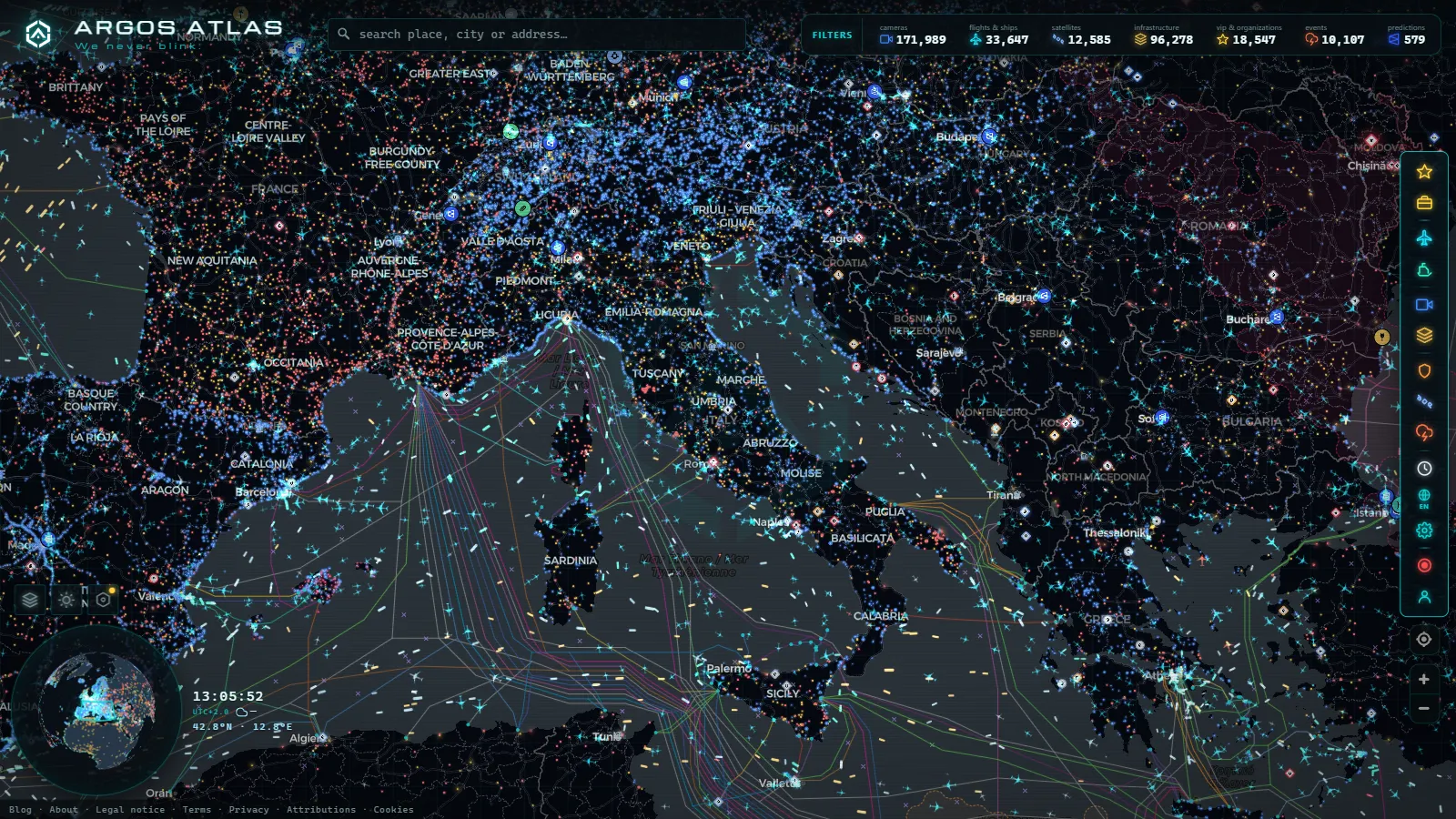
Driving into Florence is less a traffic problem than an access problem. The motorway ring around the city is reasonably well covered by cameras you can look at before you leave home, and then there is a line, running roughly along the viali di circonvallazione, past which the cameras stop showing you anything and start reading your number plate instead.
That line is the ZTL, the Zona a Traffico Limitato of the centro storico, and it is the one thing worth understanding before you point a car at Firenze. This guide keeps the two systems apart: the public cameras that let you check the A1, the A11 and the FI-PI-LI in advance, and the electronic gates in the centre, which are cameras in the strict sense and feeds in no sense at all.
The ZTL, the varchi and the fine that arrives four months later
The historic centre is closed to non-authorised traffic for most of the working day. The entry points are covered by varchi elettronici, electronic gates: a plate-reading camera on a gantry over the street, a sign, and an illuminated panel telling you whether the gate is currently active. There are dozens of them around the perimeter and on internal streets, and they are not subtle. If you can see the gantry, it has already seen you.
The zone is split into sectors, lettered A, B and O for the core plus additional ones on the fringes, and the timetable is neither the same for all of them nor the same all year. The comune runs a winter timetable and a summer one, and adds a night ZTL on summer weekend evenings, when the centre fills up. Hours printed in a guidebook two years ago are worth nothing. Check the current ones on the day you travel.
Three practical points that catch visitors:
- Each pass is its own offence. Driving in, out and in again is not one mistake, it is several, and they are notified separately.
- A hotel inside the zone can register your plate, but somebody has to actually do it, normally at check in and for a limited window. Booking a room is not an authorisation by itself.
- A rental car turns one fine into two charges. The rental company identifies you to the authority, bills you an administration fee, and the real notice lands months later.
What the ZTL cameras record, and why the feed is not public
A varco camera is not a traffic webcam that happens to point at a gate. It exists to read a plate, check it against the list of authorisations valid at that moment, and generate evidence when there is no match. That is why the image never becomes public: it is an evidence stream inside a sanction procedure, and publishing it would expose identifiable plates and drivers.
The distinction goes well beyond Florence. Cameras built to inform (motorway stills, low resolution, refreshed on a timer, often deliberately too coarse to read a plate) get published. Cameras built to enforce (plate readers, bus lane cameras, average speed systems) do not. The categories and the legal reasoning behind them are set out in traffic cameras, privacy and what the law actually says. Italy makes the split unusually visible, because ZTLs are everywhere and the enforcement layer sits directly on top of the tourist layer.
So, the honest version: for the part of Florence most people want to see, Piazza del Duomo, Ponte Vecchio, via Tornabuoni, there is no official traffic camera feed at all. There are private and tourism webcams aimed at monuments, which is a different product with different reliability and no obligation to anyone.
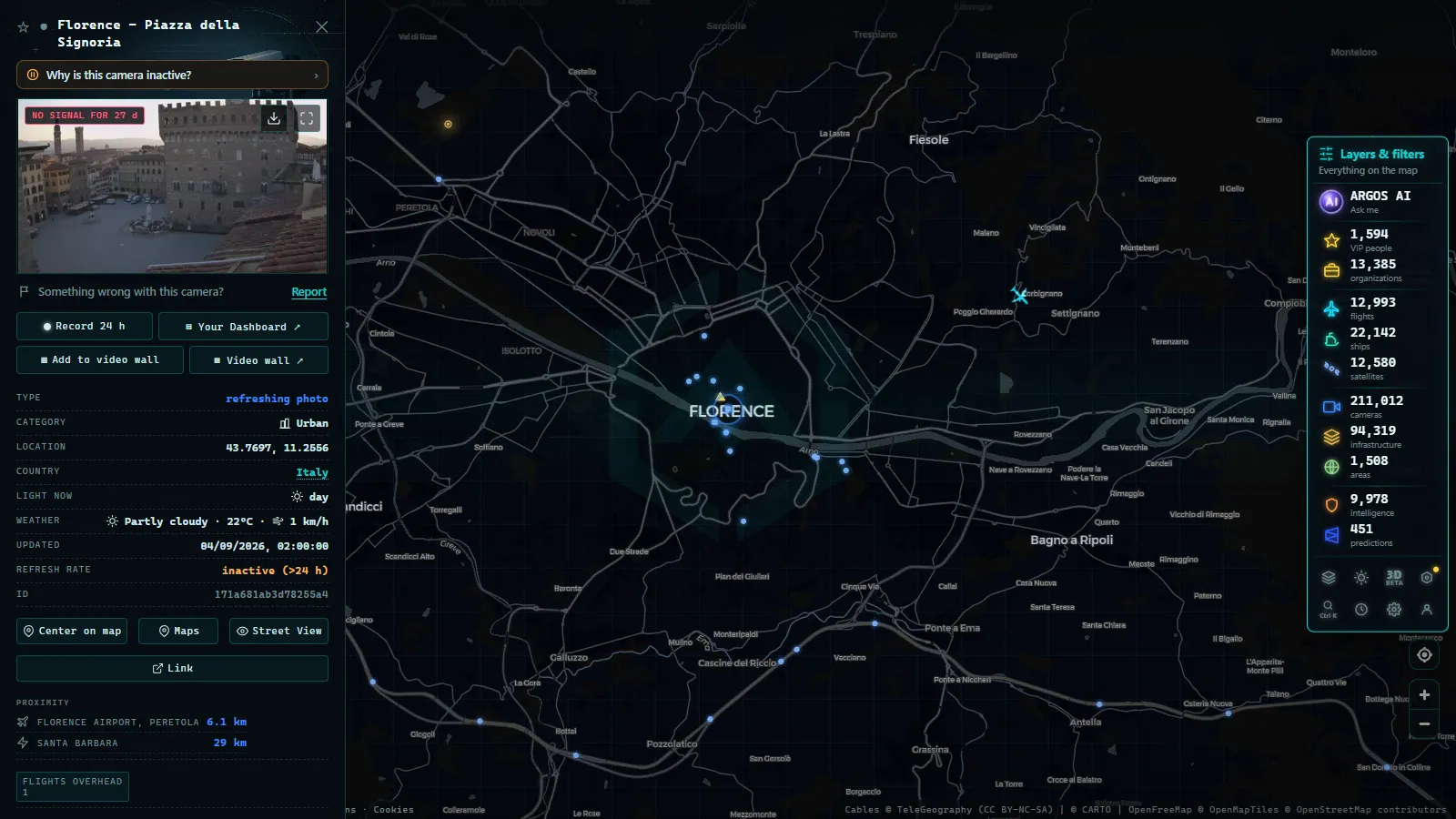
Florence traffic cameras on the motorways: A1, A11 and the FI-PI-LI
Outside the ring, coverage improves sharply, because the operators there are motorway concessionaires and publishing camera stills is part of how they manage incidents.
A1 Milano-Napoli. Florence has an unusual number of exits on it: Firenze Nord, Firenze Scandicci, Firenze Certosa, Firenze Impruneta and Firenze Sud. Autostrade per l'Italia publishes camera images along the corridor, including the section north towards Calenzano and Barberino di Mugello where the Variante di Valico and long running roadworks have made queues a routine condition rather than an event. If you are arriving from the north, that section is the useful check, not the city itself. The same corridor seen from the other end is covered in traffic cameras in Bologna and the A1 and A14 junction.
A11 Firenze-Mare. Short, busy, and the one that actually decides your morning. It runs from the junction at Firenze Nord past Peretola, Sesto Fiorentino and the Osmannoro industrial belt towards Prato, Pistoia and the coast. Two lanes for much of its length, a heavy commuter flow, and an airport hanging off it.
FI-PI-LI. The Firenze-Pisa-Livorno superstrada is toll free, lacks a hard shoulder for long stretches, and behaves accordingly: one breakdown near Lastra a Signa or Empoli can hold up the entire road. It is run by the regional road administration rather than a concessionaire, and its cameras are published on that basis. Anyone flying into Pisa instead of Peretola should look here first.
The approaches that are not motorway. The SS67 along the Arno towards Pontassieve and Empoli, the SS222 Chiantigiana towards Greve in Chianti, and the RA3 raccordo down to Siena are ANAS or local roads with far thinner coverage: a handful of key junctions, not continuous vision. In winter the SS65 della Futa and the Apennine passes to the north are the ones that need chains or close outright, and they follow the pattern described in mountain pass cameras and checking the snow before you drive.
From the ARGOS ATLAS channel.
Where Florence traffic cameras stop: the viali and the centro storico
Between the motorways and the ZTL there is a band that is badly served in both directions: the viali di circonvallazione (Lavagnini, Matteotti, Gramsci, Amendola and the rest), the Viadotto dell'Indiano, viale Guidoni and Novoli, the approaches to Careggi. This is where Florence traffic genuinely seizes up, and it is the part with the least public camera coverage, because the city's own cameras feed a municipal control room and the tram operation, not a public page.
The practical workaround is not a camera, it is the tram. Line T1 starts at the Villa Costanza park and ride, right at the Firenze Scandicci exit of the A1, and puts you in the centre without ever approaching a varco. Line T2 links the airport to the station. Nearly everything painful about driving in Florence disappears if you park before the viali, and no amount of camera coverage changes that arithmetic.
Peretola: the airport where the weather decides
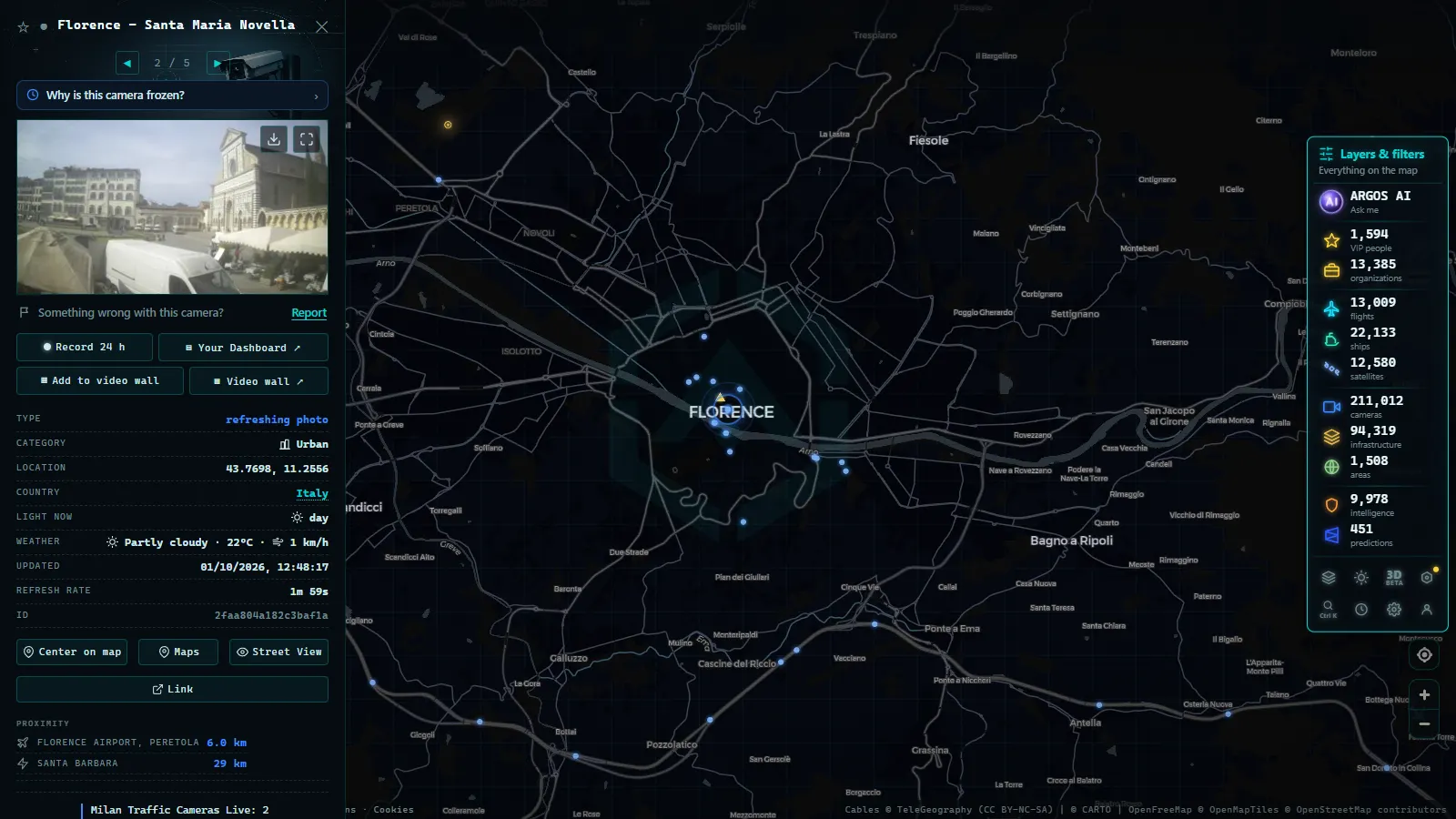
Aeroporto di Firenze Amerigo Vespucci (FLR) sits beside the A11 at Peretola, minutes from the centre and boxed in by the Osmannoro plain. It has a single short runway and a well earned reputation for diversions: crosswind and low visibility send arrivals to Pisa or Bologna often enough that any Florence plan built on a tight connection needs a fallback written into it.
There is no public traffic camera on the terminal approach. What you can watch is the air side: the aircraft themselves, on ADS-B, including the go-around that tells you a diversion is coming before the arrivals board admits it. The airport catalogue behind the map holds 47,927 airports (count as of September 2026), Peretola among them.
What you can actually watch, corridor by corridor
| Corridor | Who operates the cameras | What you get | Still or video |
|---|---|---|---|
| A1 (Firenze Nord, Scandicci, Certosa, Impruneta, Firenze Sud) | Autostrade per l'Italia | mainline and exit approaches, plus the Calenzano and Barberino stretch | stills on a refresh timer |
| A11 Firenze-Mare | Autostrade per l'Italia | Peretola, Sesto Fiorentino, Osmannoro, junction with the A1 | stills |
| FI-PI-LI superstrada | regional road administration | Scandicci, Lastra a Signa, Empoli and westwards | stills |
| SS67, SS222 Chiantigiana, RA3 Firenze-Siena | ANAS and local authorities | key junctions only | stills, sparse |
| Viali di circonvallazione and city streets | Comune di Firenze | municipal control room use | not published |
| ZTL varchi, sectors A, B, O and the fringe sectors | Comune di Firenze, Polizia Municipale | enforcement evidence | never public |
| Peretola (FLR) landside | airport operator | no public traffic feed | not published |
How to watch Florence traffic cameras on a single map
ARGOS ATLAS puts all of the public ones on one dark map instead of one browser tab per operator. Open the live map, zoom onto Tuscany, and the camera layer draws whatever we have ingested for the area: Autostrade per l'Italia points along the A1 and the A11, the regional cameras on the FI-PI-LI, the thin ANAS coverage on the state roads. Click a marker and you get the operator's own image plus the name of the source, so you always know who is behind the picture. The full catalogue is 200,000+ cameras worldwide (count as of September 2026); Florence is a modest, motorway heavy slice of it.
Two habits are worth building. First, work inward from the destination: check the exit you intend to use, then the corridor feeding it, rather than starting with the whole region. Second, treat a frozen image as information in itself. If a camera has not refreshed, that is the operator's outage and not your browser, and it happens more often than anybody advertises; the usual causes are in why a traffic camera is not working. Florence also sits inside a national picture worth knowing, mapped in traffic cameras in Italy: Autostrade, ANAS and the Alpine passes.
What we cannot show you
- No ZTL gate view, ever. Not a technical limitation, a legal one. Any site claiming otherwise is showing you something else.
- Almost nothing inside the viali. The municipal network exists, but it is not published as a public feed, so the most congested part of the city is the part you cannot preview.
- Stills, not video. Italian motorway cameras are single frames refreshed on a cycle. Good enough to see a queue, useless for watching something unfold.
- Coverage moves. Cameras get taken out during roadworks and come back somewhere else. The A1 north of Florence has been a construction site for years, and the camera list there is less stable than the road.
- Nothing about your own fine. A camera image will not tell you whether a gate was active when you passed it, or whether your plate was on a list. Only the comune knows that, and it tells you by post.
Frequently asked questions
Can I watch the ZTL cameras in Florence live?
No, and you never will. The varchi elettronici on the edge of the centro storico are plate readers feeding an enforcement procedure, not information cameras. Their images are evidence in an administrative sanction file, so they are not published anywhere. Anything advertised as a live ZTL camera feed is either a tourism webcam pointed at a nearby monument or something that is not what it claims.
Is the map free, live and usable without registering?
Yes. ARGOS ATLAS is free, needs no account and no app, and it shows each operator's own image at whatever refresh rate that operator publishes. What you see is the source feed, credited to the source, not a copy stored by us. If a camera is down, you see it is down.
What happens if I drive into the Florence ZTL by mistake?
The gate reads your plate, finds no authorisation, and a notice follows. Each pass through a gate is treated separately, so entering, leaving and re-entering can produce more than one. With a rental car the company identifies you to the authority and adds its own administration fee, and the notice typically reaches you months after the trip. A hotel inside the zone can register your plate, but it has to actually do it, normally at check in and for a limited window.
Which cameras are worth checking before driving to Florence?
In order: the A1 exit you intend to use (Firenze Nord, Scandicci, Certosa, Impruneta or Firenze Sud), then the corridor feeding it. Coming from Bologna, check the Barberino di Mugello and Calenzano stretch, which queues routinely. Coming from the coast or Pisa, check the FI-PI-LI around Lastra a Signa and Empoli. The A11 matters if you are heading for Peretola or Prato.
Are Florence traffic cameras video or still images?
Almost all of them are stills, single frames refreshed on a timer, not streaming video. That is the norm on Italian motorways and it is enough to tell you whether a carriageway is moving. It is not enough to read a plate, which is deliberate on the part of the operators.
- Ireland Traffic Cameras Live: Motorways, Tunnels, Cities
- Trieste Traffic Cameras Live: 4 Zones From Port to Border
- Venice traffic cameras live: causeway, Mestre and Marghera
- Georgia 511 Traffic Cameras: Watch I-285 and I-16 Live
- Sicily traffic cameras: the A19, the A18 and the Messina run
- Verona traffic cameras: the A4, A22 and the Garda exits live