Blog · Traffic cameras
Cagliari Traffic Cameras: SS131, Elmas Airport and the Port
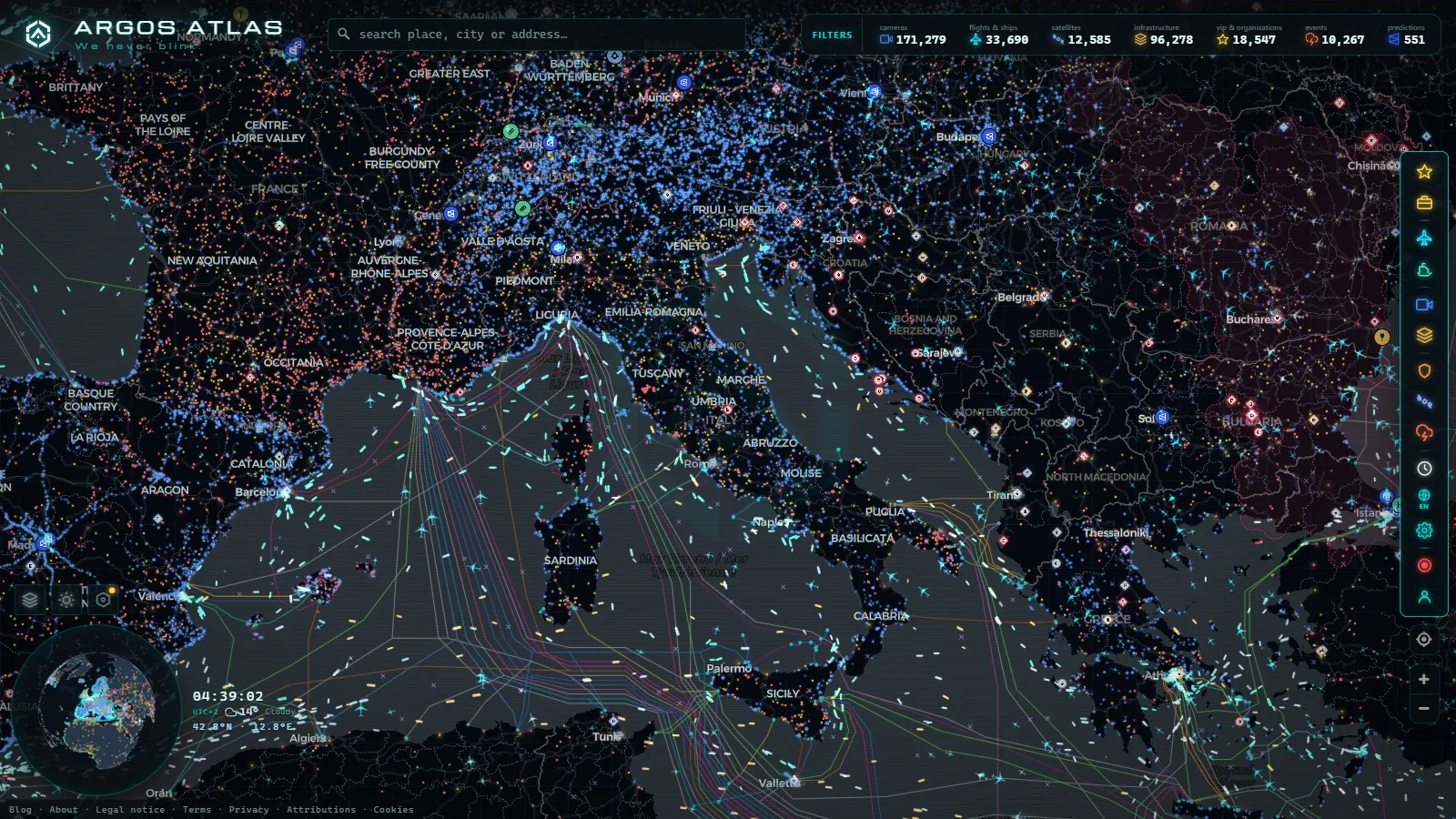
Sardinia is the only large Italian region with no motorway at all. No toll gates, no concessionaire control room, no dense metropolitan camera grid like Rome or Milan. What the island has instead is a single spine: the SS131 Carlo Felice, which starts on the edge of Cagliari next to Elmas airport and runs north through Oristano and Macomer to Sassari and Porto Torres. A branch, the SS131 DCN, leaves it at Abbasanta and heads east to Nuoro and on toward Olbia. Watch that corridor and you are watching most of the traffic that moves on the island.
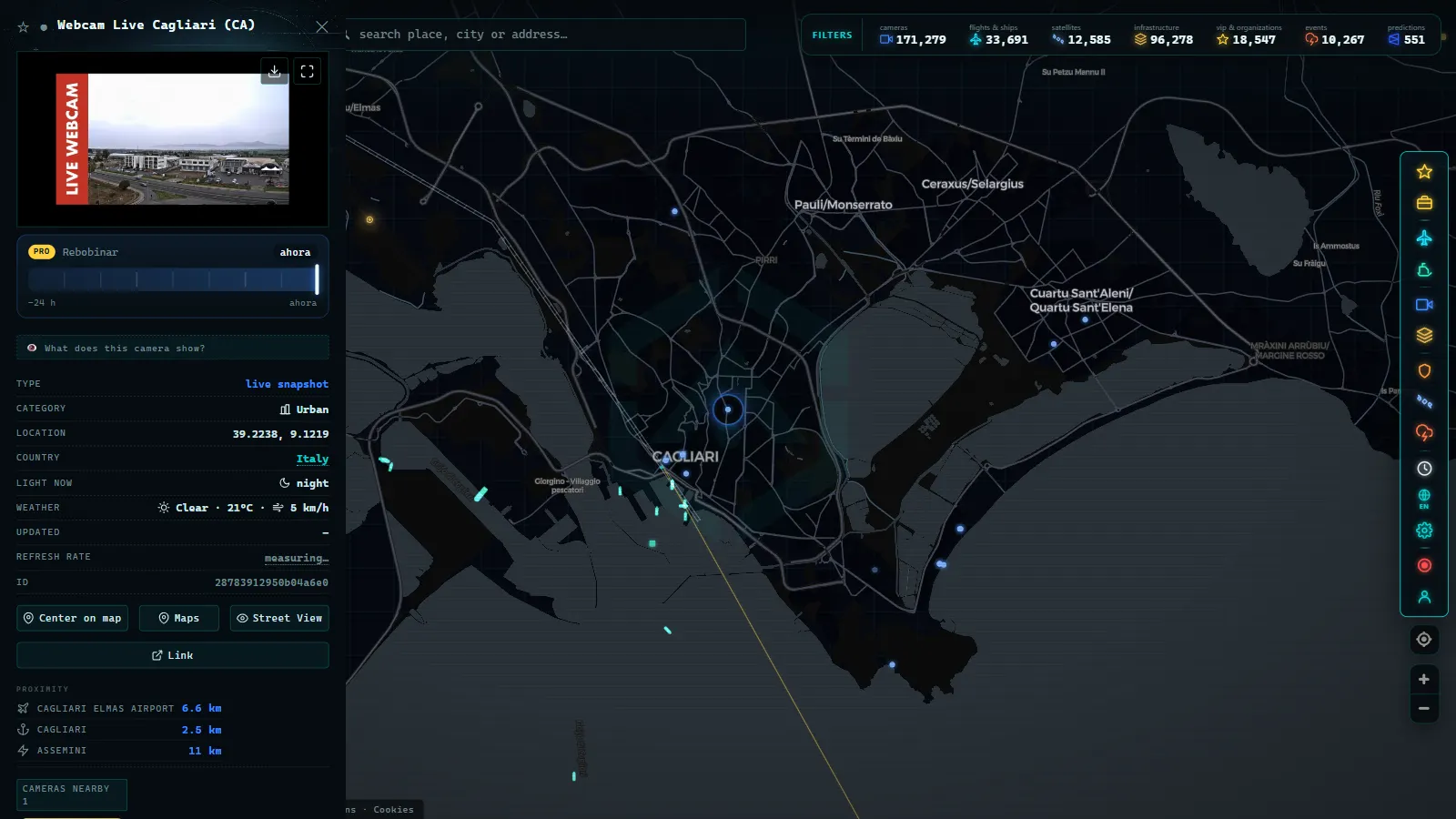
In Cagliari itself the watchable part is compact: the SS554 ring around the eastern suburbs, the SS130 toward Iglesias, the SS195 down the coast to Sarroch and Pula, the port at the foot of Via Roma and the approach to Elmas. Road cameras, harbour webcams, ADS-B aircraft and AIS ships all sit on the same dark background on the live ARGOS ATLAS map, which pools 200,000+ public cameras worldwide (count as of September 2026) with no account and no payment. This article is about which of them are worth opening for Cagliari, and which parts of Sardinia have nothing pointed at them at all.
What Cagliari traffic cameras actually cover
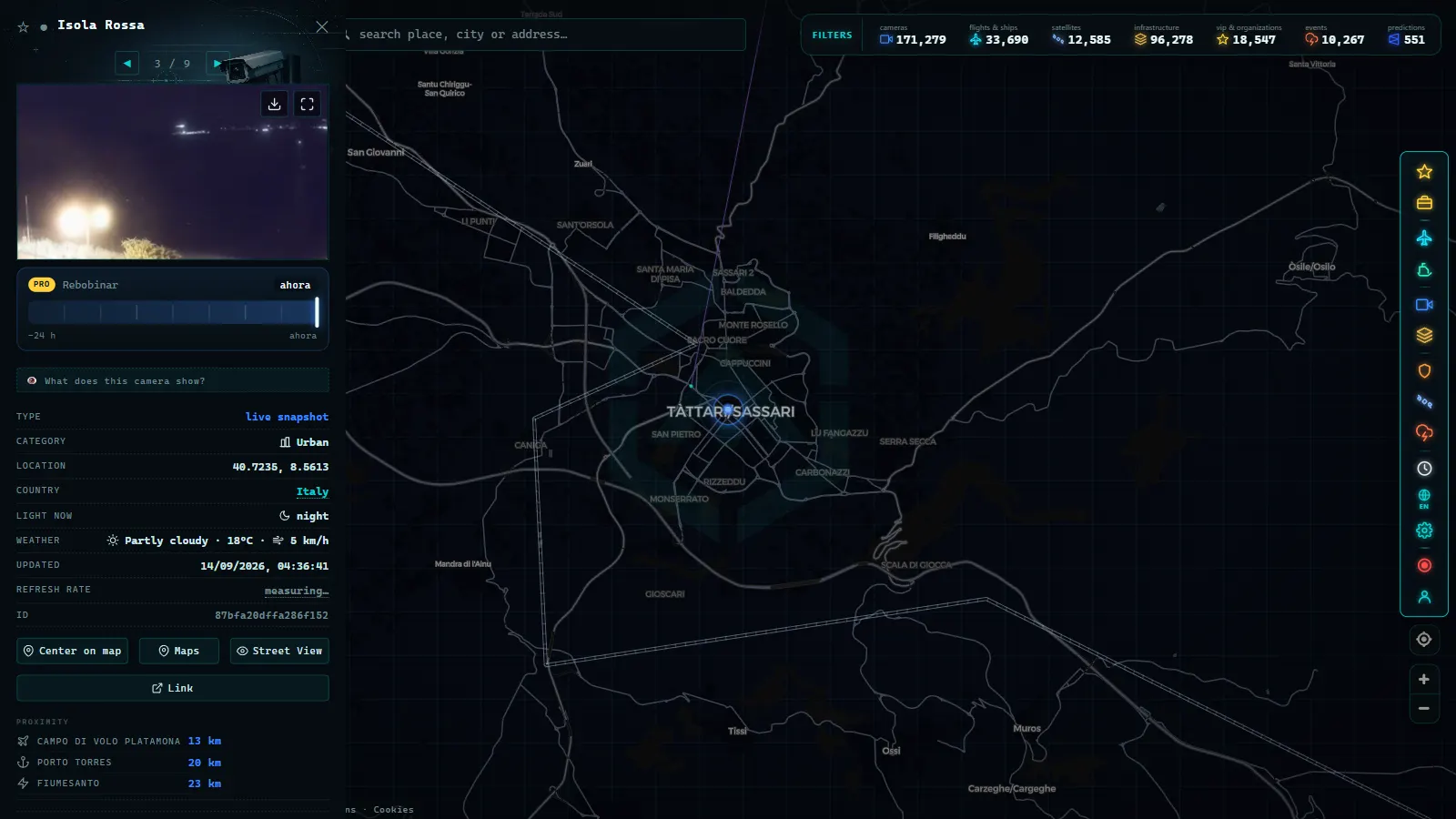
Road cameras in Sardinia belong to ANAS, the state road operator, because there is no motorway concessionaire here running a parallel network. ANAS puts cameras at junctions, interchanges, tunnels and bottlenecks it already knows about, not at regular intervals along a route. In practice that means usable eyes on the first stretch out of Cagliari and on the approaches to Oristano and Sassari, and long gaps in between where nobody is looking.
They are stills, not video. A frame refreshes every few minutes, so read it as the state of the road a moment ago. If an image looks identical for half an hour, the camera has probably stopped updating rather than the road having emptied. At night many of these frames are close to useless: headlights and a black background, enough to count vehicles, not enough to judge conditions.
The cameras you notice in the city centre are a different species entirely. The access gates into Castello and the Marina district, the bus lane readers downtown: those are enforcement devices tied to fines and plate recognition, and they are not published, here or anywhere else in Italy. What fills the gap is the tourist and weather layer: webcams on the Poetto seafront, over Marina Piccola and the Sella del Diavolo, on hotel roofs along Via Roma. They refresh faster than the road cameras and they tell you the weather instantly, which is why the city looks better covered than its roads really are.
The SS131 is a corridor, not a ring road
This is the difference between Sardinia and every other Italian region with a big island capital. In Sicily the live picture is a network: the A19 to Catania, the A18 along the east coast, motorway operators with their own feeds. In Cagliari there is one road that matters and a couple of local arteries feeding it.
The SS131 begins at the Cagliari end as a busy commuter road. Monday mornings and Friday evenings it fills between the city, Assemini, Decimomannu and the Campidano towns, and that first section is the best watched part of the whole route. Past Sanluri and Sardara the traffic thins out and so do the cameras. After Oristano the road climbs toward the Campeda plateau between Macomer and Bonorva, which is the highest and most exposed part of the crossing: fog in autumn, crosswind and heavy rain in winter, occasionally sleet. It is also the stretch with the least coverage, so the honest advice is to use a forecast rather than hunt for a camera that does not exist.
From there the road drops toward Sassari and the industrial area at Porto Torres. The eastern branch, the SS131 DCN, runs from Abbasanta to Nuoro and connects onward to the Sassari to Olbia link, the modern dual carriageway that finally gave the north a fast road. In summer that road works in pulses, not in a steady flow, because the cars come off ferries in batches.
Route by route: what is watchable in Sardinia
| Route | What it carries | Best live layer | Where coverage stops |
|---|---|---|---|
| SS131 Carlo Felice (Cagliari to Porto Torres) | The island's main artery, commuters plus freight | ANAS road cameras near Cagliari, Oristano and Sassari | Long gaps between Oristano and Macomer, including Campeda |
| SS131 DCN plus the Sassari to Olbia link | Nuoro, Gallura, ferry traffic from Olbia | Ferry arrivals on AIS as a leading indicator | Almost no cameras inland between Abbasanta and Nuoro |
| SS554 Asse Mediano (Cagliari eastern ring) | Quartu, Selargius, Monserrato, the hospital corridor | Road cameras at the main junctions | Surface streets inside the suburbs |
| SS130 (Cagliari to Iglesias) | Elmas, Decimomannu, the Sulcis commute | Road cameras near the airport junction | Everything past Villamassargia |
| SS195 Sulcitana (Cagliari to Sarroch and Pula) | Refinery traffic, summer beach traffic to Chia | Tankers off Sarroch on AIS, coastal webcams | The inland stretch toward Teulada |
| SS125 Orientale Sarda (east coast) | Tourism to Ogliastra and the Costa Rei | Coastal webcams in the resort towns | The mountain sections, effectively unwatched |
| Elmas airport approach | Arrivals and departures, airport road | ADS-B aircraft, airport area webcams | Aprons, terminals, gate areas |
| Port of Cagliari and Porto Canale | Ferries, cruise calls, container terminal | AIS ship positions, harbour front webcams | Inside the port gates and check-in queues |
From the ARGOS ATLAS channel.
Elmas airport: watch the aircraft, not the terminal
Cagliari Elmas sits between the SS130, the SS391 and the Santa Gilla lagoon, a few minutes from the centre and with its own railway station on the Cagliari to Decimomannu line. That proximity is the useful part for traffic: if the airport road is moving, the city approach is moving.
What you will not get is a camera inside the terminal or on the apron. Airport operators publish very little, and what exists tends to be a single wide shot. The reliable layer here is the aircraft themselves. Arrivals from Rome Fiumicino and Milan Linate run all year under the continuity of service rules that keep the island connected, and from late spring the charters and low cost routes from northern Europe pile on top. You can follow all of it with the same technique described in the guide to tracking aircraft in real time.
One caveat worth stating: ADS-B coverage over the Tyrrhenian depends on ground receivers, so an aircraft crossing from the mainland can drop off the map mid sea and reappear near the coast. That is a gap in reception, not a vanished flight. And on the ground at a quiet apron, aircraft often stop transmitting altogether.
If you are near the runway end, the Molentargius wetland next door is the spot where flamingos and landing aircraft share the same frame. Several local webcams point at it.
The port of Cagliari and the ferries you can follow
Cagliari really has two ports. The historic one sits at the foot of Via Roma, taking ferries and cruise calls right against the city façade, which is why harbour webcams here double as city cameras. The other, Porto Canale, is the container terminal west of the city toward Giorgino and Macchiareddu, a working industrial basin whose activity has gone through long pauses over the years.
Ferry routes out of Cagliari reach Civitavecchia, Naples and the Sicilian ports, with more sailings in summer than in winter. The way to read them is by ship position rather than by camera: how AIS tracking works explains the signal, and the map carries 1,081 mapped ports so you can jump straight from Cagliari to Olbia, Porto Torres or Santa Teresa Gallura and compare. Two honest limits. AIS gives you position, course and speed, never whether boarding is running on time. And on the Strait of Bonifacio crossing to Corsica, a strong maestrale cancels sailings while the ships still sit visibly at the quay, so a ship on the map is not a ship that is leaving.
Cagliari traffic cameras compared with the rest of Italy
On the mainland, the live picture is built on motorway operator feeds plus regional networks, which is why the country guide to Italian traffic cameras leans so heavily on the Alpine passes and the northern corridors. Sardinia has none of that machinery. Its coverage is thinner, more coastal and more dependent on webcams that exist for tourism rather than for traffic management.
The upside is that a thin network on a single corridor is easy to learn. Four or five cameras, checked in order, tell you almost everything about getting out of Cagliari.
What you cannot see, and why
This is the part most guides skip. In Sardinia you will not find enforcement and ZTL cameras, interior views of terminals or port gates, continuous video on the state roads, or anything at all on most of the mountain interior. Winter frames go dark early. Several coastal webcams are seasonal and simply stop updating in November. And ANAS cameras go offline for maintenance like any other, which is usually what is happening when a traffic camera does not load rather than a fault on your side.
Five practical tricks for Cagliari traffic cameras
- Start zoomed on the Gulf of Cagliari and work outward. The SS554 and the SS130 junctions near Elmas are the two that decide whether leaving the city is quick.
- Check the frame timestamp before anything else. An old frame on a quiet road is normal, an old frame at rush hour means the camera is stale.
- For anything north, look at ferries first. An inbound ship at Olbia or Porto Torres predicts the road better than the road cameras do.
- Use harbour and beach webcams as a weather instrument for the city, but not for Campeda. Coastal conditions in Cagliari say nothing about fog on the plateau.
- Keep the map link for the view you use. The position and zoom travel in the URL, so your Cagliari setup reopens exactly as you left it.
Sardinia rewards patience more than volume. One corridor, a handful of cameras placed where the traffic actually stacks, and two ports whose ship movements explain the rest of the island's rhythm.
Frequently asked questions
Is it free to watch Cagliari traffic cameras, and do I need an account?
Yes, it is free, and there is no registration. The map opens straight onto the public feeds, so you click a camera on the SS131 or the SS554 and the latest frame loads. Nothing is behind a login and nothing is hidden behind a trial.
Are the images live video or still frames?
Almost all Sardinian road cameras publish still images that refresh every few minutes, not continuous video. Coastal and harbour webcams usually update faster. Treat a road frame as the state of that point a few minutes ago, and check the timestamp before you trust it.
Why are there so few cameras between Oristano and Sassari?
Because ANAS places cameras at junctions, tunnels and known bottlenecks rather than along the whole route, and the middle of the SS131 has few of those. The Campeda plateau, the stretch most likely to have fog and crosswind, is also the worst covered. For that section, a weather report beats a camera.
Can I see the ZTL cameras in Castello or the ones reading number plates?
No. Access control and enforcement cameras are tied to fines and plate recognition, and they are not published anywhere in Italy. What you can watch in the old town are tourist and hotel webcams pointed at the harbour front and the rooftops, which show weather and crowds but not the ZTL gates.
What is the best way to know if the Olbia or Porto Torres road will be busy?
Watch the ferries instead of the road. Traffic on the SS729 and the SS131 DCN arrives in waves timed to ship docking at Isola Bianca, so an AIS position for an inbound ferry tells you about the next hour of road traffic better than any single camera does.
- Treviso traffic cameras: the A27, the A4 and the passes north
- Padua Traffic Cameras: the Tangenziale, the A4 and the A13
- Louisiana Traffic Cameras: 545 on a Live Map, I-10 and Bridges
- Bavaria Traffic Cameras: A8, A9 and 6 Alpine Border Routes
- Lugano traffic cameras: the A2, Chiasso and the lake live
- Christchurch Traffic Cameras: Live Now, Free, No Sign-up