Blog · Traffic cameras
Austria Traffic Cameras: Alpine Passes, Tunnels and Vienna
Open an ASFINAG camera on the A13 Brenner motorway and what you get is a still photograph of the carriageway, stamped with the minute it was taken and replaced a few minutes later. Not video, not zoomable, not sharp enough to read a number plate. It is enough to see whether the asphalt is wet, white or covered in stopped trucks, and on a January morning that is usually the only thing you actually need to know.
Most searches for Austria traffic cameras come down to four places: the Brenner, the Tauern tunnel on the A10, the Arlberg, and the Vienna approaches when half the city leaves at once. This page covers those, plus the part almost nobody writes down: what the picture does when the operator decides you should not be looking at it.
What Austria traffic cameras actually show right now
ASFINAG runs the tolled motorway and expressway network (the A and S roads) and publishes camera images for most of it through its traffic information service. The house style is consistent across the country and worth understanding before you trust a frame:
- They are stills, not streams. A frame is captured, published and left in place until the next one arrives. The interval is measured in minutes.
- They are deliberately low resolution. Plates and faces are not resolvable. That is the design intent and the reason these feeds can be public at all.
- They carry a timestamp. This is the most useful element on the whole image and the first thing to read.
- Night coverage is uneven. Lit portals and urban sections stay readable after dark. An open alpine stretch with no lighting gives you a black rectangle.
Below the motorway level, each province publishes its own cameras on regional roads and passes. Land Tirol, Land Salzburg, Land Kärnten and Land Steiermark all maintain their own sets, and those are the ones covering the passes ASFINAG has no reason to watch. Then there are the private road companies: Grossglockner Hochalpenstrassen AG, Felbertauernstrasse AG and the operators of the Silvretta Hochalpenstrasse run cameras on the roads they charge for.
ASFINAG, the provinces and the private toll roads
Knowing who owns a camera tells you how it will behave. ASFINAG cameras are the most consistent: same framing conventions, same refresh discipline, dense coverage on the A and S network, and they stay up all year because the motorways stay open all year.
Provincial cameras are patchier and more interesting. They sit on the B roads and the passes, which is exactly where winter decisions get made, but the refresh can be slower and individual units go offline for a season without anyone noticing.
Private toll road cameras follow the road's business. A seasonal alpine road that shuts for the winter often leaves its cameras publishing, which produces the single most misread image in the country: a beautifully lit, completely empty snowy road that looks passable and is legally shut.
Finally, a large number of Austrian webcams are panoramic tourism and weather cameras pointed at mountains, valleys and ski areas. They tell you about cloud, visibility and how much snow fell overnight. They do not tell you about the road surface. Do not substitute one for the other.
Austria traffic cameras on the alpine passes: Brenner, Tauern, Arlberg
The three names people search for are three different problems.
The Brenner (A13 on the Austrian side, continuing as the A22 in Italy) is rarely a snow problem and almost always a capacity problem. It is the busiest freight crossing of the Alps, and the cameras near the Europabrücke and the approach ramps mostly show you how far back the truck queue reaches. If you are coming down from Munich, the picture on the German side matters as much as the Austrian one, and Germany's Autobahn camera network covers that approach.
The Tauern corridor on the A10 is the north to south holiday artery, with the Tauern and Katschberg tunnels as its two chokepoints. The useful cameras are the portal views: a queue at the mouth on a Saturday in July or February is the whole story.
The Arlberg is really two roads. The S16 Arlberg road tunnel is tolled, open year round and the reliable option. The B197 pass road over the top is free, scenic and the first thing to close when it snows hard. The same tunnel versus pass logic governs the Swiss crossings, and traffic cameras in Switzerland work in almost the same way.
| Route | Who runs it | What the camera gives you | Winter behaviour |
|---|---|---|---|
| A13 Brenner motorway | ASFINAG | Stills at the Europabrücke and the approach ramps | Open all year, images dominated by truck queues |
| A10 Tauern (Tauern and Katschberg tunnels) | ASFINAG | Portal views at each tunnel mouth | Open all year, portal queues on holiday weekends |
| S16 Arlberg road tunnel | ASFINAG | Portal views on both sides | The dependable crossing when the pass shuts |
| B197 Arlberg pass road | Provincial authorities (Tirol, Vorarlberg) | Road surface on the open pass | Closes at short notice in heavy snow |
| Felbertauernstrasse (B108) | Felbertauernstrasse AG | Tunnel portals and the approach valleys | Open all year, closures for avalanche risk |
| Grossglockner Hochalpenstrasse | Grossglockner Hochalpenstrassen AG | Road level and panoramic views near Hochtor | Seasonal road, shut through the winter |
| A23 Südosttangente, Vienna | ASFINAG | Dense stills along the urban carriageway | A congestion problem, not a snow one |
From the ARGOS ATLAS channel.
Reading winter off a still image
A good pass camera answers a narrow set of questions honestly. Is the surface black, wet, slushy or white. Are there wheel ruts, which means traffic is moving and a plough has been through. Is there spray behind vehicles, which means water rather than ice. Is anything stopped.
Here is what the same image will never tell you, and this is where people get caught out. It will not show black ice, which looks exactly like clean wet asphalt. It will not tell you whether winter equipment is legally required, because that is set by regulation and signage, not by weather. It will not tell you the snow depth, since a low angle flattens everything. And it will not tell you about the ten kilometres between this camera and the next one, which on an alpine road is often the section that decides your trip.
One more habit worth building: check two cameras at different altitudes on the same road. A clear valley portal and a white summit is the normal winter pattern, not a contradiction. The general technique for this, including how to pair a road camera with a weather camera, is covered in the guide to cameras on mountain passes.
When the operator cuts the image
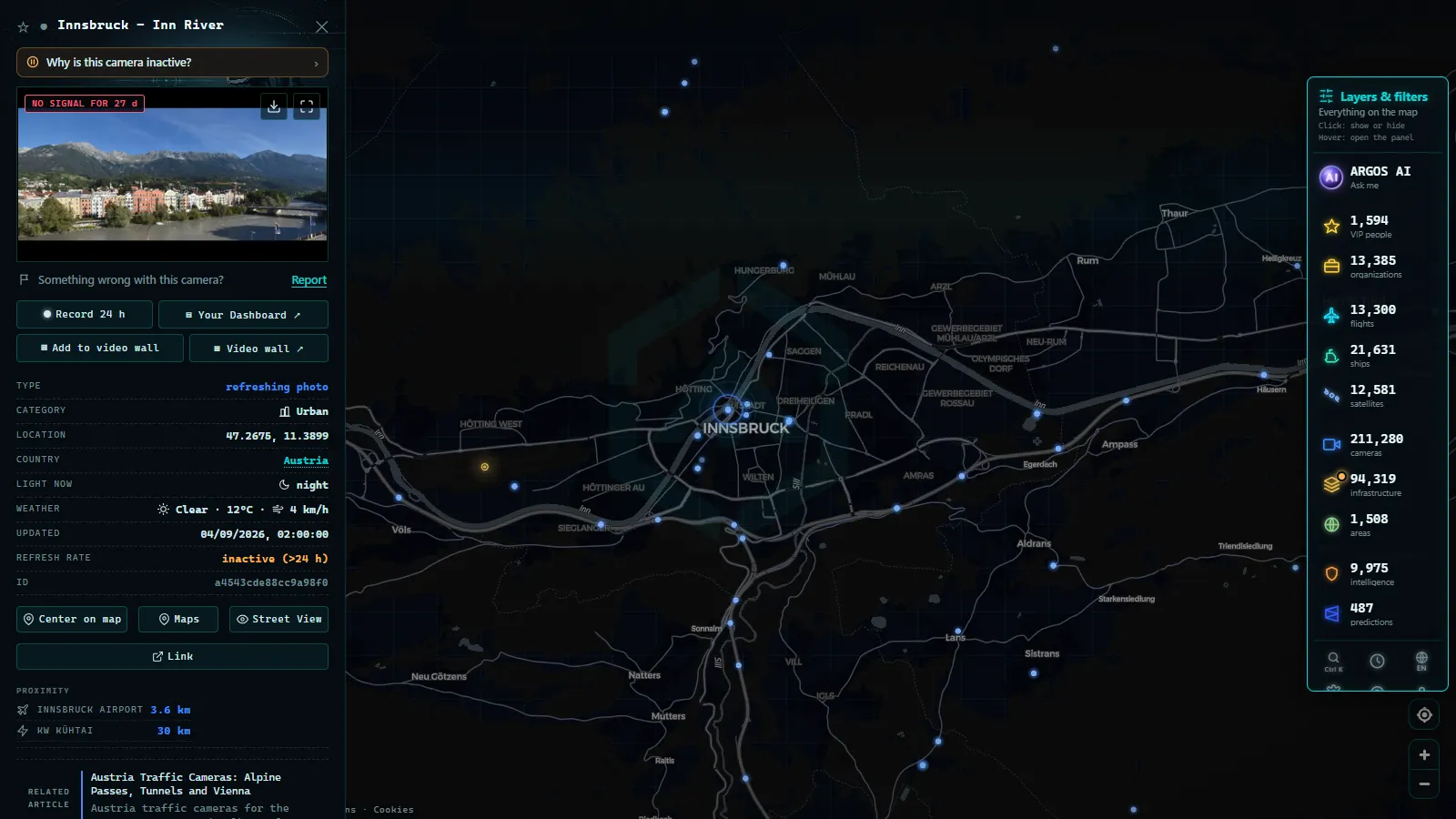
This is the part that surprises people. Austrian road cameras are not guaranteed to keep showing you the road. Feeds get pulled or held back for serious incidents, for roadworks, for maintenance and for plain network faults, and the public rarely gets told which one it is.
What you observe from outside is one of four things: the timestamp stops advancing while the picture stays put, a generic placeholder replaces the frame, the camera quietly disappears from the list, or the whole cluster on one stretch goes at once.
The diagnosis is simple and it is worth learning. If a single camera freezes while its neighbours keep updating, the problem is that camera. If every camera along a stretch stops at the same minute, the problem is the stretch, and something is happening on it. That is a genuine signal, not an absence of one. The wider taxonomy of outages, from scheduled maintenance to dead links, is in the piece on why a traffic camera stops working.
Be honest with yourself about the limit here: a withheld image is not a closure notice. Confirm with the operator's own traffic bulletin before you change route.
Austria traffic cameras around Vienna: the A23, the A22 and the Praterbrücke
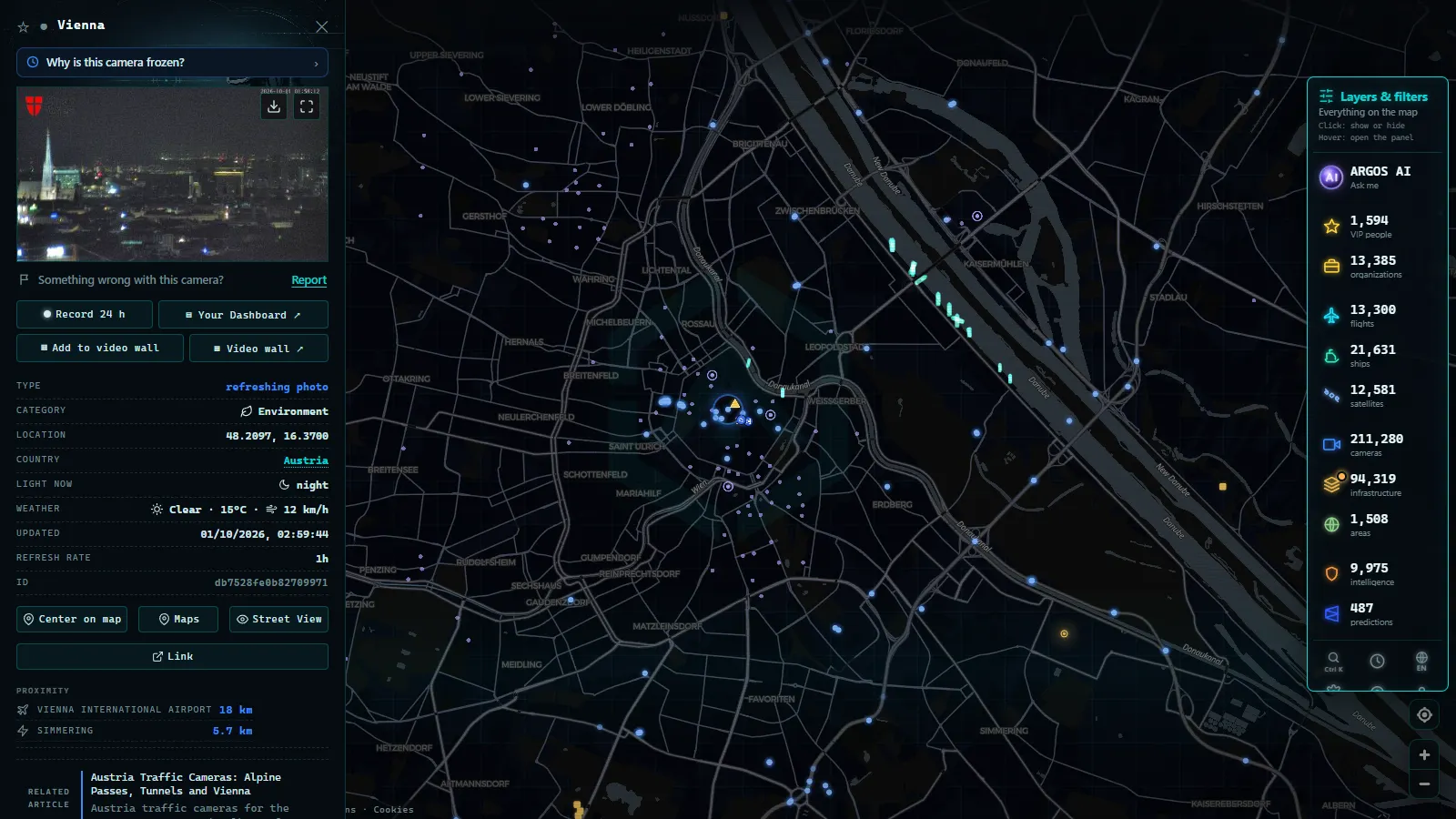
Vienna's camera coverage is dense and it is all about congestion. The A23 Südosttangente, routinely described as the busiest road in the country, is watched along most of its length, and the frames at the Praterbrücke crossing of the Danube are the ones that tell you whether the eastern side of the city is moving.
North of the river, the A22 Donauuferautobahn and the Kaisermühlentunnel are the counterpart. Add the A4 towards the airport and Hungary, the A1 Westautobahn towards St. Pölten and Linz, and the A2 heading south towards Graz, and you have the five directions that matter on a Friday afternoon.
The honest limitation for urban cameras: a still frame shows you a queue, not a delay. You can see that three lanes are packed, but you cannot tell whether that means eight minutes or forty. Pair the camera with the traffic bulletin, and use the picture for the thing it is good at, which is confirming that a reported jam is real and seeing where its tail actually is.
A quick routine before an alpine drive
Start with the operator bulletin for closures and winter equipment requirements. Then open two cameras on your route at different altitudes and check both timestamps. Then look at a panoramic camera for visibility. Three checks, two minutes, and you will know more than any single image can tell you.
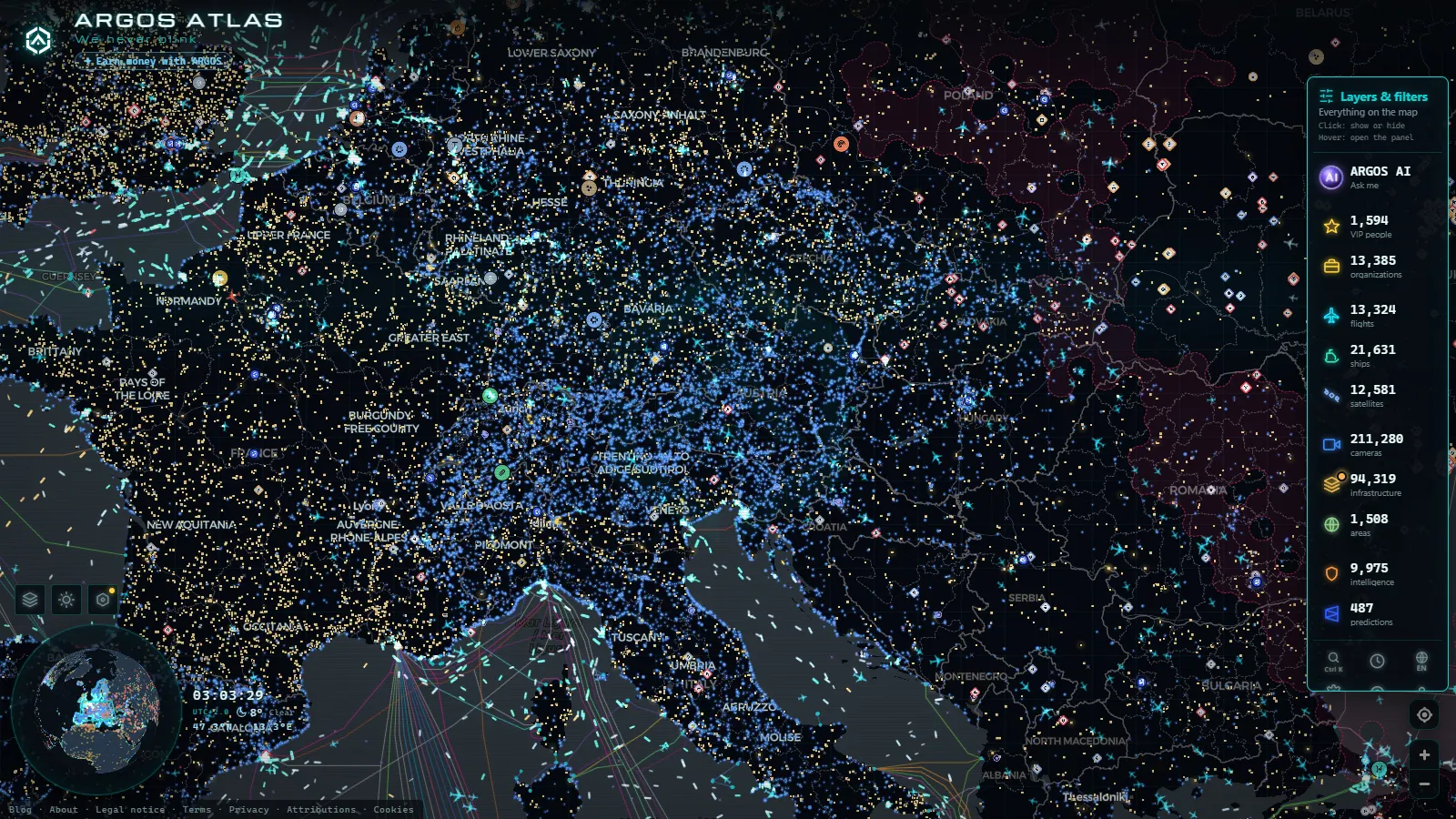
Doing that across borders is where a single map beats a stack of national portals, because an alpine trip usually touches Austria, Germany, Italy or Switzerland in one afternoon. On the ARGOS ATLAS live map the Austrian feeds sit alongside the rest of the continent (200,000+ public cameras worldwide, count as of September 2026), with no account and no payment, so you can jump from a Brenner portal to a Bavarian approach without changing sites. If you want the operator by operator picture for the rest of the continent first, start with the guide to traffic cameras in Europe country by country.
Frequently asked questions
Are Austria's traffic cameras free to watch, live and without registration?
Yes. ASFINAG and the provincial road authorities publish their camera images as public information, with no account, no payment and no app required. The word live needs an asterisk: what you get is a still photograph refreshed every few minutes, not a video stream. Check the timestamp printed on the frame before you treat it as current.
Do Austrian cameras show the inside of the Brenner, Tauern or Arlberg tunnels?
No. The published feeds cover the portals and the approach ramps, not the tunnel bore. Operators do watch the interior continuously from their control rooms, because that is how ventilation, incident detection and closures are managed, but those images stay internal. For the public, a tunnel camera means a picture of the mouth.
Can I tell from a camera whether an alpine pass is closed?
Not reliably. A camera showing deep snow and no traffic can be a closed road or simply a quiet minute, and a clear picture at the portal says nothing about conditions at the summit where there may be no camera at all. Closures are announced by ASFINAG, the provincial authority or the road company. Use the camera to confirm the announcement, not to replace it.
Why is an Austrian mountain camera black at night?
Because there is no street lighting on most open alpine stretches and the cameras have no infrared illumination. Between dusk and dawn a rural pass camera gives you a dark rectangle with occasional headlight streaks. Lit tunnel portals, urban sections and the Vienna motorways stay usable all night, which is why night checks work better on the valley approaches than on the summit.
How often do Austrian traffic camera images refresh?
In minutes rather than seconds, and the exact interval varies by operator and by camera. ASFINAG motorway cameras update on a steady cycle; provincial and private toll road cameras are often slower. The practical test is to reload twice a few minutes apart and watch the timestamp. If it does not advance while neighbouring cameras do, that camera is stuck.
- Iowa 511 Traffic Cameras Live: I-80, I-35 and I-380 in One Map
- Iceland road cameras live: Ring Road, passes and black ice
- Bergamo Traffic Cameras: A4, Tangenziale Sud and Orio al Serio
- Taiwan Traffic Cameras: Who Operates Them and How to Read One
- Florence traffic cameras: ZTL gates, A1, A11 and Peretola
- Ireland Traffic Cameras Live: Motorways, Tunnels, Cities