Blog · Critical infrastructure
The Biggest Airports in the World: 2025 Passenger Ranking
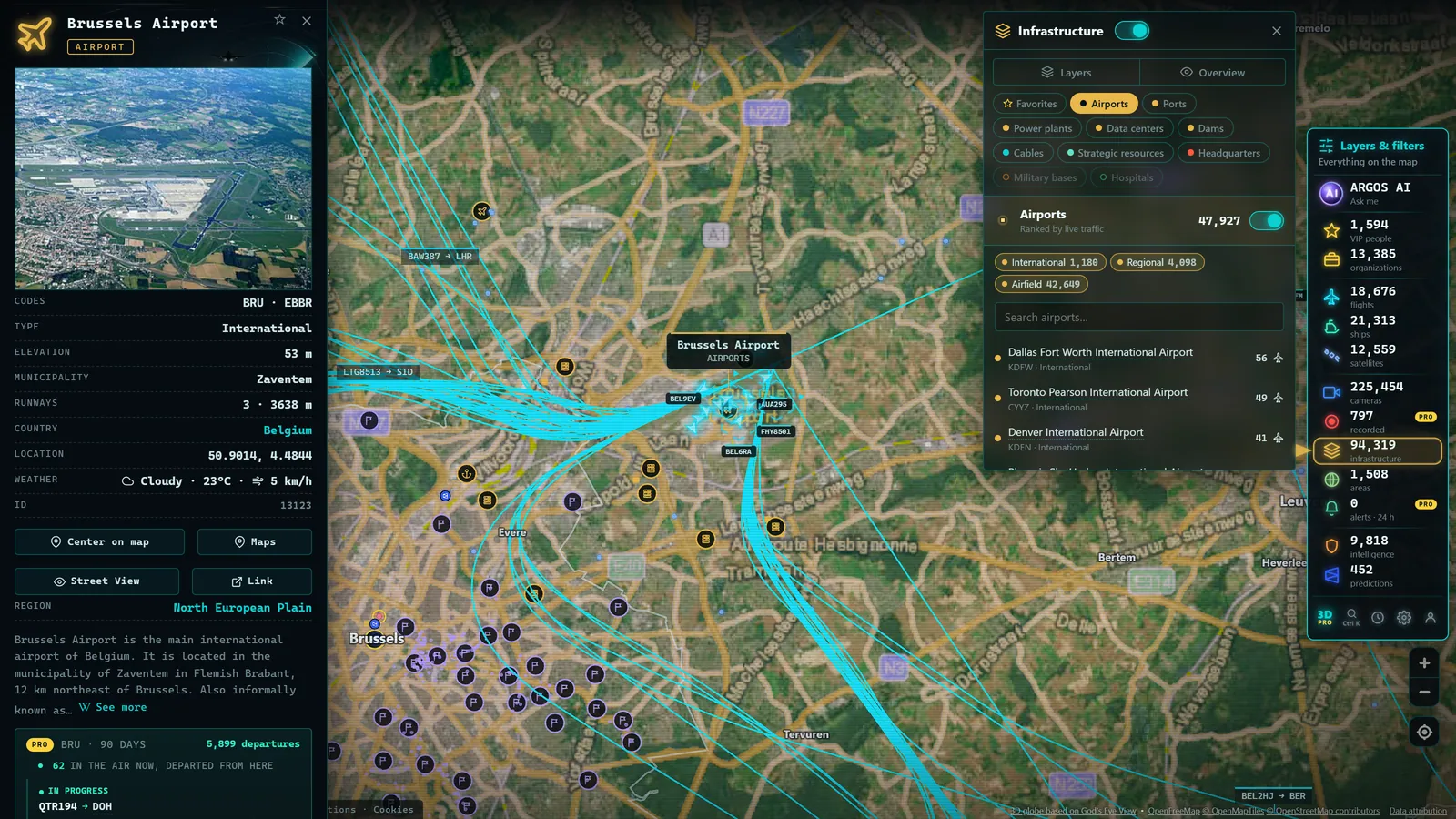
Which is the biggest airport in the world? The short answer has been the same for decades (Atlanta) and the long answer is far more interesting, because "biggest" flips completely depending on what you decide to measure. This year there is genuine news in the table too: a Chinese airport has made the largest jump in the top 10, and the continental balance has shifted.
Below is the ACI World ranking with 2025 data, the industry's reference count, together with the nuances that rarely make the headlines: why Atlanta always wins, what explains the rise of Asia and the Gulf, and why the airport with the most passengers is not the one that moves the most aircraft. At the end, how to look in on any of these hubs live from your browser.
The biggest airports in the world: the top 5 with figures
These are the five busiest by passenger numbers in 2025, per the ACI World ranking:
| Rank | Airport | Code | City | Passengers in 2025 |
|---|---|---|---|---|
| 1 | Hartsfield-Jackson | ATL | Atlanta, United States | 106.3 million |
| 2 | Dubai International | DXB | Dubai, United Arab Emirates | 95.2 million |
| 3 | Tokyo Haneda | HND | Tokyo, Japan | 91.7 million |
| 4 | Dallas/Fort Worth | DFW | Texas, United States | 85.7 million |
| 5 | Shanghai Pudong | PVG | Shanghai, China | Close to 85 million |
Three continents in five places. Two American airports, one Gulf hub, one Japanese and one Chinese: a fair snapshot of where the weight of global air traffic sits today. And there is a story inside the table, Shanghai Pudong made the biggest jump in the top 10, moving from tenth place in 2024 to fifth in 2025. That kind of leap does not happen by accident, and we will come back to it.
A note on the codes you will see throughout this article: ATL, DXB, HND are IATA codes, the three-letter standard the industry uses to identify every airport on tickets, bag tags and maps. If you want to master that language (including the four-letter codes pilots use) we have a full guide to IATA and ICAO airport codes.
Why Atlanta is the busiest airport on the planet
Atlanta is not America's largest city, nor its most visited, nor its wealthiest. Yet its airport has topped the world ranking for decades with almost boring consistency. There are two reasons, and neither is luck.
The first is the hub-and-spoke model. Major US airlines do not fly from every city to every city: they funnel flights through a few central nodes where passengers change aircraft for their final destination. Atlanta is the historic hub of one of the world's largest airlines, which means an enormous share of its passengers never set foot in the city, they land, walk to another gate and take off again. The airport does not measure demand for Atlanta; it measures demand for half a country.
The second is geography. From Atlanta, most of the continental United States sits within a short or medium flight, in a climate that (storm season aside) allows reliable operations. For an airline that needs hundreds of aircraft to arrive and depart in synchronised waves, that combination is gold.
The result is an airport engineered as a connection machine: parallel concourses linked by an underground train, parallel runways allowing simultaneous operations, and a choreography of arrivals and departures in banks. If you want to see how the American air map divides between its big nodes, we cover it in the biggest airports in the United States.
The rise of Asia and the Gulf: Dubai, Haneda and Pudong
Places 2, 3 and 5 tell three different stories about the same eastward shift in the centre of gravity.
Dubai (DXB) is the intercontinental connecting hub par excellence. Its position halfway between Europe, Asia and Africa makes it a natural transfer point for long-haul routes that once ran through Europe. Unlike Atlanta, its traffic is overwhelmingly international: almost nobody flies to Dubai on a domestic leg, and that specialisation explains how it holds its own against hubs in far more populous countries.
Tokyo Haneda (HND) plays a different game. It is the city airport of one of the planet's largest metropolitan areas, with an extraordinarily dense Japanese domestic market and a solid international recovery after years of restrictions. Haneda does not need to be a global transfer point: serving the people who want to reach Tokyo or leave it is quite enough.
Shanghai Pudong (PVG) is this year's headline, and its jump from tenth place in 2024 to fifth in 2025 is the clearest signal yet that Chinese air traffic has normalised after a long parenthesis of restrictions. When a market that size returns to full operation, the world ranking reorders itself.
From the ARGOS ATLAS channel.
Who completes the top 10 of the busiest airports in the world
From sixth to tenth place, the ACI World ranking with 2025 data throws up several names worth knowing, even if the exact figures separating them matter less.
Istanbul (IST) sits eighth. It is Turkey's bid to replicate Dubai's logic at the western edge of Asia: a new, enormous airport designed from the first blueprint for intercontinental transfer.
Guangzhou Baiyun (CAN) is ninth, and its trajectory is one of the most striking in the whole table: it came from 57th place in 2022. Together with Pudong, it shows how thoroughly Chinese traffic has rebuilt the top of the ranking in just a few years.
Denver (DEN) and Chicago O'Hare (ORD) complete the top 10. With them, the American count in the world's first division reaches four airports: Atlanta, Dallas/Fort Worth, Denver and Chicago O'Hare. No other country comes close to that concentration, and it is the direct consequence of the connecting model: a continental country where a handful of pivot cities handle almost everyone's journey.
Outside the top 10, the biggest mover in the top 20 was Kuala Lumpur, climbing from 26th to 20th. As for Europe, London Heathrow remains the continent's largest airport for international traffic, a role it holds through its combination of a powerful home market and dense transatlantic connections. The full European picture, with its major hubs and its balance between countries, is in Europe's busiest airports.
The nuance that matters: "biggest" depends on what you measure
Here is the twist that turns a list into an explanation. Asking which is the biggest airport in the world is like asking which is the fastest car: it depends on the criterion.
| Criterion | Who leads | Why |
|---|---|---|
| Passengers | Atlanta (ATL) | The world's most efficient connecting hub, with 106.3 million in 2025 |
| Aircraft movements | Chicago O'Hare (ORD) | More take-offs and landings than anywhere else, ahead of Atlanta and Dallas/Fort Worth |
| Land area | Plains airports | Those built on vast tracts of land, designed to grow for decades |
| International traffic | Global transfer hubs | Airports where nearly every passenger crosses a border, like Dubai |
The aircraft-movements figure is the most revealing of all. That Chicago O'Hare is the world number one in take-offs and landings while Atlanta leads on passengers means O'Hare handles, on average, smaller aircraft or fewer passengers per operation: lots of regional and short-connection traffic, against Atlanta's big-aircraft machinery. Two equally "big" airports with opposite operating profiles.
Land area deserves an honest warning: it is the worst-defined of the three criteria, because every airport counts its footprint differently (cargo zones, land banked for expansion, adjacent military facilities) and wildly different numbers circulate. So we treat it qualitatively here: some airports were built on plains larger than entire cities, and almost none of them are the ones carrying the most passengers.
9.8 billion passengers: the context behind the 2025 ranking
No hub makes sense without the total. In 2025 the world's airports handled around 9.8 billion passengers, up 3.6% on 2024, according to ACI World's count.
With that reference, the ranking reads differently. The great hubs are enormous in human terms (Atlanta moves more people in a year than the population of many countries) yet they represent a modest slice of a global system spread across thousands of airports. World air traffic is not a pyramid with five giants at the top: it is a very dense network in which the giants are simply the knots where the most threads cross.
That moderate growth is also what makes a five-place climb in a single year possible: when the pie grows slowly, positions move by redistribution rather than by tide.
Latin America and Spain on the world map
Neither Spain nor any Latin American country appears in the world ranking's first division, and it is worth explaining why without it sounding like a failing.
In Latin America, the major airports of Mexico City, São Paulo and Bogotá are first-rank regional nodes handling very respectable volumes, but they operate in markets with less aggregate domestic traffic than the United States or China, and with less intercontinental transfer business than the Gulf. Mexico's own league of large airports (which has the added quirk of splitting the capital's traffic across more than one facility) is covered in the biggest airports in Mexico.
In Spain, Madrid-Barajas and Barcelona-El Prat are substantial European hubs with well-defined roles: Madrid as the natural gateway between Europe and Latin America, Barcelona as one of the continent's great leisure airports. Their scale makes more sense compared with the rest of Europe than with Atlanta or Dubai, because the European model spreads traffic across many capitals instead of concentrating it in three or four nodes.
Watching the world's biggest hubs operate live
Rankings take five minutes to read; understanding one of these airports takes a little longer, and the best way is not to read but to watch.
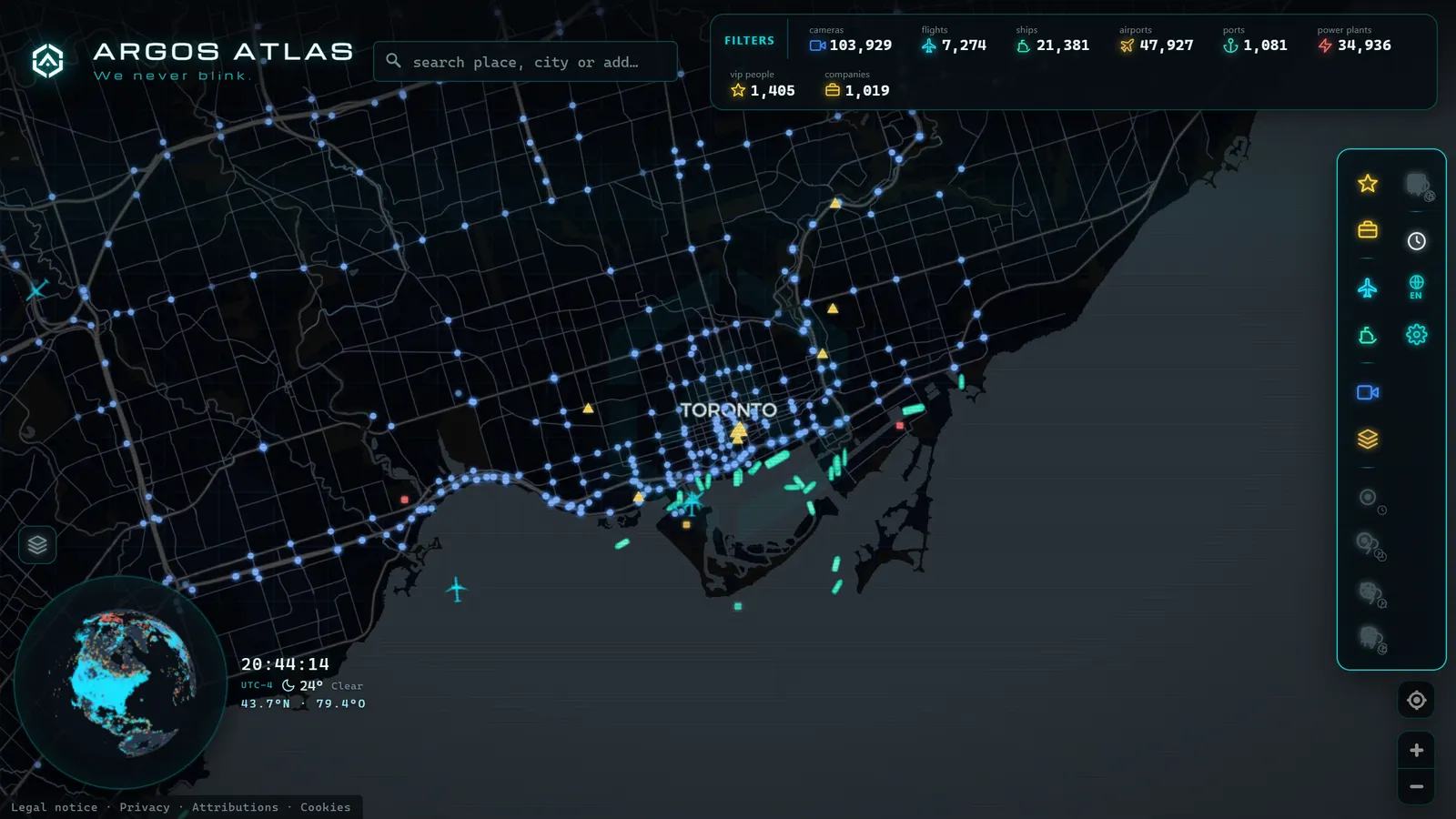
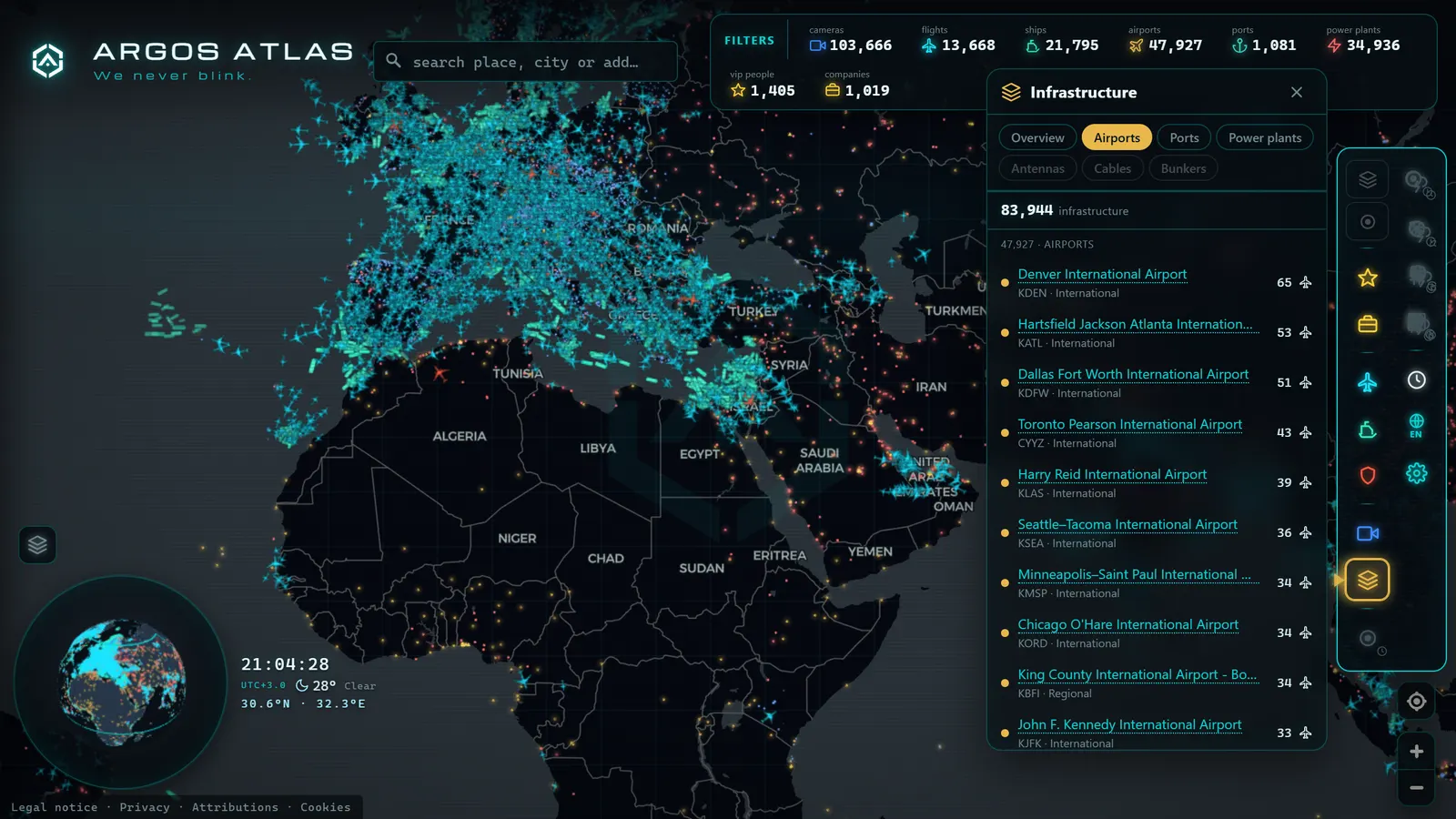
Commercial aircraft broadcast their position via ADS-B, and on the ARGOS ATLAS map you can see it in real time: search for Atlanta, Dubai or Haneda and watch how each hub behaves. Over Atlanta you will see the connecting model drawn on screen, dozens of arrivals in a row, a pause, dozens of departures. Over Dubai, the signature of an intercontinental hub, with night-time long-haul waves. Over O'Hare, the relentless drip of operations that explains its world lead in movements.
Three tips to get more out of it:
- Pick the hour carefully. Connection banks cluster in the early morning and late afternoon; mid-afternoon makes many hubs look quiet.
- Compare two airports back to back. Opening Atlanta and then Heathrow on the same day teaches more about airline business models than any table.
- Switch on other layers. Public cameras in the area, nearby ports and live shipping give context to an airport that is almost never alone in its territory.
If you want to understand the technology behind all of this before you start watching, we explain it in how to watch aircraft in real time.
The biggest airports in the world are not just enormous terminals: they are the central gears of a system that moves almost ten billion people a year. Open the map, centre it on Atlanta at seven in the evening, and you will watch one of those gears turn live.
Biggest airports: what the word means when nobody says "by passengers"
"Biggest airports" is often typed as a shorthand for "which airports handle the most people," but a meaningful share of the world's largest air hubs are not built around passengers at all. They are built around freight. When freight forwarders, e-commerce platforms and airlines talk about the "biggest airports," they usually mean the ones that move the most cargo tonnage overnight, not the ones with the fullest passenger terminals.
Memphis International Airport is the clearest example: it barely registers in passenger rankings, yet it operates as FedEx's global superhub and has spent years among the busiest airports on the planet by cargo volume. Louisville Muhammad Ali International, home to UPS Worldport, follows the same pattern: a modest passenger footprint next to a freight operation that runs through the night. Hong Kong International Airport does both jobs at once, ranking high on passenger counts and cargo tonnage, which is part of why it keeps appearing in "biggest airport" lists built on different metrics.
This is not a contradiction with the passenger ranking above (it is a different question with a different answer). A cargo hub is optimized for apron space, sorting facilities and overnight turnarounds rather than for gates and check-in halls, so it can be enormous in operational terms while looking modest on a passenger chart. Some Gulf airports, covered in our biggest airports in the Middle East roundup, sit in between: they carry heavy cargo volumes alongside their passenger traffic, which is one reason the region punches above its population in most "biggest" lists.
| What "biggest" measures | Typical example |
|---|---|
| Passengers per year | Covered above (Atlanta, Dubai, Haneda) |
| Cargo tonnage | Memphis, Louisville, Hong Kong |
| Land area | Not the same list as either of the above |
If your search for "biggest airports" was really about freight, the passenger numbers on this page will look wrong: that's not an error, it's a different definition of the same word. On the live map, cargo flights and passenger flights share the same sky and the same tracked routes, so you can watch a FedEx overnight run out of Memphis the same way you'd watch a passenger jet leave Atlanta.
Frequently asked questions
What is the biggest airport in the world?
It depends what you measure. By passengers it is Atlanta (ATL), with 106.3 million in 2025 according to the ACI World ranking. By aircraft movements (take-offs and landings) the world leader is Chicago O'Hare, ahead of Atlanta and Dallas/Fort Worth. By land area the crown goes to airports built on vast plains, which are not the same ones that top the passenger table.
How many passengers did the world's airports handle in 2025?
Around 9.8 billion, up 3.6% on 2024, according to ACI World's count. That is the aggregate figure for all commercial air traffic on the planet, and it is the number that puts each mega-hub into proportion.
How many US airports are in the global top 10?
Four: Atlanta, Dallas/Fort Worth, Denver and Chicago O'Hare. That concentration is a direct product of the American hub-and-spoke model, where a handful of cities absorb most of the country's connecting traffic.
Why does Atlanta always win, and not a bigger city?
Because Atlanta is a connecting hub, not just an origin-and-destination airport. A large share of its passengers never leaves the terminal: they land, walk to another gate and take off again. Add a geographic position that puts most of the United States within a short or medium flight, and the maths works.
Can I watch these airports live, for free?
Yes. On the ARGOS ATLAS map you can open Atlanta, Dubai or Haneda and watch their traffic in real time thanks to ADS-B signals, alongside other layers such as public cameras in the area. It runs in any browser, free and with no sign-up.
- Iran on a Live Map: Airports, Flights and Hormuz Ships
- Biggest Airports in the Middle East: 6 Hubs, Live Data
- Italy Airports Live Map: 4 Fields and What They Hide
- Mumbai live map: ships, flights and port data in real time
- Philippines Airports Live Map: Manila, Clark, Cebu, Davao
- Poland Airports Live Map: Chopin, Gdansk, Krakow and More