Blog · World webcams
Perseids 2026: when to watch and how to see them live
The 2026 Perseids arrive holding the best hand the calendar can deal: the maximum falls on a new moon night, with no lunar glare to wash out the fainter meteors. They also land inside an unusually rich astronomical week, because on 12 August a solar eclipse is visible from Spain in the late afternoon, and in the small hours that follow the August 2026 meteor shower reaches its peak.
This guide is practical: which nights to watch, at what hour, where to look, and how to follow the shower live by webcam if you get clouds, live under city glare, or simply cannot get out. One warning up front, because we would rather say it than sell it: a webcam is no substitute for a genuinely dark sky. It is the fallback plan, and it is an excellent tool for deciding whether the drive is worth it.
When are the Perseids 2026: dates and the peak night
The Perseids are not a night, they are a season. In 2026 Earth crosses the comet's dust trail from 17 July to 24 August. Activity runs for nearly six weeks, though for most of that stretch it is modest: the occasional meteor, enough to reward anyone who looks up patiently.
The bulk of it concentrates into two nights:
- The night of 12-13 August is the maximum. If you only get one shot, take this one.
- The night of 11-12 August also delivers high activity. It is a genuine alternative, not a consolation prize, and it is worth keeping in mind because a single Atlantic front or an afternoon thunderstorm can write off one specific night.
Then there is the Moon, usually the party-pooper of this event. Not in 2026: the peak coincides with a new moon, so the sky stays dark from dusk to dawn. In terms of conditions there is nothing better to ask for, and it does not come round every year.
Perseids peak time: the small hours of the 13th
The hour matters as much as the night. For 2026, peak density is estimated between 4:00 and 6:00 in the early morning of the 13th, Central European Summer Time. Translate that to your own zone, but the underlying rule travels: the pre-dawn hours win.
Why so late, in three ideas:
- The radiant climbs as the night goes on. The higher the point the meteors appear to stream from, the more of them fall above your horizon instead of below it.
- Before dawn you face into the traffic. After midnight your side of the planet points along Earth's direction of travel, so you meet meteors head-on rather than catching them up.
- The ground quietens down. Street lighting does not vanish, but at four in the morning the sky above almost anywhere is a little cleaner than at midnight.
The honest catch: by 4:00 to 6:00 an August night is already edging towards twilight. The good window is real but short. If you are going to drive, drive early enough to be set up before three.
Night by night: what to expect from 10 to 14 August
| Night | Expected activity | Moon conditions | What to do |
|---|---|---|---|
| 10 → 11 | Building, still moderate | No meaningful moonlight before dawn | Scouting night: test the site, the sightlines and your layers |
| 11 → 12 | High | Dark sky | The best alternative to the peak; go if the forecast for the 12th looks poor |
| 12 → 13 | Maximum | New moon: full darkness | The night. Aim to be watching between 4:00 and 6:00 |
| 13 → 14 | High but declining | Sky still dark | Rescue plan if cloud stole the maximum from you |
| 14 to 24 | Steady decline to the end of the season | Moonlight gradually returning | Scattered meteors; a decent excuse for a quiet night out |
One caveat that saves disappointment: the "meteors per hour" numbers that circulate every August are theoretical, calculated with the radiant overhead and under perfect skies. From a real site, with some light around and the radiant halfway up, you will see considerably fewer. It is still very much worth doing.
From the ARGOS ATLAS channel.
Where to look (and why not at the radiant)
The Perseids take their name from Perseus, the constellation their trails converge on when traced backwards. At this time of year it rises in the north-east after dark and climbs through the night. That convergence point is the radiant.
And here is the advice almost nobody gives: do not stare straight at the radiant. Right there the meteors come towards you head-on and register as short, almost disappointing dots. The long, spectacular trails appear some distance away from it. What actually works:
- Lie flat on your back or use a reclining chair. Posture decides how long you last, and lasting is half the job.
- Take in as much sky as you can: peripheral vision catches more meteors than a fixed stare.
- Give your eyes twenty minutes to adapt to the dark, then do not ruin it with a phone screen. If you need light, make it dim and red.
- Aim your gaze at the darkest part of your horizon, usually the side away from the nearest town.
How to watch the Perseids live by webcam: what works and what doesn't
Now the uncomfortable part. Searching for a live Perseid stream and expecting crisp meteors from any public camera ends in disappointment, and it is worth explaining why:
- The overwhelming majority of public webcams are built for daylight: traffic, beaches, harbours, town squares. At night many go black or show nothing but street lamps.
- The sensor and compression in an ordinary surveillance camera are not designed to record a flash lasting a fraction of a second. A very bright fireball can slip into a frame; an average meteor, almost never.
- The cameras that do help are a different breed: mountain passes, high-altitude stations and summit installations, with clean horizons and no city underneath.
That said, a webcam has two excellent uses that night, and neither is the one people expect:
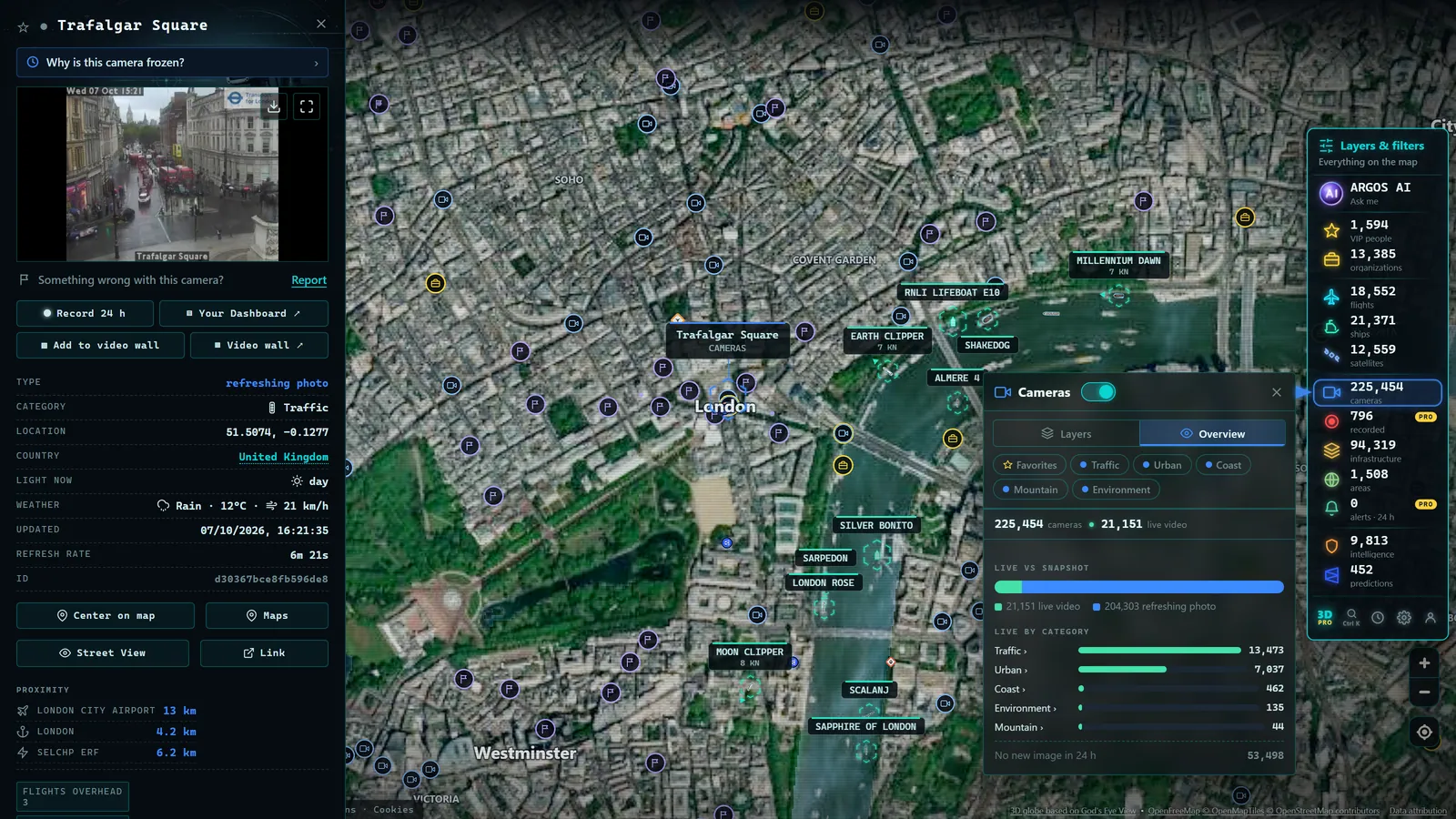
- Checking the cloud before you leave. By far the best reason. On the ARGOS ATLAS map you can open cameras at the exact spot you planned to drive to and see whether the sky is genuinely clear, rather than trusting a forecast icon. We have a whole guide to weather webcams for checking conditions live.
- Borrowing a sky you don't have. If you live in a city centre, a mountain camera at least shows you what a night without light pollution looks like. The mountain pass cameras are a good starting point, and the catalogue of live webcams around the world will take you to other latitudes while you wait.
The Canary Islands: Europe's fallback dark sky
If one place in Spain has a championship sky, it is the Canaries. The area around Teide is considered one of the best skies in Europe: altitude, dry air, a sea of clouds that caps the coastal light from below, and decades of sky-protection culture behind it.
It is also the most heavily covered part of the country in public cameras: the map holds 642 public cameras in the Canary Islands (map count as of August 2026), 362 of them in Tenerife. That is a remarkable density for seven islands.
The honest reading of that number: most are tourist cameras pointed at beaches and promenades, and at four in the morning they will not show you a single Perseid. The ones that matter that night are the summit cameras and those facing inland, and their value lies in two very specific things: seeing whether there is a sea of clouds or Saharan dust haze (dust ruins an observing night as thoroughly as cloud does) and checking conditions over the peaks before committing to the climb.
Eclipse in the afternoon, Perseids before dawn: the 12 August double
12 August 2026 is not only the eve of the maximum. That same day a solar eclipse is visible from Spain in the late afternoon, total along a band across the north of the country. The coincidence is not trivial: in a single day you can watch an eclipse at sunset and, a few hours later, the peak of the year's most popular meteor shower.
The specifics (where the band runs, what each region sees and how to prepare) are in the dedicated guide to the August 2026 solar eclipse in Spain. The practical consequence here is simple: if you were already planning to travel somewhere dark for the Perseids, consider leaving on the afternoon of the 12th rather than at night. With a little planning both fit into the same trip.
And a warning that never goes amiss: the eclipse must not be viewed without certified protection, however brief the glance. Perseids are a naked-eye event; the Sun never is.
Preparing for the night of 12-13 August
- Pick your site in advance and be set up before three in the morning.
- Check the cloud on camera the same day: once in the afternoon and again just before you leave.
- Bring warm clothing even in August: at altitude, lying still, it gets genuinely cold.
- No white torches in the group; one is enough to ruin everyone's dark adaptation.
- Patience, horizontal: half an hour of watching is the minimum before judging a night.
- Decide your fallback beforehand: if the sky is covered at midnight, go home and try again on the night of 13-14.
The 2026 Perseids have nearly everything going for them: a long season, a maximum well placed before dawn, and a new moon that steps out of the way. If the weather cooperates, the only real decision is where to lie down. If it does not, open the map, look at the cameras where you were headed and in the mountains around it, and decide from real images instead of a cloud icon. It is free, it needs no account, and at eleven o'clock on the night of the 12th it may save you a two-hour drive, or convince you to make it.
Frequently asked questions
When are the Perseids in 2026?
Activity runs from 17 July to 24 August 2026, but the maximum falls on the night of 12-13 August. The night before, 11-12 August, also brings high activity and is the best fallback if the 12th is clouded out where you are.
What time are the Perseids best?
Peak density for 2026 is estimated between 4:00 and 6:00 in the early hours of 13 August, Central European Summer Time. Wherever you are, the hours before dawn always beat the evening, because the radiant is still low on the horizon before midnight.
Will the Moon spoil the show this year?
No, and that is the headline for 2026: the peak coincides with a new moon, so the sky stays dark all night long. That is the best possible condition for a meteor shower and it does not happen every year.
Can I watch the Perseids live by webcam for free, without signing up?
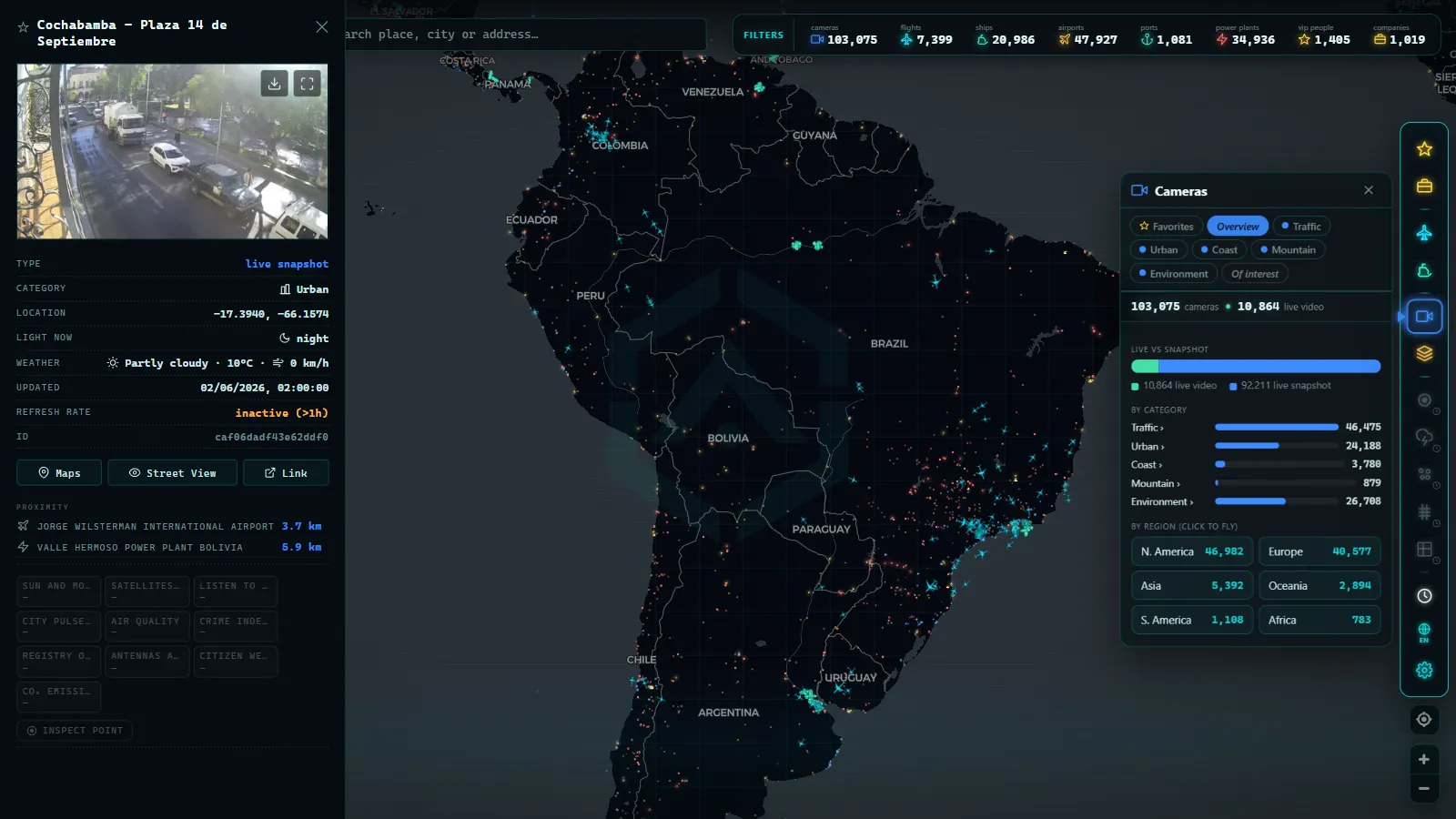
The public cameras on the ARGOS ATLAS map are free to browse with no account, yes. But set expectations properly: an ordinary webcam almost never catches a meteor. Its real value that night is checking whether the sky is genuinely clear before you drive out, and looking in on dark skies such as the Canary Islands when your own sky is hopeless.
Is anything else happening on 12 August?
Yes. A solar eclipse is visible from Spain that same day, late in the afternoon. An eclipse at sunset followed by the Perseid maximum a few hours later makes 12 August 2026 the astronomy date of the year in Spain.
- Canary Islands webcams: 642 live cameras, island by island
- Solar eclipse 2026 live stream: how to watch it safely
- Airport Webcams Live: Plane Spotting From Your Screen
- Nepal Live Map: What You Can Actually Track in Real Time
- Antarctica live map: what you can really watch right now
- Guatemala live map: what you can see right now, layer by layer