Blog · World webcams
Spain Eclipse Traffic Measures Aug 12: Path & Live Webcams
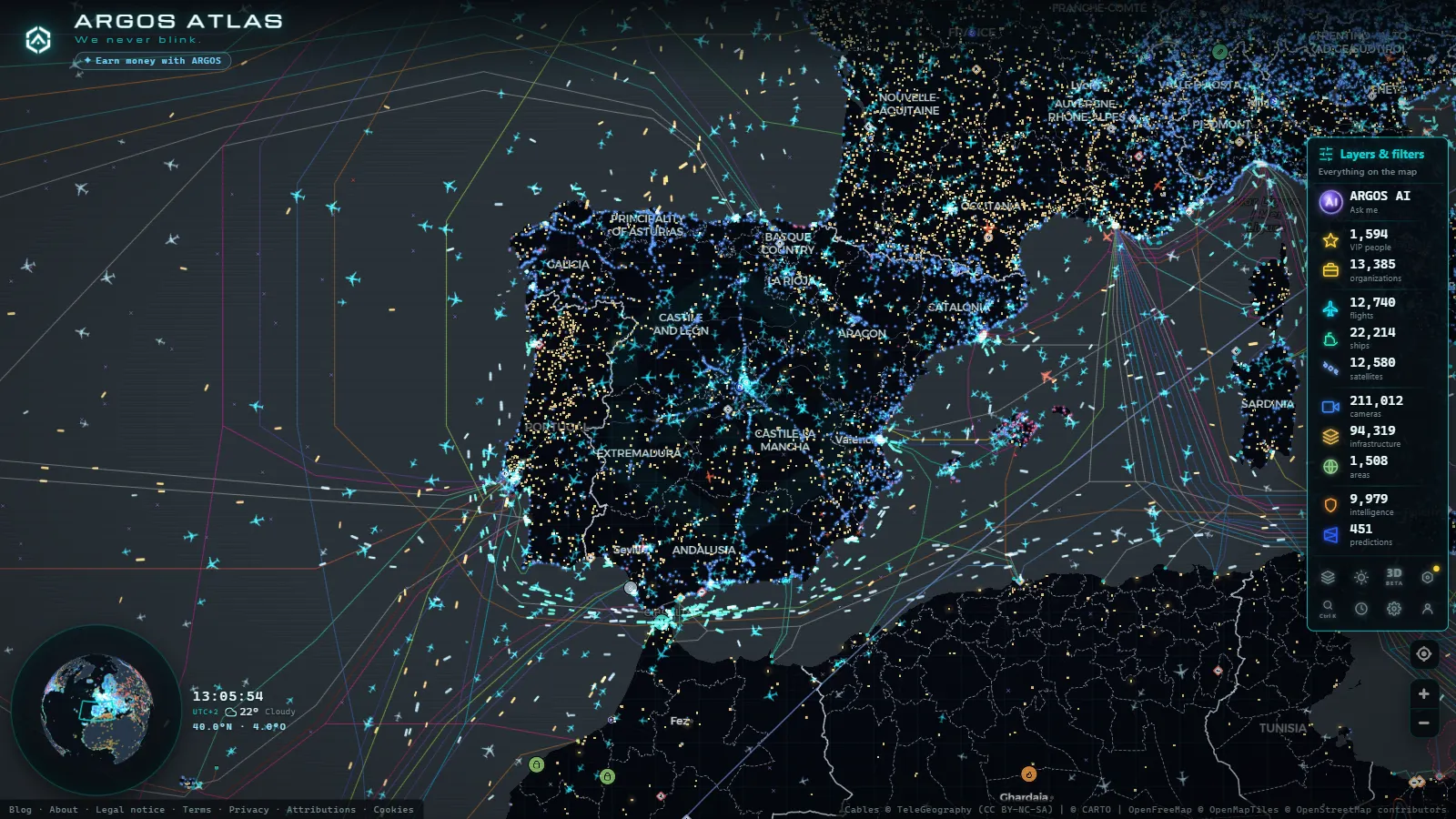
On August 12, 2026, Spain hosts a total solar eclipse, the first visible as total from the Iberian mainland in over a century. The partial phase starts around 7:30 PM local time, totality sweeps the country between 8:27 PM and 8:33 PM depending on where you stand, and it is all over by about 9:20 PM, with the Sun grazing the horizon. If you are inside the path of totality you will watch night fall in the middle of the day; if you are not, public webcams in the right cities let you follow it live, for free, from anywhere in the world.
This guide covers the essentials: which cities sit inside the path, the timing phase by phase, and how to build your own multi-camera eclipse feed.
When it happens and what you will see
The date is Wednesday, August 12, 2026, at the end of the afternoon. The Moon starts "biting" into the solar disk around 7:30 PM. Totality (the Moon covering the Sun completely) arrives between 8:27 PM and 8:33 PM depending on the location, lasting up to roughly 1 minute 48 seconds on the center line, near Oviedo and León. The process then reverses, and the partial phase fades out near 9:20 PM.
One detail shapes everything: the Sun will be very low over the western horizon during totality. That makes 2026 a "horizon eclipse", in person you need high ground or a clear view to the west, with no buildings or mountains blocking the last few degrees of sky. It is also exactly why well-placed webcams (coastal, mountain-top, rooftop) will be such a good way to follow it.
The path of totality, city by city
The Moon's shadow enters through the northwest and exits over the Mediterranean, crossing Spain in a band roughly 290 kilometers wide. Here is where the main cities stand:
| City | Total eclipse? | Key moment (local time, CEST) |
|---|---|---|
| A Coruña | Yes, about 76 seconds of totality | Totality between 8:27 and 8:33 PM |
| Oviedo | Yes, near the national maximum | Totality between 8:27 and 8:33 PM |
| Santander | Yes | Totality between 8:27 and 8:33 PM |
| Bilbao | Yes | Totality between 8:27 and 8:33 PM |
| León | Yes, near the national maximum | Totality between 8:27 and 8:33 PM |
| Burgos | Yes | Totality between 8:27 and 8:33 PM |
| Valladolid | Yes | Totality between 8:27 and 8:33 PM |
| Soria | Yes | Totality between 8:27 and 8:33 PM |
| Zaragoza | Yes | Totality between 8:27 and 8:33 PM |
| Teruel | Yes | Totality between 8:27 and 8:33 PM |
| Castellón | Yes | Totality between 8:27 and 8:33 PM |
| València | Yes | Totality between 8:27 and 8:33 PM |
| Lleida | Yes | Totality between 8:27 and 8:33 PM |
| Tarragona | Yes | Totality between 8:27 and 8:33 PM |
| Palma de Mallorca | Yes | Totality between 8:27 and 8:33 PM |
| Madrid | No, very deep partial | Maximum around 8:30 PM |
| Barcelona | No, very deep partial | Maximum around 8:30 PM |
| Seville | No, very deep partial | Maximum around 8:30 PM |
The takeaway: northern and eastern Spain, plus the Balearics, get the main event. Madrid, Barcelona and Seville will watch the Sun shrink to a brilliant sliver, striking, but without the darkness or the corona.
Why webcams are the perfect plan B
Not everyone can stand inside a 290-kilometer band on a Wednesday in August. Even inside it, one badly placed cloud or a blocked horizon can ruin the minute that matters. Live public cameras solve both problems:
- Be where you cannot be. From home you can open a camera in A Coruña, another in Zaragoza and another in Palma, and watch the shadow race across a whole country in minutes.
- It is 100% safe. Looking at the Sun without filters damages your eyes, partial phases included. A screen carries no such risk.
- Pick the best sky. If clouds threaten one region, jump to another city inside the path with one click.
- See the ambient effect. What a webcam captures best is not the solar disk but the landscape: the sudden darkening, streetlights switching on, that eerie light over the sea. Beach and harbor cameras are ideal for it.
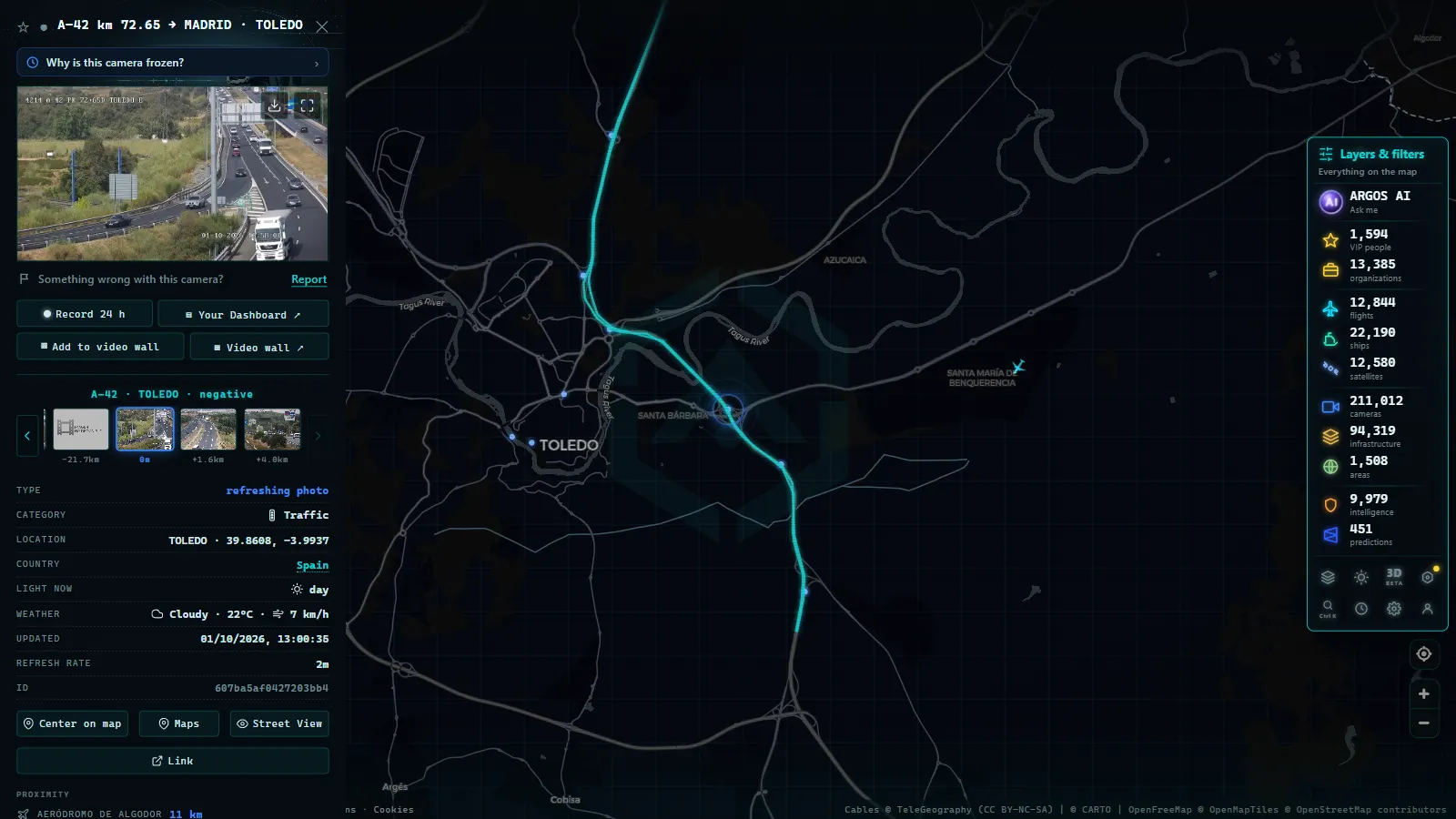
The ARGOS ATLAS map gathers more than 10,000 public cameras across Spain (traffic, beaches, ports and mountains) out of roughly 175,000 worldwide. You can filter by area, open several feeds at once and build your own multi-camera broadcast of the eclipse without installing anything.
Recorded straight off the map, no sound.
How to build your eclipse multi-screen
A concrete plan for the evening of August 12:
- Before 7:30 PM, open the map and pick three or four cameras inside the path: a coastal one in Galicia or Asturias, an urban one in Zaragoza or València, one in the Balearics. West-facing beach webcams in Spain are the first choice.
- Prioritize cameras with a clear western horizon: the Sun will be very low, so a camera looking west over open water beats a narrow street every time.
- At 8:20 PM, stop switching. Lock in your chosen feeds: totality lasts barely more than a minute and you do not want to spend it reloading tabs.
- Watch the landscape, not just the sky. The light collapse, cars switching on headlights in traffic cameras, the sea going dark, that is the part no close-up photo of the disk shows you.
- Stay a while after totality. The "reverse dawn" light of the following minutes, with the Sun reappearing almost glued to the horizon, is worth screen time too.
If you want to understand the kinds of public cameras out there and why some stream video while others post periodic snapshots, there is a guide to weather and landscape webcams.
Traffic on August 12: the other show
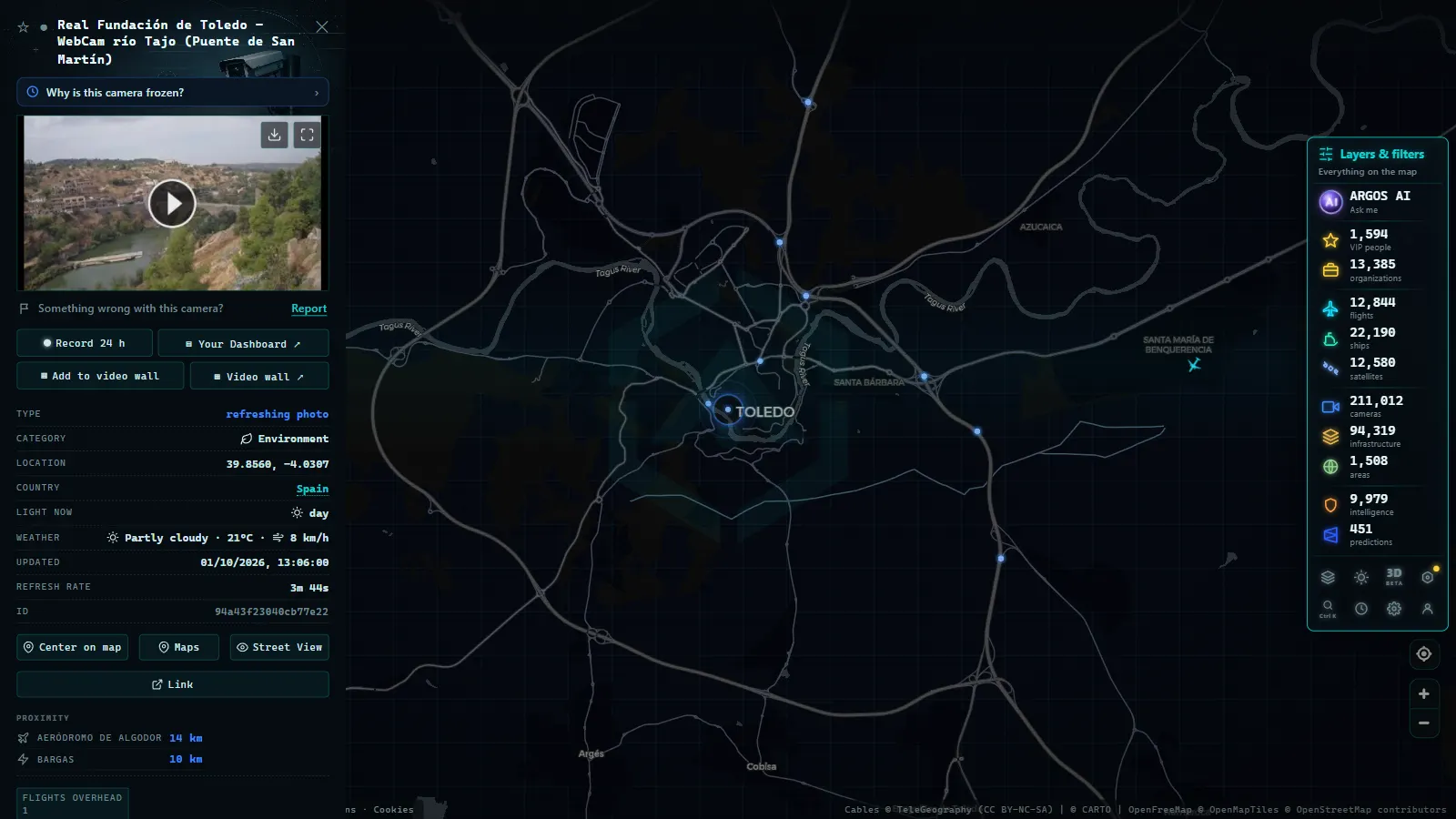
The eclipse lands in the middle of Spain's peak travel season. The national traffic authority (DGT) has already announced special traffic-management measures for eclipse day, within a summer in which it expects more than 104 million long-distance road trips. Easy to see why: thousands of people converging on the path of totality the same evening, and the dangerous temptation to stop on the hard shoulder to look up.
If you plan to drive that day, check the DGT live traffic cameras and the state of the access roads beforehand. If you travel in the days before, remember that Spain's early-August getaway operation concentrates the heaviest traffic of the summer.
Traffic cameras will tell the eclipse story their own way, too: you will watch entire highways switch their headlights on at half past eight in the evening.
What totality feels like
If you have never seen a total eclipse, this is what happens inside the path during that long minute:
- Light drains strangely in the preceding minutes, as if someone were turning a dimmer; shadows become sharp and unfamiliar.
- When totality hits, night falls in seconds. Bright stars and planets appear, and around the black disk of the Moon you see the corona, the white halo that only shows itself at moments like this.
- The temperature drops noticeably and a breeze often picks up; animals behave as if dusk had arrived.
- Past the maximum, a dazzling point of light breaks the edge of the disk (the "diamond ring") and the whole sequence runs in reverse.
Outside the path, the show is subtler but real: a strange, dimmed light and a Sun reduced to a glowing fingernail, always viewed with protection, or through a screen.
One final tip
A total eclipse at home happens once in a generation. If you can reach the path of totality, do it, with a clear western horizon and certified glasses. If you cannot, open the live map, choose your cameras well, and watch the most beautiful blackout of the century roll from A Coruña to Palma without leaving your chair.
Frequently asked questions
What time is the solar eclipse on August 12, 2026 in Spain?
The partial phase begins around 7:30 PM local peninsular time (CEST). Totality sweeps the country between 8:27 PM and 8:33 PM depending on the city, and the partial phase ends near 9:20 PM with the Sun very low in the west.
Which Spanish cities are in the path of totality?
The path crosses Spain from northwest to southeast and includes A Coruña, Oviedo, Santander, Bilbao, León, Burgos, Valladolid, Soria, Zaragoza, Teruel, Castellón, València, Lleida, Tarragona and Palma de Mallorca, among others.
Will Madrid, Barcelona or Seville see the total eclipse?
Not as total: all three lie outside the path of totality and will see a very deep partial eclipse instead. To experience darkness you need to be inside the path, or follow it live through webcams located there.
Can I watch the 2026 eclipse online for free?
Yes. Public webcams in cities inside the path (beaches, harbors, mountains and traffic cameras) let you follow the darkening live and safely. On an aggregator map you can open several cities at once and compare skies.
Is it dangerous to look at the eclipse directly?
Yes: looking at the Sun without certified filters damages your eyes, including during partial phases. Watching through a webcam is completely safe; in person, only use certified eclipse glasses.
- Hurricane Live Cameras: Watch Miami's 982 Feeds This Season
- Perseids 2026: when to watch and how to see them live
- Canary Islands webcams: 642 live cameras, island by island
- Solar eclipse 2026 live stream: how to watch it safely
- Airport Webcams Live: Plane Spotting From Your Screen
- Nepal Live Map: What You Can Actually Track in Real Time