Blog · Live flights
Registration, Callsign, ICAO Hex: How to Identify Any Aircraft Flying Over You
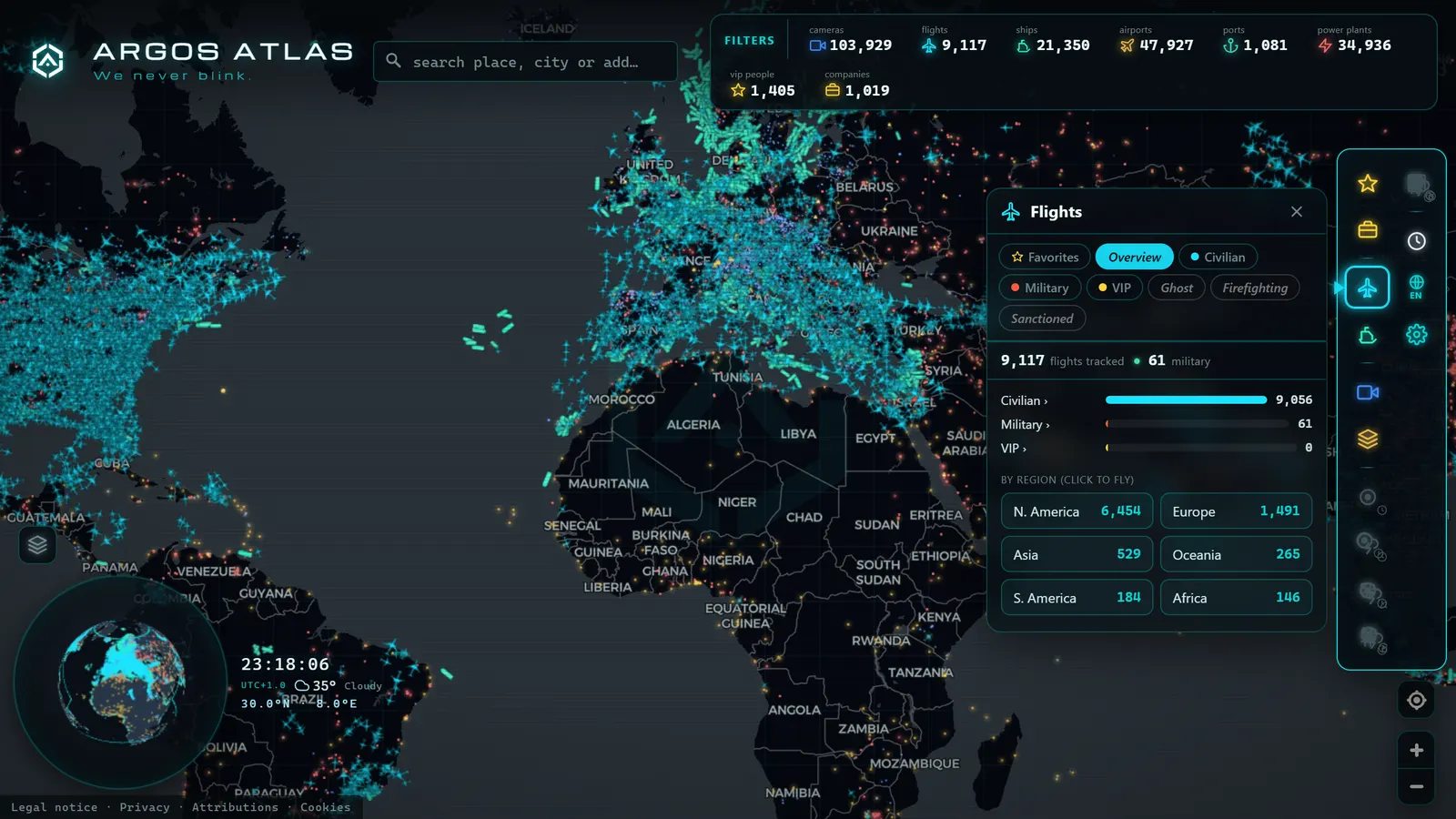
A plane passes over your house, you look up, and the question arrives on its own: what aircraft is that, where is it coming from, where is it going? Not long ago, answering required radio hobbyist knowledge or a lot of guesswork. Today all you need is a live flight map and the ability to read three or four pieces of data. This article teaches you exactly that: how to identify an aircraft from its registration, callsign, and transponder code, and how to move from one-off curiosity to genuinely understanding what crosses your sky.
An aircraft's three identities
The first thing that throws off newcomers is discovering that a single aircraft has several "identities" simultaneously, and they do not always match. There are three, and each answers a different question.
The registration: the aircraft's serial identity
The registration identifies the physical aircraft, just as a car's license plate identifies the vehicle rather than the driver. It is painted on the fuselage (usually near the tail) and stays with the aircraft as long as it remains registered in that country. If the airline sells the plane to one in another country, it gets re-registered; otherwise it keeps its registration for years.
The registration answers the question "which specific aircraft is this?" Two flights with the same flight number on different days may be operated by aircraft with completely different registrations, because airlines rotate their fleets constantly.
The callsign: the name of the operation
The callsign (or call sign) is what the crew uses to communicate with air traffic control. It identifies the operation, not the aircraft. On commercial flights it usually combines the airline's ICAO code with a number, which often resembles the commercial flight number, but not always. In private aviation or government flights, the callsign may simply be the registration itself or a special identifier.
The callsign answers the question "what flight is this aircraft doing right now?" It is the identity you will see most prominently on live maps.
The flight number: the commercial label
The flight number is what appears on your boarding pass and airport departure boards. It is a passenger-facing label and can hide surprises: with codeshare agreements, a single physical flight is sold under several airline numbers. You book with one carrier and fly on another carrier's aircraft.
Why do these three not coincide? Because they serve different audiences: the registration serves the registry and maintenance, the callsign serves air traffic control, the flight number serves the commercial operation. When you look at a map, be clear about which of the three you are reading.
The ICAO24 hex: the transponder's fingerprint
There is a fourth identity, less visible but more important for map tracking: the ICAO24 hex code. It is a 24-bit identifier assigned to each aircraft's transponder, unique worldwide, normally written as six hexadecimal characters.
Unlike the callsign, which changes with each operation, the hex stays with the aircraft while it retains its registration. It is the "fingerprint" that ADS-B receiver networks use to distinguish each airframe: even if a plane flies for one airline today and on a charter with a different callsign tomorrow, its hex identifies it as the same aircraft. If you want to understand how that data travels from the aircraft to your screen, we explain it in detail in what ADS-B is and how flight tracking works.
For the enthusiast, the hex has an excellent practical use: it lets you follow the "life" of a specific aircraft. Hex code ranges are allocated by country, so the hex also hints at the country of registration, just as the registration prefix does.
Registration prefixes: the passport painted on the fuselage
Aircraft registrations follow an international prefix system by country, inherited from radio communication agreements dating back a century. Knowing the most common ones turns every aircraft into a small geography exercise:
- N, United States (N followed directly by numbers and letters, no hyphen, e.g. N12345 or N456AB)
- G-, United Kingdom (e.g. G-BOAC)
- F-, France
- D-, Germany
- EC-, Spain
- EI-, Ireland
- C-, Canada
- VH-, Australia
- JA, Japan
There are dozens more, but these get you through a large share of the traffic you will encounter over Europe, North America, and the Asia-Pacific. One notable detail: the format varies by country. US registrations can be long combinations after the N, while most European registrations follow a prefix-hyphen-letters pattern.
The prefix shows where the aircraft is registered, which does not always match where it operates: for tax and fleet management reasons, it is common to see aircraft registered in one country flying routes for airlines of another.
From the ARGOS ATLAS channel.
How to identify the aircraft passing over right now
Here is the practical part. You hear or see an aircraft and want to know what it is. The process is simpler than it looks:
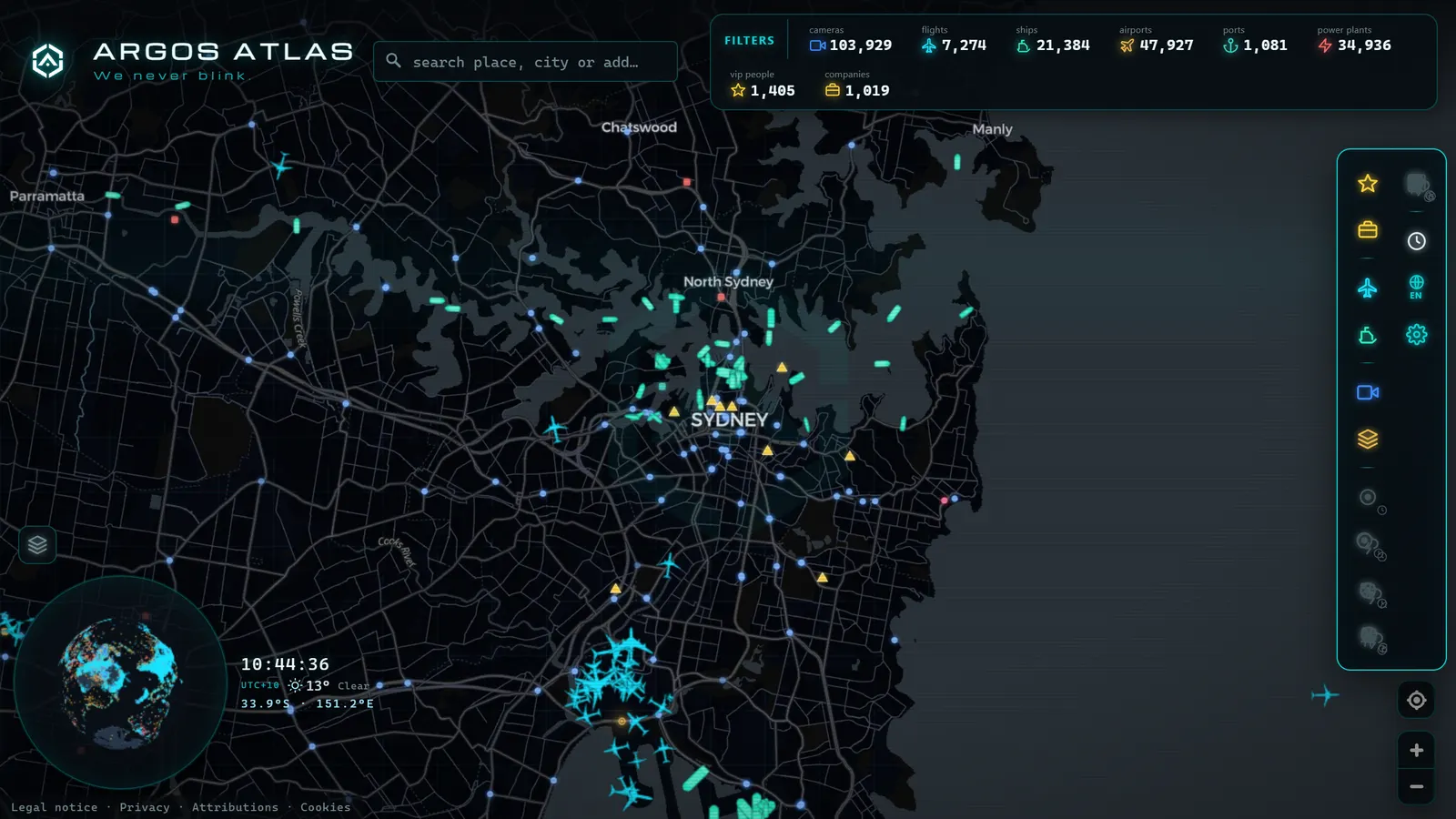
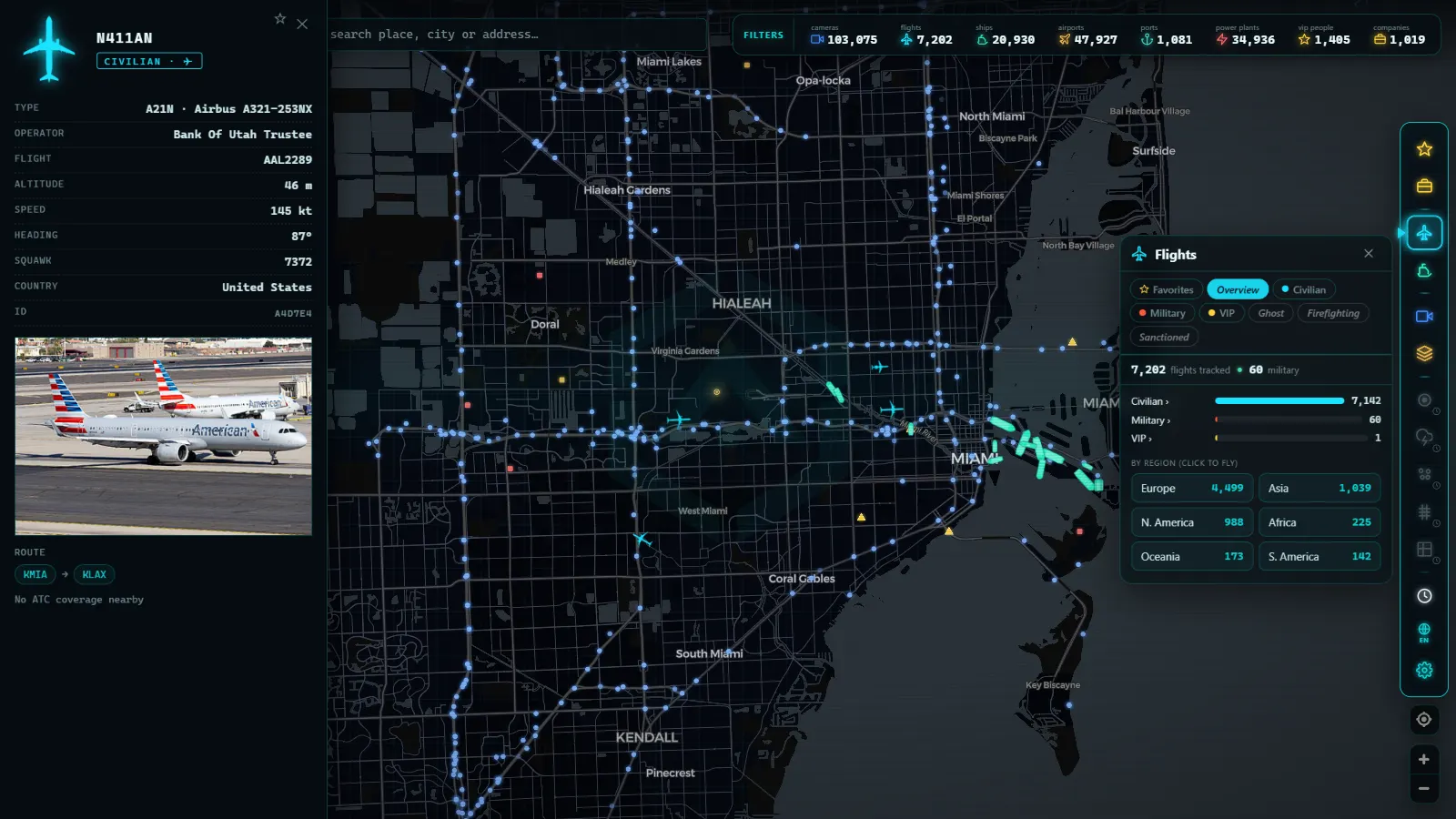
- Open a live flight map on your phone or computer. In Argos Atlas, flights appear on the map with their real-time data, alongside all the other layers.
- Find your vertical: center the map on your location and look for aircraft that are overhead or approaching. The icon's direction tells you where the plane is heading; compare it with what you see in the sky.
- Read the flight card: callsign, aircraft type, origin and destination, altitude and speed. With that you already know whether it is the regular afternoon flight to the Caribbean or a freighter heading to northern Europe.
- Cross-reference with what you see: four engines or two? Large aircraft or small? High and fast (en route) or low and slow (on approach)? If it matches, you have your answer.
A useful trick: aircraft at cruise altitude pass over your position in one or two minutes, so the map snapshot and the real sky align almost instantly. If the aircraft you can see does not appear on the map, there are several possible explanations (from light aircraft without ADS-B equipment to coverage gaps) and military traffic has its own visibility rules, as explored in the article on military aircraft.
To get the most out of the map, the article on how to see aircraft in real time walks through everything you can do with live flights step by step.
Recognizing models at a glance: a few pointers
Identifying the exact model by eye is an art that takes years to master, but a handful of clues get you oriented quickly:
- Number and position of engines: two under the wings is the modern norm; four engines mark the great long-haul veterans; tail-mounted engines point to regional jets or business aircraft.
- Winglets: the upswept wingtips come in distinct shapes depending on manufacturer and generation; with practice they become a recognizable signature. Compare the split scimitar winglets of a Boeing 737 MAX with the blended winglets of older 737NGs, or the distinctive "sharklets" of the Airbus A320neo family.
- Size and proportions: the relationship between fuselage length and wingspan, landing gear height, and fin size. A wide-body twin-aisle aircraft is distinguishable from a narrow-body single-aisle even at altitude, by its shadow and contrail spread.
- Tail and nose silhouette: each family has its own profile. Experienced spotters identify a model by the nose shape the same way you recognize a friend from behind.
Do not be frustrated if you initially mix up similar variants: even expert spotters hesitate between versions of the same family. The map card is there precisely to confirm.
From curiosity to hobby: the world of plane spotting
Many people discover this curiosity becomes addictive. Plane spotting (observing, identifying, and often photographing aircraft) is a hobby with decades of history and very active communities worldwide. The annual Maho Beach pilgrimage in Sint Maarten, where jets land meters above the beach, has become iconic. At London Heathrow, Manchester, or Amsterdam Schiphol, official viewing areas fill with enthusiasts daily. In the US, spotting communities gather at LAX, ORD, and DFW.
Some people collect registrations like stamps, noting every individual airframe seen; others pursue the perfect photograph at runway thresholds; others track the life of entire fleets from delivery to scrapping. Online registries like Airfleets and Planespotters.net catalog photos by registration, and live maps let you know in advance exactly what is arriving at your airport.
You do not need to go that deep to enjoy it. Simply knowing that the silver dot crossing your sky is a specific flight with an origin, a destination, and a history already changes the way you look up.
All of this, on the live map
Theory makes more sense with practice. In Argos Atlas, flights are displayed live on the world map with their real-time data: you can track the traffic over your position, compare callsigns with what you see in the sky, and explore what is moving over any point on the planet, all without registration. Civil aviation coexists on the same map with other layers (ships, airports, military traffic) so each identification comes with its context.
Frequently asked questions
What is the difference between a flight number, a callsign, and a registration?
They are three identities with different functions. The registration identifies the physical aircraft and is painted on the fuselage, like a car's license plate. The callsign identifies the specific operation and is what the crew uses on the radio with air traffic control. The flight number is the commercial label seen by the passenger. They do not have to match: the same airframe flies different operations every day, and the same flight can be sold under several numbers through codeshare agreements.
What is the ICAO24 hex code?
It is a 24-bit identifier assigned to each aircraft's transponder, unique worldwide, represented as six hexadecimal characters. It is the fingerprint that ADS-B networks use to tell aircraft apart: while the callsign changes with each operation, the hex stays with the airframe while it keeps its registration, making it possible to follow a specific aircraft's track over time.
How do I know the model of the aircraft I can see?
The most reliable method is to check a live flight map: each flight's card usually shows the aircraft type. If you want to guess at a glance, look at the number and position of engines, winglet shape, relative fuselage size, and tail silhouette. Distinguishing close variants of the same family is difficult even for veteran enthusiasts, so use the map to confirm.
Can I find out who owns an aircraft from its registration?
In many countries, aircraft registries are public or searchable, so a registration usually leads to the registered operator or owner. That said, the true beneficial ownership is sometimes behind leasing companies or management firms, especially in business aviation, so the registry shows who appears on record, which is not always who uses the aircraft.
Conclusion
Identifying an aircraft stops being a mystery once you understand its identities: the registration says what airframe it is, the callsign says what operation it is flying, the flight number says how it is sold, and the ICAO24 hex ties everything together as a unique fingerprint. With those four concepts and a live map, the sky above your home becomes an open book readable in seconds.
Next time you hear a jet, try it: open the map, find your vertical, and put a name, origin, and destination to that point in the sky. And if you want to go further, discover where traffic concentrates on the world's busiest air routes, understanding the flows makes every identification even more satisfying.
Frequently asked questions
What is the difference between a flight number, a callsign, and a registration?
The registration identifies the physical aircraft, like a car's license plate, and is painted on the fuselage. The callsign identifies the specific operation and is what the crew uses on the radio. The flight number is the commercial label seen by the passenger. They do not necessarily match: the same aircraft flies under a different callsign every day.
What is the ICAO24 hex code?
It is a 24-bit identifier assigned to each aircraft's transponder, unique worldwide, typically written as six hexadecimal characters. It is the fingerprint that ADS-B networks use to distinguish each aircraft, even if the callsign or operator changes.
How do I know the model of the aircraft I can see?
The most reliable method is to look it up on a live flight map: the aircraft card usually shows the type. At a glance, helpful clues include the number and position of engines, winglet shape, relative size, and tail silhouette, though distinguishing close variants takes practice.
Can I find out who owns an aircraft from its registration?
In many countries aircraft registries are public or searchable, so a registration usually leads to the registered operator or owner. In some cases the true beneficial owner sits behind leasing companies or management firms, so the registry does not always tell the full story.
- Track Flights in Real Time Over Mexico: A Complete Airspace Guide
- Live Flights Over Argentina: Ezeiza, Aeroparque and the Patagonian Airports
- Live Flights over Australia and Oceania: Qantas, Virgin Australia and Trans-Pacific Routes
- Live Flights Over Japan: ANA, JAL and the World's Busiest Domestic Routes
- Live flights over India: tracking IndiGo, Air India and SpiceJet in real time
- Live Flights Over Canada: Air Canada, WestJet and the Routes of the Great North