Blog · Live flights
Live Flights Over Japan: ANA, JAL and the World's Busiest Domestic Routes
The most precisely choreographed sky on Earth
Japan's domestic aviation network surprises almost everyone who sees it for the first time on a live flight map. A country with the world's most punctual high-speed rail (the Shinkansen) still manages to sustain one of the planet's densest and most disciplined domestic air networks. Before the pandemic, Japanese airlines carried over 300 million domestic passengers per year. Recovery has now passed 95 percent of that level, and the skies over the Japanese archipelago are busier than ever.
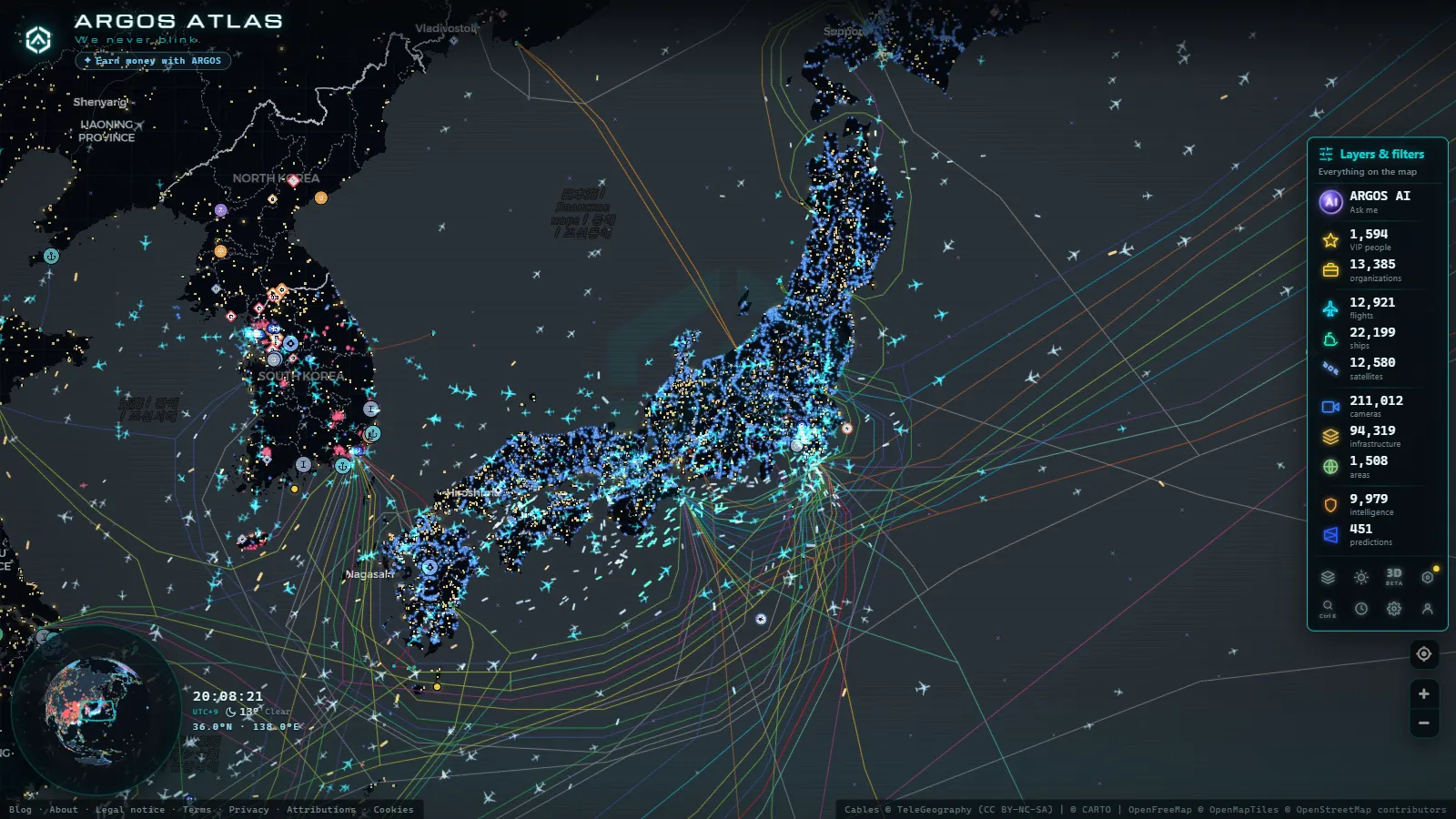
Opening ARGOS ATLAS and centering on Japan reveals the density immediately: dozens of aircraft threading through narrow corridors over Honshu, streams of planes descending into the Tokyo Bay complex, and a constant shuttle service connecting Hokkaido to the south. What sets this airspace apart is not just volume but precision. The Japan Civil Aviation Bureau (JCAB) enforces separation standards that are reference benchmarks globally, and the result is visible in real-time tracking data: tightly sequenced approaches, minimal holding patterns, and a rhythm that feels almost mathematical.
ANA and JAL: two giants, one sky
All Nippon Airways (ANA)
ANA is Japan's largest airline by passengers and fleet size. Founded in 1952, it operates over 80 domestic destinations from its primary hubs at Tokyo Haneda, Osaka Itami, and Nagoya Centrair. Its navy-blue livery is the most frequently spotted identifier when filtering Japanese airspace on ARGOS ATLAS.
ANA deploys the Boeing 787 Dreamliner on long-haul international routes from Haneda, but domestically the workhorses are the Boeing 737 and Airbus A320/A321 family. During Japan's national holiday clusters (Golden Week in late April and early May, and the Obon summer break in August) ANA can operate over 600 domestic segments in a single day, a logistics feat that requires almost perfect ground handling coordination at every station.
Japan Airlines (JAL)
JAL's story since its 2010 bankruptcy and restructuring is a case study taught in business schools. It emerged leaner, with a simplified fleet and a renewed focus on service quality that has since won it multiple international awards. Domestically, JAL operates from Haneda and maintains a strategic second hub at Naha Airport in Okinawa, which serves as a gateway to the island chain stretching toward Taiwan.
JAL's domestic fleet includes Boeing 737s on most routes and the 777 on the highest-density corridors where 400-seat capacity is justified. The rivalry between JAL and ANA is as structured as it is intense: on every major route, both carriers schedule flights within minutes of each other, creating effective price competition that keeps fares in check for frequent flyers.
"In Japan, a two-minute flight delay prompts a formal apology from the captain. It is not a quirk, it is the operational baseline."
The routes that define Japanese domestic aviation
Tokyo Haneda – Sapporo New Chitose
This is arguably the single busiest domestic corridor in Asia. Hokkaido, Japan's northernmost main island, has no high-speed rail connection to Honshu, the Shinkansen extension is still under construction and years from completion. The aircraft is therefore the only practical option for the 835-kilometre journey, completing it in around 90 minutes. The Haneda–New Chitose route alone moves 9 to 10 million passengers annually, and when flights from Narita and regional airports are included, total Hokkaido air traffic from the Tokyo area surpasses 12 million passengers per year.
On ARGOS ATLAS at any time of day, four or five aircraft are simultaneously in different phases of this single route: one departing Haneda, one at cruise altitude over Tohoku, one beginning descent, one on final approach to New Chitose. Frequencies run at one to two departures per hour in each direction, operated interchangeably by ANA and JAL.
Tokyo – Osaka (Haneda/Narita to Itami/Kansai)
The competition with the Shinkansen is nowhere more visible than here. The bullet train covers the 500 kilometres between Tokyo and Osaka in 2 hours 30 minutes with near-perfect reliability, which should theoretically make the 75-minute flight redundant. Yet the Haneda–Osaka Itami route still moves close to 8 million passengers per year. The reasons are practical: travellers based far from central Tokyo or Osaka find that the total door-to-door time is comparable; those connecting to international flights find Haneda or Kansai Airport more convenient than backtracking from Shin-Osaka; and corporate travellers on company accounts often have contractual reasons to fly. The route persists because geography, infrastructure gaps, and individual itineraries all argue for its existence.
Tokyo – Fukuoka
Fukuoka, the largest city of northern Kyushu, is the third-largest domestic destination from Tokyo. At nearly 900 kilometres, the Shinkansen journey exceeds five hours, long enough to make the 95-minute flight genuinely competitive. Combined ANA and JAL frequencies exceed 30 round trips daily, and Peach Aviation adds further low-cost options from Narita.
Tokyo – Naha (Okinawa)
Okinawa is Japan's premier domestic leisure destination: coral reefs, subtropical climate, and a culture distinct from mainland Japan. With 1,600 kilometres of open Pacific between the islands and Honshu, there is no rail alternative. The Haneda–Naha route is the longest in the domestic network and the one most likely to feature JAL's Boeing 777 in high-density configuration. In summer, the route operates what amounts to a continuous shuttle from early morning to late evening.
From the ARGOS ATLAS channel.
Narita vs Haneda: understanding the Tokyo airport split
For anyone watching Tokyo's air traffic on ARGOS ATLAS, the first question is almost always the same: why are there two major airports, and how are they different?
Haneda (HND) is Tokyo's city airport. Just 14 kilometres from the urban core, it handles virtually all domestic traffic and, since 2020, a significantly expanded international schedule following slot renegotiations with foreign carriers. Its four runways allow up to 90 aircraft movements per hour. The express monorail and Keikyu train lines connect Haneda to central Tokyo in 15 to 25 minutes, making it the preferred choice for business travellers on tight schedules.
Narita (NRT), 60 kilometres northeast of central Tokyo, was for decades the primary international gateway and remains critical for long-haul routes to North America, Europe, and Southeast Asia. Its greater distance from the city makes it less attractive for time-sensitive journeys, but lower slot costs and more available infrastructure keep it relevant. Narita is also the main hub for Peach Aviation and Jetstar Japan, the country's two largest low-cost carriers, whose point-to-point model is less sensitive to the extra transfer time.
On the ARGOS ATLAS map, the behavioural difference between the two airports is clear: Haneda shows a near-continuous stream of short and medium-haul movements across all hours of the day. Narita shows sharper peaks tied to intercontinental banking, heavy arrivals in the morning from transoceanic overnight flights, and a concentrated departure bank in the late afternoon and evening.
Low-cost carriers: the third force reshaping Japanese aviation
Japan opened slowly to low-cost aviation but has now developed a fully functioning LCC sector. Peach Aviation, a subsidiary of ANA Holdings, operates from Kansai and Naha with fares that can undercut full-service carriers by 40 percent on the same route. Jetstar Japan, in which JAL holds a stake, replicates the model from Narita. Skymark Airlines, the only fully independent low-cost carrier of scale, holds meaningful market share on routes where ANA and JAL frequency is lower.
These carriers are identifiable on ARGOS ATLAS by their registration prefixes (JA…) and their distinct operational patterns: shorter ground times, steeper descent profiles to maximise cycle efficiency, and a heavier concentration on secondary airports such as Kobe, Osaka Kansai, and Naha rather than the premium slots at Haneda.
Typhoon season and live disruption tracking
Japan sits in the western Pacific typhoon belt. Between June and October, tropical systems can disrupt hundreds of flights in a matter of hours. When a strong typhoon approaches Kyushu or Okinawa, watching ARGOS ATLAS shows the system's effect in real time: a surge of departures as airlines clear aircraft before the window closes, then a near-total absence of traffic over the affected airports, followed by a resumption wave as the storm moves on and ground operations restart.
Winter brings a different disruption pattern. Heavy snowfall in Hokkaido can temporarily close New Chitose Airport, and the recovery sequence (visible as a burst of arrivals once the runway is cleared) is one of the more dramatic real-time aviation events observable in the region. Japanese ground crews are exceptionally fast at snow clearance, limiting closures to the shortest possible window, but the traffic spike on reopening is unmistakable on any live tracking map.
Tracking Japan's airspace with ARGOS ATLAS
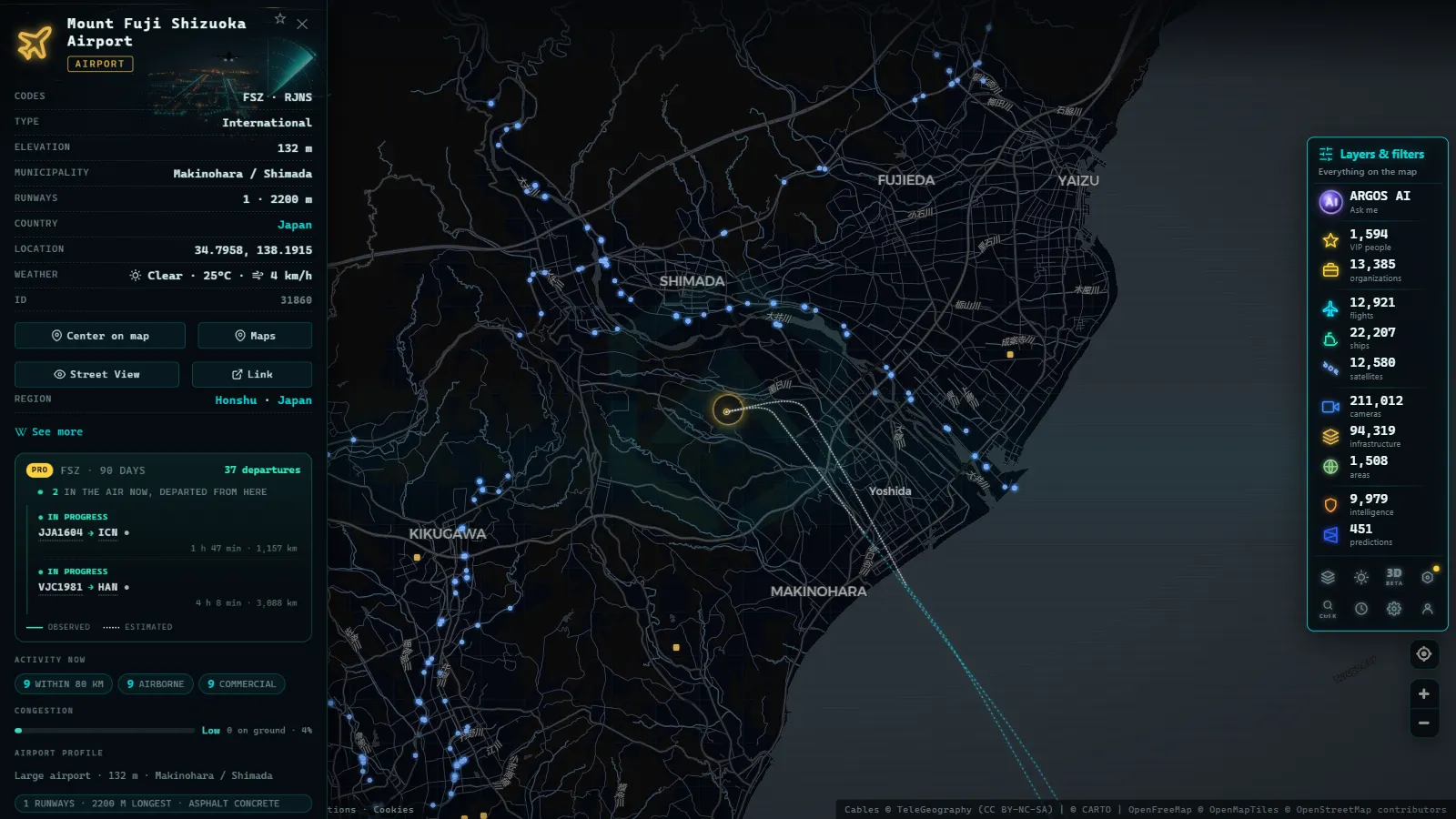
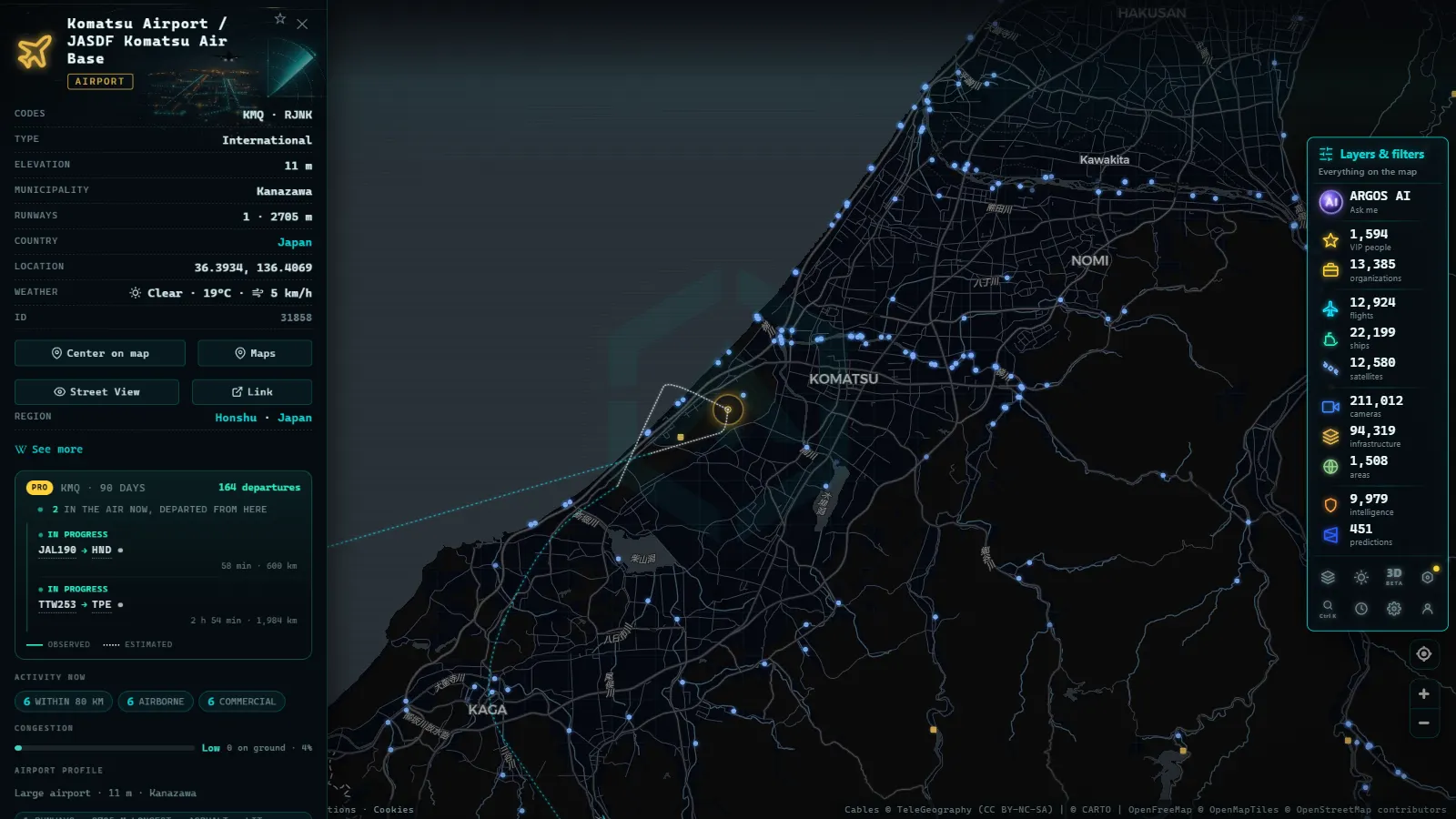
From ARGOS ATLAS, enabling the flights layer and centering the view on the Japanese archipelago immediately reveals the density of the Sapporo corridor and the cluster of traffic around Tokyo Bay. Clicking any aircraft shows its flight number, airline, origin, destination, current altitude, and ground speed. Zooming into the Haneda–Narita area makes the operational split between the two airports visually immediate.
For aviation enthusiasts in European or American time zones, Japan's morning rush (which corresponds to late evening in Europe or midday on the US East Coast) is particularly worth watching. Haneda's first departure bank begins around 06:00 JST, and within an hour the map transitions from nearly empty to dozens of aircraft climbing simultaneously toward Hokkaido, Okinawa, Fukuoka, and Osaka.
Japan's sky does not rest. Now you can see it move.
Frequently asked questions
What is the busiest domestic route in Japan?
The Tokyo Haneda–Sapporo New Chitose corridor competes with Tokyo–Osaka for the top spot. Both move over 9 million passengers per year, making them among the busiest domestic routes in the world.
Do ANA and JAL fly the same routes at the same time?
Yes, on major corridors they often schedule departures minutes apart. On Haneda–Osaka Itami, combined daily frequencies from both carriers can exceed 40 round trips, with planes departing back to back.
Why is there still heavy air traffic between Tokyo and Osaka despite the Shinkansen?
The bullet train is faster city-centre to city-centre for most travellers, but flights remain competitive for those far from major stations, those with heavy luggage, or those connecting onward to international flights at Haneda or Kansai.
- Live flights over India: tracking IndiGo, Air India and SpiceJet in real time
- Live Flights Over Canada: Air Canada, WestJet and the Routes of the Great North
- Flightradar24 Alternatives: Free Flight Trackers Compared
- Live Flight and Ship Tracker: Planes and Ships on One Map
- How to Track Planes in Real Time: A Guide to Online Flight Radar
- What is ADS-B: the technology that makes flight tracking possible