Blog · Live flights
Live Flights over Australia and Oceania: Qantas, Virgin Australia and Trans-Pacific Routes
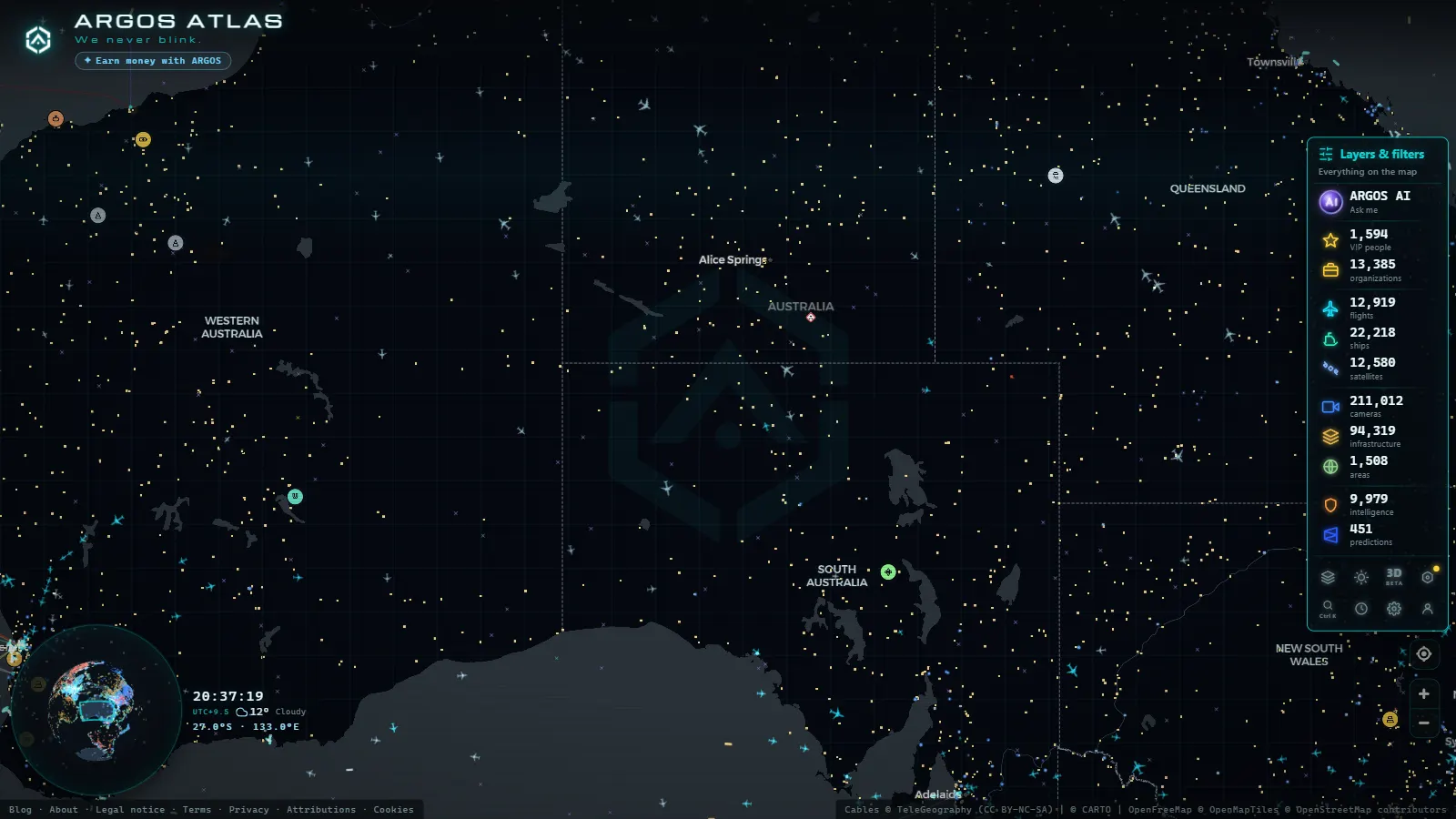
The world's most isolated continent, connected by air
Australia is one of the largest countries on Earth by land area, yet its geography places it at the far end of virtually every global air route. Surrounded by ocean on all sides and separated from major trading partners by thousands of kilometres of water, aviation in Australia is not a convenience, it is fundamental infrastructure. A domestic flight from Sydney to Perth already covers more than 3 900 km, a distance roughly equivalent to flying from London to Riyadh.
Today, tools like ARGOS ATLAS make it possible to watch that traffic unfold in real time: each moving dot over the Pacific or above Australia's red interior represents an aircraft carrying passengers and crew along a route planned weeks in advance.
The domestic network: three carriers, thousands of frequencies
Qantas: the flying kangaroo
Founded in 1920 in Queensland as the Queensland and Northern Territory Aerial Services, Qantas is the oldest continuously operating airline in the world. Its domestic network extends from major urban centres to remote communities in the Northern Territory and Western Australia where the aircraft is the only practical means of transport. The busiest routes (Sydney–Melbourne, Sydney–Brisbane and Melbourne–Perth) support dozens of daily rotations operated by Boeing 737s and Airbus A330s.
In ARGOS ATLAS, the Australian registration prefix VH- is visible in aircraft identifiers, making it straightforward to distinguish locally registered aircraft from international transits passing through Australian airspace.
Jetstar: the low-cost arm
Jetstar, the Qantas subsidiary launched in 2004, covers price-sensitive domestic routes and several short-haul international services to the South Pacific: Denpasar (Bali), Tokyo Narita and Auckland. Its fleet relies on the Airbus A320 family for shorter distances and the Boeing 787 Dreamliner for longer international sectors. On the flight map, Jetstar Dreamliners appear as dots crossing the Coral Sea or the Timor Sea on their way to South-East Asia.
Virgin Australia
Relaunched after its 2020 financial restructuring, Virgin Australia operates primarily in the domestic market with a Boeing 737 fleet. Although it scaled back international operations significantly during the pandemic, it maintains routes to New Zealand and codeshare arrangements with long-haul carriers connecting through its Sydney and Brisbane hubs.
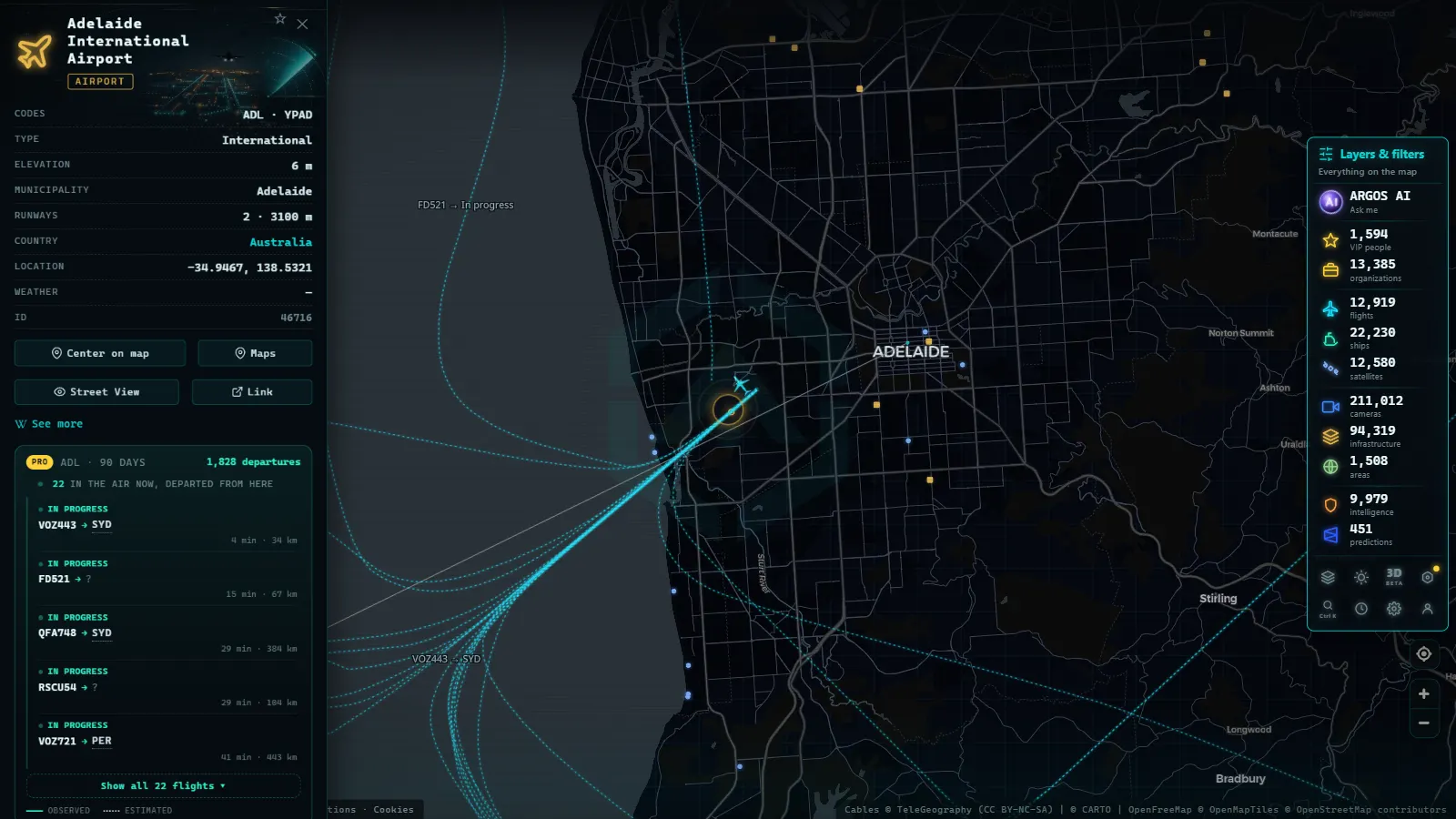
Trans-Pacific routes: among the longest flights on Earth
Routes between Australia and the North American west coast rank among the longest scheduled commercial flights on the planet, with journey times of 15 to 17 hours and distances exceeding 12 000 km over the central Pacific.
Sydney to Los Angeles
The Sydney–LAX route (SYD–LAX) is the most iconic trans-Pacific service from the southern hemisphere. Qantas operates it with the Boeing 787-9 and Airbus A380, sharing frequencies with United Airlines and American Airlines. Eastbound the flight takes roughly 14 hours; westbound it stretches to 15.5 hours as aircraft push against the jet stream. In ARGOS ATLAS, these flights trace pronounced north-eastward arcs on a flat map projection, though they actually follow great-circle paths over the central Pacific or slightly north of Hawaii.
Sydney to Dallas and Melbourne to Los Angeles
Qantas also operates Sydney–Dallas Fort Worth (DFW), a route that can exceed 16 hours eastbound on the Airbus A380. American Airlines serves Melbourne–LAX, adding another city-pair to the trans-Pacific flow from Australia. On ARGOS ATLAS's flight layer, these appear as near-horizontal trajectories when the globe is viewed from above the Pacific.
Project Sunrise: non-stop to London and New York
Qantas has long been working toward so-called "sunrise flights", non-stop services from Sydney to London and New York, operated with the Airbus A350-1000 scheduled to enter service from 2026 to 2027. When these routes enter regular operation, they will appear in ARGOS ATLAS as trajectories of more than 20 hours crossing Asia or the Americas depending on direction, the longest scheduled passenger flights ever operated.
From the ARGOS ATLAS channel.
The Kangaroo Route: Sydney to London via Asia
The Kangaroo Route is one of the most historically significant itineraries in world aviation. First flown with multiple stops in the 1940s, the Sydney–London connection is today completed in two segments with a stop in Singapore (Qantas or Singapore Airlines), Dubai (Emirates) or Bangkok (Thai Airways). Total travel time including the stop runs 22 to 24 hours. On the map, the route traces a diagonal that climbs from South-East Asia, crosses the Indian subcontinent or Middle East, and descends over Western Europe.
Oceania beyond Australia: regional routes
New Zealand and Air New Zealand
Auckland is the second major hub of the South Pacific. Air New Zealand operates an extensive domestic network between the North and South Islands and covers transoceanic routes to Los Angeles, London, Tokyo and Houston. The Sydney–Auckland corridor (SYD–AKL) is among the busiest in the southern hemisphere, with dozens of daily frequencies operated by Qantas, Jetstar, Virgin Australia and Air New Zealand all visible simultaneously in ARGOS ATLAS.
Pacific islands: Fiji, Papua New Guinea and beyond
Fiji Airways connects Nadi with Sydney, Melbourne, Auckland, Honolulu and Los Angeles, acting as a regional hub for the central Pacific islands. Air Niugini, Solomon Airlines and Air Vanuatu cover the Melanesian archipelagos, while Air Tahiti Nui links Papeete with Los Angeles and Paris. In ARGOS ATLAS, these flights appear as scattered trajectories over open ocean, many of them without terrestrial radar coverage and dependent on satellite-based ADS-B positioning for tracking.
ADS-B technology over the open ocean
The Pacific is one of the most challenging airspaces in the world for aircraft tracking. Until recently, flights over open ocean would disappear from control screens for hours at a time. The rollout of space-based ADS-B (particularly through networks such as Aireon, integrated into the systems of Airservices Australia and Airways New Zealand) has enabled near-continuous coverage across most of the South Pacific.
ARGOS ATLAS draws on these data sources to display updated positions even over oceanic segments where coverage gaps previously lasted for hours. When an aircraft appears on the map at the empty coordinates of the central Pacific, its position is derived from a low-Earth orbit satellite that received the aircraft's ADS-B transmission and relayed it to ground stations.
How to explore Australian air traffic in ARGOS ATLAS
ARGOS ATLAS displays the flight layer in real time, making it possible to observe the density of traffic over the Australian continent at any moment. During the morning peak on the east coast (roughly 06:00 to 09:00 AEST) the airspace over Sydney, Melbourne and Brisbane fills with trajectories converging and diverging in the orderly patterns dictated by STAR and SID instrument approach procedures.
To watch the trans-Pacific departures in action, the best window is between 20:00 and 23:00 AEST, when overnight flights to Los Angeles, Dallas and Tokyo depart from Sydney and Melbourne. The arcs extending north-eastward from the Australian coast represent some of the longest journeys a commercial passenger can take today.
From ARGOS ATLAS, you can follow each of those moving points across the Pacific and grasp (in a single glance) the true scale of the southern hemisphere's air connectivity. Whether you are tracking a specific Qantas flight, monitoring the Kangaroo Route, or simply watching the overnight trans-Pacific departures fan out across the map, the live flight layer turns abstract route data into something immediate and tangible.
For related reading on long-haul aviation, explore how polar routes compare to the trans-Pacific crossing in terms of distance, operational complexity and the technology that keeps them visible on maps like this one.
Frequently asked questions
Which airlines dominate domestic flights in Australia?
Qantas and its low-cost subsidiary Jetstar together with Virgin Australia dominate Australian domestic aviation, covering the high-frequency trunk routes between Sydney, Melbourne, Brisbane and Perth.
How long is the Sydney to Los Angeles flight?
The Sydney–LAX route takes approximately 14 to 15.5 hours depending on direction, covering around 12 000 km over the central Pacific. Qantas operates it with the Boeing 787-9 and Airbus A380.
Can I track trans-Pacific flights in the middle of the ocean on ARGOS ATLAS?
Yes. ARGOS ATLAS integrates ADS-B satellite data to display aircraft positions over open ocean, including long-haul flights crossing the Pacific between Australia and North America.
- Live Flights Over Japan: ANA, JAL and the World's Busiest Domestic Routes
- Live flights over India: tracking IndiGo, Air India and SpiceJet in real time
- Live Flights Over Canada: Air Canada, WestJet and the Routes of the Great North
- Flightradar24 Alternatives: Free Flight Trackers Compared
- Live Flight and Ship Tracker: Planes and Ships on One Map
- How to Track Planes in Real Time: A Guide to Online Flight Radar