Blog · Ships & AIS
Anchored Ship: See Which Vessels Are Waiting Right Now
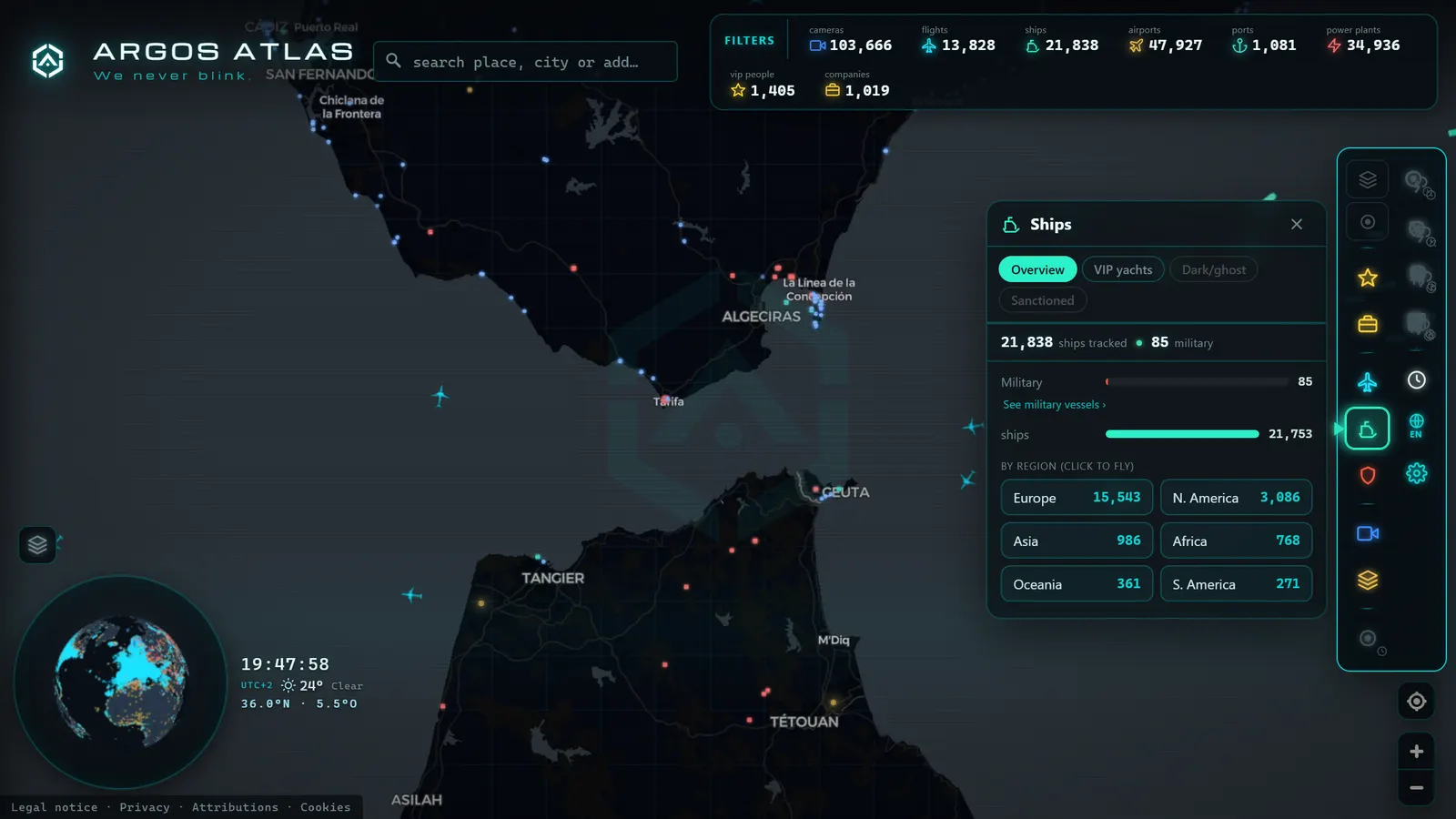
If you have ever looked at a live maritime map, you will have noticed something striking: outside the world's major ports there are clusters of completely stationary ships, sometimes dozens of them, arranged like a car park on the water. They are not broken down or lost. They are at anchor. Understanding what it means for a vessel to be at anchor (and why it waits where it does) is one of those small keys that turn a pretty map into a tool for reading global logistics. This article explains what anchoring means, why ships do it, how AIS declares the state, and what a packed anchorage can suggest (with appropriate caution) about the port behind it.
What anchoring actually means
To anchor is to lower the anchor and hold the vessel to the seabed, keeping the ship in position without engines or mooring lines. It cannot be done just anywhere. Ports and maritime authorities designate specific areas for it, called anchorages, chosen for adequate depth, suitable bottom type (one that holds an anchor well), and reasonable shelter from bad weather.
The anchorage lies outside the quay wall, typically in front of the harbour entrance or in a nearby roadstead. In practice it is the port's waiting room: vessels hold there before entering to complete formalities, await a berth assignment, or receive orders. One detail that surprises first-time observers: an anchored ship is not fixed to a single exact point. It pivots slowly around its anchor in response to wind and current, tracing an arc. This gentle circular drift, known as swinging at anchor, is the signature of a vessel properly anchored.
Why a ship anchors: the five standard reasons
The specific circumstances vary, but almost all cases fall into five categories.
Berth waiting. The most common reason. Quays are a finite resource: if a terminal is occupied, the vessel waits outside until a slot is allocated. Ports manage queues and berth windows, and the anchorage absorbs the gap between arriving ships and available space. Outside the Port of Singapore, Rotterdam, or the Port of Los Angeles you can observe this pattern at almost any hour.
Formalities and clearances. Before a ship can operate in a port it must complete customs declarations, health inspections, documentary checks for the cargo, and other administrative requirements. While paperwork is processed, the vessel waits at anchor.
Bunkering and provisions. Many ports offer refuelling (known as bunkering) directly in the anchorage, via bunker barges that come alongside the vessel. The waiting period is also used to take on stores, change crew members, or receive technicians for maintenance.
Adverse weather. When a storm builds, entering port or continuing a passage can be more dangerous than waiting. A sheltered anchorage is the logical place to ride out bad conditions. This is a routine precaution in exposed approaches such as the English Channel or the approaches to the Gulf of Mexico during hurricane season.
Charterer's orders. The least intuitive reason, and often the most commercially significant. In the bulk and crude oil trades, the party that has chartered a vessel sometimes prefers to keep it waiting: because cargo prices may improve, because the final destination has not yet been confirmed, or because demurrage costs less than a bad deal. The ship anchors where instructed. It is logistics, but it is also floating commercial strategy.
How AIS declares it: the navigational status field
This is the technical layer, and it is simpler than it sounds. Every AIS-equipped vessel broadcasts, alongside its position and speed, a field called navigational status: a standardised code that the crew configures to declare the ship's current condition. The standard values include:
- Under way using engine: the vessel is propelling itself.
- At anchor: held to the seabed by its anchor.
- Moored: secured to a berth, quay, or buoy with lines.
- Not under command: the vessel cannot manoeuvre due to an exceptional circumstance such as a mechanical failure.
- Other states including restricted manoeuvrability, aground, or engaged in fishing.
These fields are part of the international AIS standard (the same system that the IMO's SOLAS convention makes mandatory for vessels above a certain size and all passenger ships) and are verifiable in any technical documentation of the protocol. If you want to understand the full system, we cover it in detail in what AIS is and how it lets you see ships in real time.
An honest caveat: the status is set manually by the crew, and is sometimes not updated. It is not unusual to see a vessel moving at twelve knots that still declares itself "at anchor". A reliable reading therefore combines the declared status with observable evidence: speed over ground and position history.
From the ARGOS ATLAS channel.
What an anchored ship looks like on the map
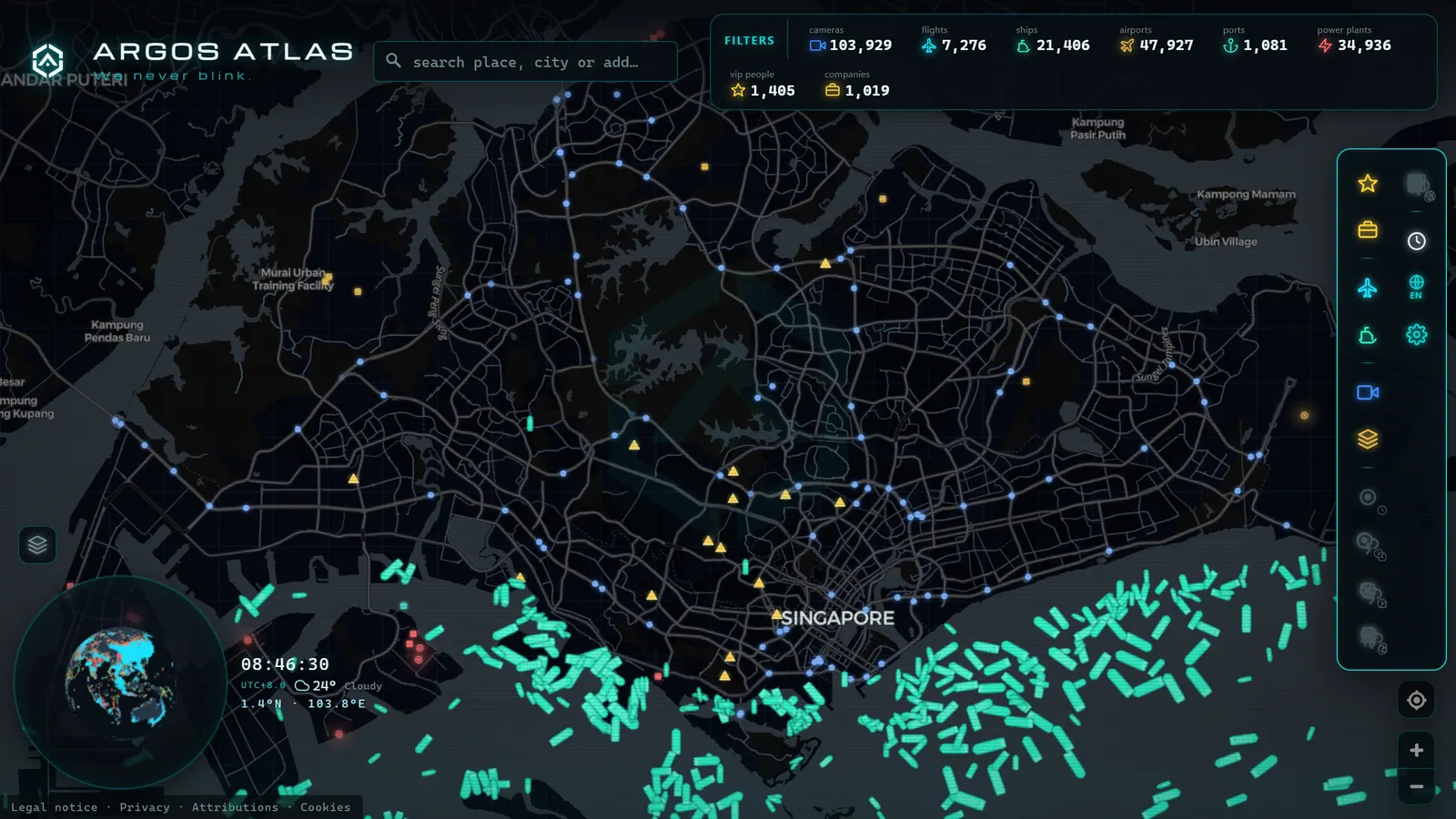
On a live viewer, anchoring has an unmistakable visual character. In front of the entrance to any major port you will see clusters of stationary points, spaced with a certain regularity (each vessel needs its own swinging room) and showing zero or near-zero speed. That is the anchorage performing its function as a waiting room.
The difference from moored vessels is also visible at a glance. Moored ships sit inside the port, pressed against the quay lines, often in neat rows alongside terminals. Anchored ships are outside, distributed across the roadstead, touching nothing. Two populations of stationary points, two different stories: some are already working, others are waiting their turn.
Looking at the entrance of a major port on the map is like looking at the door of a busy restaurant: the queue outside tells you as much as the tables inside.
With a little practice you can even detect swinging. If you return to the same anchorage a few hours later, the anchored points will have rotated slightly around their position, while the moored vessels remain fixed against the quay.
What a crowded anchorage can suggest
This is why logistics analysts pay close attention to anchorages: they are a visible symptom of a port's condition and, by extension, of the supply chain behind it.
An anchorage noticeably fuller than usual can point to several situations:
- High demand: more ships are arriving than the port can process, a signal of intense commercial activity.
- A strike or labour dispute slowing operations on the quays, as has occurred repeatedly at West Coast US ports and at Felixstowe in the UK.
- An operational incident: a terminal failure, a crane outage, maintenance work, or a restricted access channel.
- Weather, present or forecast, that has closed the port or made waiting the safer option.
Professional analysts observe exactly this (the accumulation of waiting vessels) as one indicator of a region's logistical pulse, in the same way that traffic through major maritime chokepoints is tracked, as we examine in straits and canals: the bottlenecks of world trade.
The important warning: a snapshot is not a diagnosis. Declaring a port congested requires comparing against its normal pattern, knowing its capacity, its seasonal rhythms, and local circumstances. A full anchorage on a Monday morning may be completely normal for that port; a half-empty one may conceal problems. As a casual observer, hold the question open (what might be happening there?) and resist the temptation of the quick answer.
At anchor, moored, adrift: the vocabulary you need
Three terms are enough to speak accurately about a stationary vessel's condition.
At anchor: held to the seabed by the ship's own anchor, in a designated area, outside the quay. The vessel retains autonomy: it can weigh anchor and leave whenever it is ready or authorised to do so.
Moored (also berthed): physically secured to a quay, jetty, or buoy with lines. This is the operational state par excellence: cargo is loaded and discharged here, and passengers embark and disembark.
Adrift: no propulsion and no restraint, at the mercy of wind and current. This can be voluntary and brief (a vessel that stops its engines offshore while awaiting orders, sometimes called controlled drifting) or the result of an emergency. In AIS terms, a mechanical failure preventing the vessel from steering is declared as "not under command".
With these three concepts clear, the next time you read a maritime news report or look at a map you will know exactly what is being described.
See it for yourself on the map
Theory is reinforced by observation. In Argos Atlas you can view vessels live using AIS positions from open sources, with their speed displayed and filtering available by vessel category and region, alongside a global port layer. The exercise is straightforward: open the map, centre it on a major port (Rotterdam, Singapore, Los Angeles, Houston) and look at the surrounding water. Identify the cluster of stationary points outside the harbour entrance (speed zero, at anchor) and compare them with the rows pressed against the quay walls inside, moored. Come back the next day and see whether the waiting room has grown or shrunk. If you then want to track one of those vessels from the moment it weighs anchor and moves into port, the step-by-step guide is in how to follow a ship live.
Frequently asked questions
Why are so many ships stopped outside a port?
Because the anchorage is the port's waiting room. Vessels wait there for a free berth, the completion of formalities and clearances, a bunker barge, an improvement in weather, or orders from their charterer. Quays are a limited resource and arrivals do not always align with available slots, so seeing ships stationary outside the harbour entrance is entirely normal at any major port in the world.
How long can a ship stay at anchor?
From a few hours to several weeks, depending on the reason. An ordinary berth wait typically resolves within hours or a couple of days. A bulk carrier or tanker awaiting commercial orders from its charterer may remain at anchor considerably longer, especially when market conditions favour waiting. Port authorities regulate anchorage use (assigning positions and sometimes charging fees) to prevent the waiting room from becoming an indefinite car park.
Are "at anchor" and "moored" the same thing?
No, and the distinction matters. At anchor means the vessel is held to the seabed by its own anchor, in a designated zone outside the port, waiting to enter. Moored (or berthed) means secured to a quay with lines, inside the port, where cargo operations take place. AIS distinguishes them with different navigational status codes, and on the map they are also visually distinct: anchored vessels form clusters in the roadstead; moored vessels line up alongside quays.
How can I tell from the map whether a ship is at anchor?
Combine three signals. First: speed practically zero, sustained over time. Second: position outside the port, typically grouped with other vessels in front of the harbour entrance, in the designated anchorage zone. Third: the navigational status the vessel itself broadcasts via AIS, which most map viewers display when you click on the ship. If all three align, it is a textbook anchorage. If speed and declared status contradict each other, trust the speed, the status is set manually and sometimes lags behind reality.
Conclusion
An anchored ship is far more than a stationary dot: it is a vessel waiting its turn in the choreography of port operations, and the collection of all of them (the anchorage) is one of the most visual indicators of a region's logistical pulse. Now that you understand what it means, why it happens, and how AIS declares it, there is only one step left: see it for yourself. Open the map, find a major port, locate its floating waiting room, and begin reading what it tells you. It is surprising how much you can learn by watching ships that are not moving.
Frequently asked questions
Why are so many ships stopped outside a port?
Most of them are at anchor waiting: for a berth to open, for customs clearance, for bunkering, for better weather, or for orders from the charterer. The anchorage works as the port's waiting room, so seeing ships idle outside the entrance channel is completely normal at any major port in the world.
How long can a ship remain at anchor?
Anywhere from a few hours to several weeks. It depends on the reason: waiting for a berth usually resolves in a day or two, whereas a bulk carrier or tanker waiting on commercial orders from its charterer may stay at anchor much longer, especially when market conditions favor patience. Port authorities regulate anchorage use, assigning positions and sometimes levying fees.
Are anchored and moored the same thing?
No. Anchored means the vessel is held in place by its own anchor on the seabed, typically outside the port. Moored means it is physically tied to a quay, jetty, or buoy with lines, inside the port, where loading and unloading takes place. These are two distinct states that AIS explicitly differentiates.
How can I tell from the map whether a ship is at anchor?
Combine three signals. First, near-zero speed maintained over time. Second, position outside the port, typically in a cluster with other vessels off the entrance channel, in the designated anchorage zone. Third, the navigational status the vessel itself broadcasts via AIS, which most live viewers display when you click on the vessel. If all three agree, it is a textbook anchor; if speed and status contradict each other, trust the speed, status is set manually and sometimes lags behind reality.
What does a very crowded anchorage indicate?
A noticeably fuller-than-usual anchorage can point to high cargo demand exceeding port capacity, a labor dispute slowing berth operations, an operational incident such as a terminal breakdown or crane failure, or severe weather closing the port temporarily. A single snapshot is not a diagnosis, compare against the port's normal pattern before drawing conclusions.
- Live Ships in the Caribbean Sea: Cruise Liners, Container Ships and Island Traffic
- Live Ships in the South Pacific: Routes Connecting Chile, Peru and Ecuador to Asia
- Live Ships in the Mediterranean Sea: Ferries, Cruise Liners and Container Ships
- Live Ships in the Strait of Malacca, the World's Busiest Shipping Lane
- Live Ships in the North Atlantic: Europe to North America Trade Routes
- Port of Santos Live: Sugar Terminals & Congestion Tracker