Blog · World webcams
How to Tell Whether a Webcam Is Official (and Why the Source Matters)
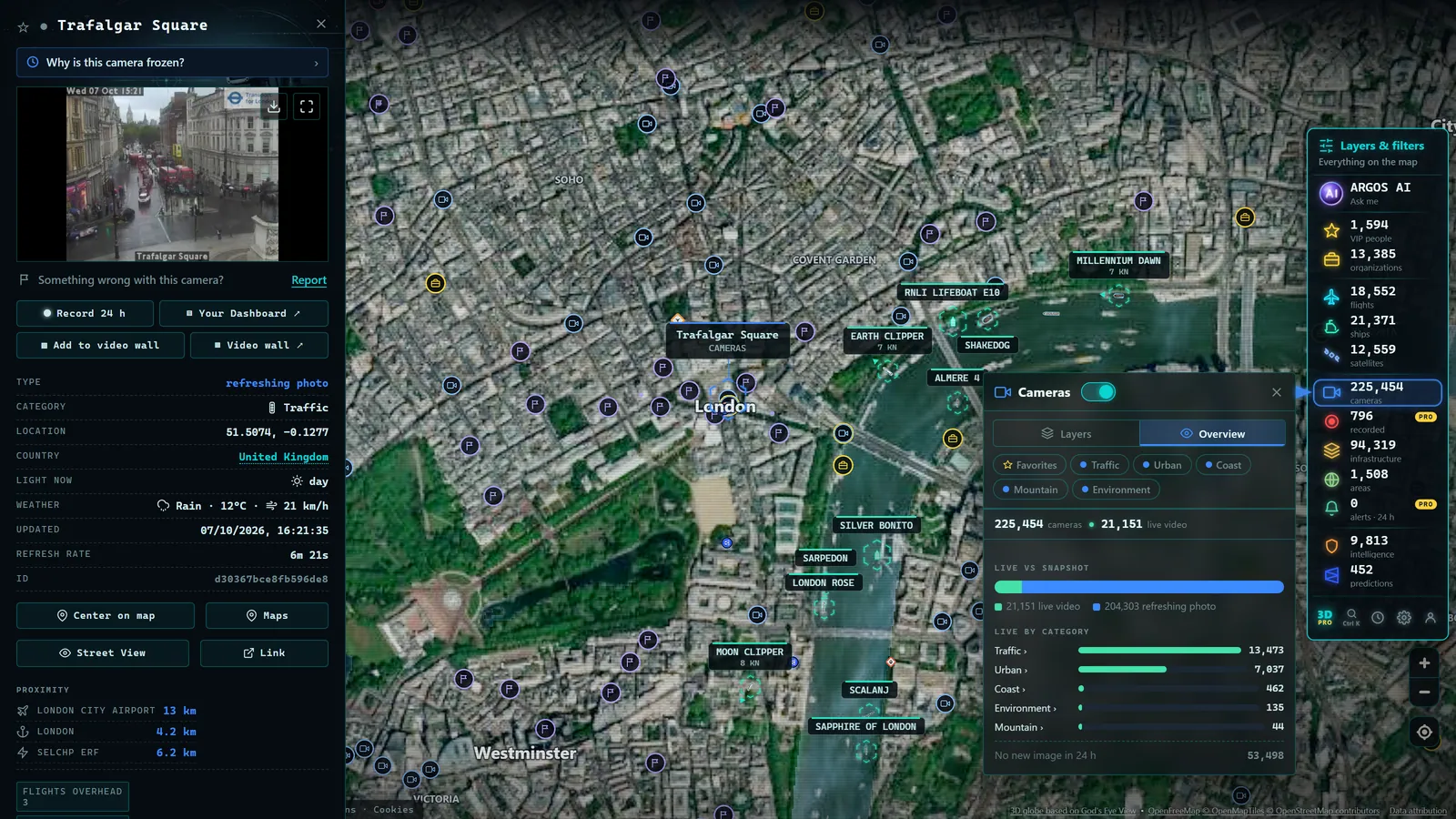
A live image is only as good as its source. You may be looking at a frame of a motorway covered in snow and have no idea whether a transport authority published it three minutes ago or whether it has been circulating since a storm two winters back. Official webcams (those published by public bodies on their own channels) resolve that problem at the root: they have an identifiable owner, a stated purpose, and a verifiable timestamp. Other cameras do not necessarily offer the same. This guide explains why the identity of the publisher matters so much, what signals mark a trustworthy source, and how to verify any live image you encounter in under a minute.
Why the source of a live image matters
When you look at a webcam, you are implicitly accepting three claims that depend entirely on who published it.
The honesty of the timestamp. An image described as "live" is only live if its time marker is accurate. Official sources either stamp the capture time directly on the image or attach it in the metadata, and their infrastructure guarantees the figure is real. An image republished by a third party may carry a timestamp that is old, cropped out, or simply fabricated, and you have no way to know without going back to the origin.
Continuity of the feed. Cameras operated by public authorities are part of stable, long-running services. If the camera covering a mountain pass in the Alps or a highway interchange in Texas has been published for years, there is every reason to expect it will still be there tomorrow. Third-party re-streams appear and disappear, change addresses, and die without notice. If you build a daily habit around a feed (checking road conditions every morning before you leave) you want to build it on something solid.
The legal basis for reuse. Images have owners, and what you can do with them depends on the conditions those owners set. With an identified official source you know who holds the rights, what uses are permitted, and who to credit. With an image that has no traceable origin, any reuse (in an article, a report, a social post) is a leap into legal uncertainty.
For casual use these guarantees may seem secondary. For any real decision (whether to set out on a road, whether to publish a piece of information, how to plan an operation) they are the difference between data and noise.
Signals that a webcam is official
You do not need to be a specialist to distinguish a reliable camera feed from a doubtful one. Four signals, taken together, give an almost reliable diagnosis.
Published on the authority's own domain
This is the strongest signal: the camera lives on the official website of the authority that operates it, or the image is served directly from its systems. The US Federal Highway Administration, the UK's National Highways, France's Bison Futé, and scores of transport departments worldwide all publish their road cameras on their own portals. When you encounter the same image on another site, the question is simply whether that site tells you where it comes from.
Clear attribution
Serious sources sign their work. The name of the operating authority appears alongside the image, and honest aggregators reproduce that attribution visibly. A complete absence of attribution (an image floating on a page with nobody claiming it) is the single most important warning sign.
Metadata that matches the location
An official camera comes with information that fits: the name of the road or site, a milepost or junction reference, the municipality, coordinates that correspond to what the image actually shows. If the label says "coastal highway" and the image shows a high-altitude mountain pass, something is wrong. Consistent metadata is difficult to fake in a sustained way, which is why its presence is reassuring and its absence is telling.
Stable update cadence
Official camera networks update on a regular schedule. Each source has its own rhythm (typically a few minutes) but it holds to that rhythm. A camera whose frame has been frozen for days with no explanation, or that updates erratically, points to an abandoned feed or a copy that has become disconnected from its original.
An official webcam answers three questions without effort: who publishes it, where it is, and when the image was taken. If any of those three remains in the air, you do not yet know what you are looking at.
To place these signals in the broader landscape of cameras that exist online, the guide on types of public cameras online explains the main families, who publishes each one, and where the line falls between genuinely public feeds and merely exposed ones.
The risks of re-streamed cameras with no attribution
The internet is full of sites that re-stream camera images from other sources without stating their origin. Many do so without malicious intent, but the result for you as a viewer is the same: you lose all capacity for independent verification. The problems that flow from this fall into three recurring patterns.
Temporal lag. The copy updates more slowly than the original, or stopped updating at some point without anyone noticing. You are watching the "live" view from hours or days ago: a road that is clear in the image may already be closed, a port shown as calm may already be closed to traffic. Lag is especially treacherous because the image loads perfectly, it only lies about when it was taken.
Mismatched locations and labels. As images are copied from one site to another, metadata is lost or corrupted. A camera ends up tagged with the name of a different city, road, or country. The image is real but it is not from where it claims to be, which for any serious use is worse than having no image at all.
Looping footage. The extreme case: feeds that replay an old sequence while presenting it as live. Without a verifiable timestamp or a cited source, a well-chosen loop (a view where nothing ever seems to happen) can pass undetected for a long time.
None of this means that everything outside an authority's own website is suspect. It means that without a stated origin you cannot distinguish a faithful copy from a broken one, and that uncertainty is incompatible with any use that actually matters.
From the ARGOS ATLAS channel.
The role of honest aggregators
Aggregators exist for a legitimate reason: official camera sources are scattered across hundreds of separate portals, and bringing them together on a single map is a genuine service, as explained in the guide on live webcams from around the world. The question is how aggregation is done, and three commitments separate the serious players from the rest.
Always cite the origin. Every camera must carry the name of the authority that publishes it, displayed visibly. Attribution is not a courtesy, it is what allows you to verify any image independently by going directly to the primary source.
Do not alter the image. Show the frame exactly as the source publishes it, without crops that change the context or any form of retouching. What you see in the aggregator should be what the authority publishes.
Maintain the link to the source. An honest aggregator does not trap your attention: it makes it easy to reach the origin, so the operating authority remains the authoritative reference.
This is the standard that Argos Atlas states in its methodology: every camera on the map comes from a deliberately open official source, is displayed with its attribution, retains only the most recently published frame (no image history) and a removal channel exists for rights holders. The full criteria are published on the sources and methodology page, because transparency about sources is only credible when it is itself made public.
The verifier's checklist: one minute, four questions
When you have a "live" image in front of you and need to decide whether to trust it, run through this list. No tools required, only attention.
- Who publishes it? Look for the attribution: the authority's name and a link to the origin. If the site does not say where the image comes from, you already have the first answer about its reliability.
- When was it last updated? Find the timestamp, either on the image itself or displayed alongside it. Compare it with the current local time at the camera's location, accounting for time zones. If there is no timestamp, treat the image as undated.
- Does the light match local time, and does the weather match the real forecast? If the location shows eleven o'clock at night but the image shows bright sunshine, or if official weather services report heavy rain while the camera shows clear skies, something is out of sync. Weather webcams are particularly useful for this cross-check, since they are designed precisely to document actual conditions at a specific place and time.
- Is there a cited source and can you reach it? The definitive test: find the camera on the authority's official channel and compare frames. If both match, the copy is faithful; if they diverge, you know which one to trust.
Four questions, one minute, and most doubtful images fail at the first or second step.
What to do with a suspicious camera
If a camera does not pass the checklist, a proportionate response has three levels.
Do not use it as the basis for decisions. Not for deciding whether to drive somewhere, not for citing in a piece of writing, not for drawing conclusions about conditions at a location. An unverified image is an anecdote, not a data point.
Find the primary source. It almost always exists. Identify the location, determine which authority manages that road, crossing, or monitoring station, and look for the camera on their official channels. If you find it, you have the reliable version; if no official camera exists for that location, the suspicious one deserves even less trust.
Report it if there is a channel to do so. Responsible aggregators maintain contact channels for exactly this purpose: if you spot a camera with incorrect metadata, a stale feed, or misleading information, reporting it helps keep the overall dataset clean. Maintaining a reliable camera map is a continuous process, and attentive users are a genuine part of it.
Frequently asked questions
How can I tell whether a webcam is official?
Verify at source. An official webcam is published on the domain of the authority that operates it, or clearly attributed to that authority wherever it appears. Supporting signals include metadata consistent with the location (road, junction, municipality), a visible timestamp, and a stable update cadence. If none of those signals are present and nobody signs the image, treat it as unverified.
Why does it matter who publishes the camera?
Because the source determines the three guarantees that make a live image useful: that the timestamp is accurate, that the feed will remain stable over time, and that reusing the image has a clear legal framework. An image with no known origin may be hours or days out of date, tagged with the wrong location, or looping on old footage, and you cannot detect any of that without consulting the primary source.
Are camera aggregators reliable?
The honest ones are, and they are recognisable by three commitments: they cite the originating authority for every camera, display the image without alteration, and maintain a link to the source so you can verify independently. This is the standard that Argos Atlas states in its public methodology. An aggregator that does not tell you where each image comes from is asking for blind faith, and blind faith is the opposite of what a live image should require.
What signs reveal a fake or out-of-date camera?
The most revealing: daylight that does not correspond to the local time at the location (midday sun when it is night there), weather that contradicts real conditions, a timestamp that is absent, cropped, or very old, scenes that repeat suspiciously, and a complete absence of attribution. A single signal is reason enough to cross-check against the official source; several together are grounds to discard the image.
Conclusion
In an internet where any image can be copied, relabelled, and re-streamed, the source is the only reliable anchor. Official webcams are worth what they are worth because there is an identifiable authority behind them, one that is accountable for the image, its timestamp, and its stated location. Everything else stands or falls on whether that origin is cited. Make the checklist a habit: who publishes it, when it was updated, whether the light is consistent, whether there is a cited source. And if you want to see how ARGOS ATLAS applies that same standard (with every camera attributed to its originating authority) you can open the map and judge the methodology for yourself.
Frequently asked questions
How can I tell whether a webcam is official?
Check at source. An official webcam is published on the domain of the authority that operates it, or clearly attributed to that authority wherever it appears. Supporting signals include metadata that matches the location (road name, milepost, municipality), a visible timestamp, and a stable update cadence. If nobody signs the image, treat it as unverified.
Why does it matter who publishes the camera?
Because the source determines the three guarantees that make a live image useful: whether the timestamp is honest, whether the feed will remain stable over time, and whether reusing the image has a clear legal basis. An image with no known origin may be hours out of date, tagged with the wrong location, or looping on old footage, and you have no way to detect any of that without going back to the primary source.
Are camera aggregators reliable?
The honest ones are, and you can recognise them by three commitments: they cite the originating authority for every camera, they display the image without altering it, and they maintain a link to the source so you can verify independently. An aggregator that does not tell you where each image comes from is asking for blind faith, which is the opposite of what a live image should require.
What signs reveal a fake or out-of-date camera?
The most telling: daylight that does not match local time at that location, weather that contradicts the real forecast, a missing or very old timestamp, scenes that repeat suspiciously, and a complete absence of attribution. Any one of those signals warrants cross-checking with the official source; several together are grounds to discard the image entirely.
- Live Webcams from Latin American Cities: Buenos Aires, Mexico City, Bogota, Lima and Santiago
- Live Webcams from European Cities: Paris, Rome, Berlin, Amsterdam, Vienna, Prague and Brussels
- Live Webcams from Caribbean Coasts: Cuba, Dominican Republic, Jamaica, Puerto Rico, Aruba and Barbados
- APRR Webcam Live: Every Camera, One Live Map
- Spain Eclipse Traffic Measures Aug 12: Path & Live Webcams
- Spain Beach Webcams: Watch the Coast Live Before You Go