Blog · Energy & grids
Why Blackouts Happen and How Power Grids Are Monitored 24/7
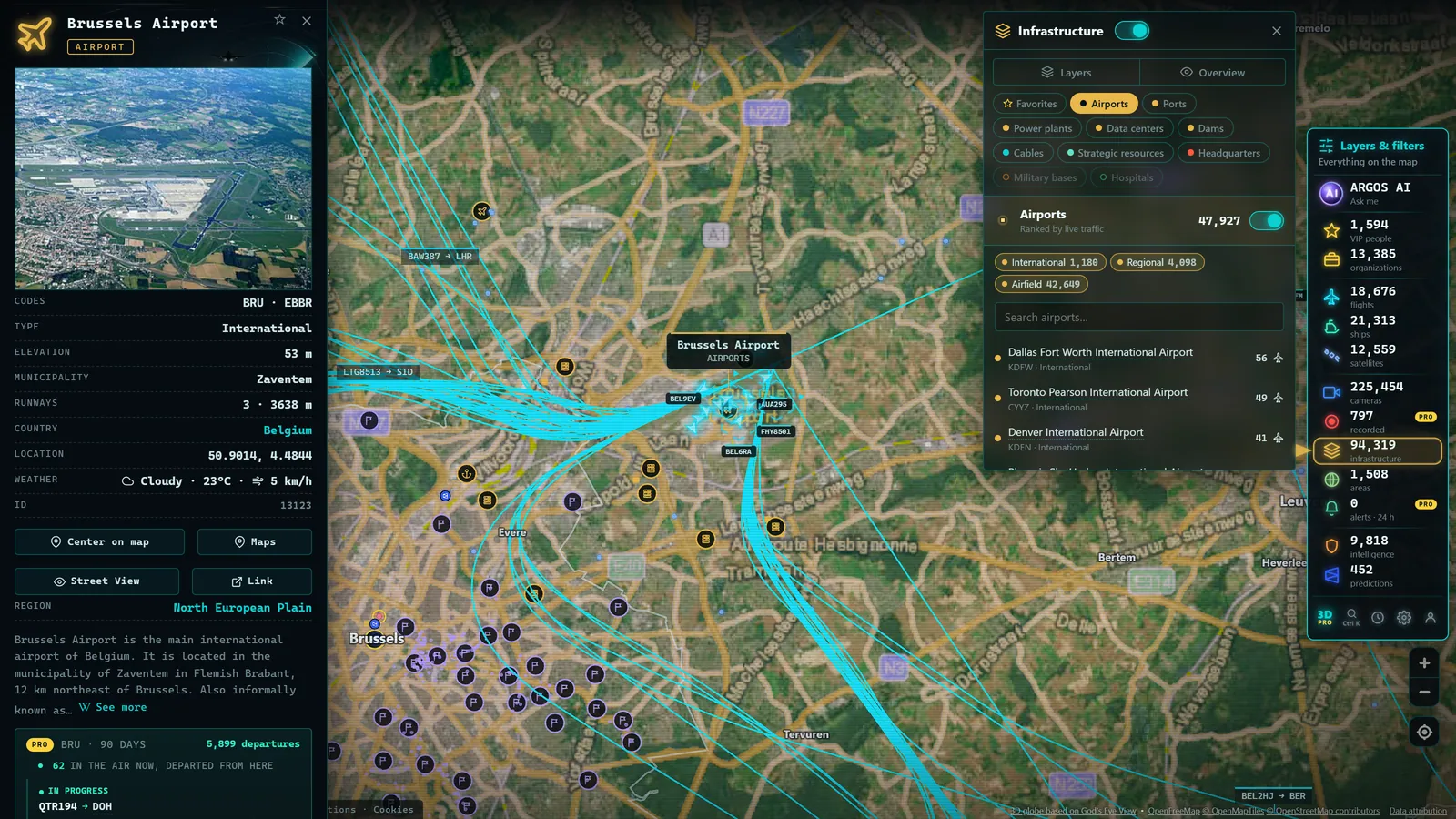
You flip a switch and the light comes on. It is so automatic that you only think about the power grid on the day it fails. Understanding why blackouts happen requires looking first at how that invisible system works: a continental machine that must remain in perfect balance every second of every day, monitored around the clock by control centers that rarely make the news. This article examines the causes of a blackout, what the major historical outages taught us, who watches the grid, and how an entire system is rebuilt after it goes dark.
The power grid is a real-time balancing act
Electricity has one characteristic that shapes everything else: at scale, it can barely be stored. What power plants generate right now is, with minor exceptions, what homes, factories, and trains are consuming right now. Generation and demand must match at every instant, and keeping that balance is the central task of any grid operator.
The thermometer of that balance is frequency. In North America the nominal frequency is 60 hertz; in Europe, 50 Hz. That is the heartbeat of the system. If consumption exceeds generation at any moment, frequency drops; if there is surplus generation, it rises. Normal deviations are tiny and are corrected automatically, with plants ramping up or down within seconds.
The problem comes when the deviation is large and fast. A sudden frequency drop triggers automatic protections that disconnect loads or generators to protect equipment. If the disturbance exceeds the system's ability to respond, those disconnections cascade and the grid can collapse. This is why a major blackout is almost never an isolated failure, it is an imbalance the system could not absorb in time.
What breaks the balance: the causes of a blackout
The causes of a blackout fall into a handful of families that recur across nearly every documented incident.
- Extreme weather. Wind and ice storms that bring down lines, lightning strikes, heat waves that spike cooling demand while reducing the efficiency of some plants. Overhead lines, running thousands of kilometers exposed to the elements, are the most vulnerable link.
- Cascade failures. The most feared mechanism. When an important line fails, the electricity it was carrying redistributes across adjacent lines. If any of those become overloaded, their protections trip them, which overloads the next ones further. A local fault can become a regional domino effect in minutes or even seconds.
- Sudden imbalances and operational errors. Incorrect switching, coordination failures between control centers, the abrupt loss of a large generation block or a major interconnection. Systems are designed to survive the loss of the single largest element in service, but improbable combinations of simultaneous faults do occur.
- Cyber incidents. Modern power grids depend on digital control and communication systems, and cybersecurity agencies have flagged the energy sector as a high-priority target for years. It is a growing risk that has driven significant investment in industrial control system protection.
Add to this list more mundane but frequent local causes: excavators cutting cables, animals in substations, vegetation touching a line. The difference between a neighborhood outage and a major blackout lies in whether the system manages to contain the disturbance or not.

Historic blackouts: lessons learned the hard way
Major blackouts function as involuntary audits of the system. Two well-documented cases illustrate the phenomenon clearly.
The 2003 Italian blackout left almost the entire country without power for hours. It began with faults on interconnection lines with neighboring countries and culminated in the Italian system separating from the rest of the European network, which it could not then sustain alone. That episode drove improvements in coordination between European operators and in emergency management protocols.
Closer to home for many readers, the 2003 Northeast blackout affected more than 55 million people across the northeastern United States and Canada, still one of the largest in North American history. Its root cause was a software bug in an alarm system combined with cascading line trips, a textbook example of how unrelated technical failures compound into a system-wide collapse.
The Iberian Peninsula blackout of April 2025 severely affected Spain and Portugal and became one of the most significant grid incidents in Europe in decades. As with any major blackout, the technical analysis is complex and properly belongs to the relevant authorities; what is beyond doubt is the fundamental lesson: a fully interconnected system can fall, and the orderly restoration of service is a process measured in hours, following well-rehearsed protocols.
Every major blackout delivers the same underlying lesson: the grid is robust against individual failures, but no system is invulnerable against extreme combinations of circumstances.
The one thing to avoid with these episodes is filling the knowledge gaps with speculation. While official investigations are ongoing, exact causes are the territory of hypotheses, and an informed reader distinguishes between what is confirmed and what is merely plausible.
Recorded straight off the map, no sound.
Who watches the grid: 24/7 control centers
Every country has a system operator responsible for maintaining real-time balance. In the United States, this function is divided among several regional transmission organizations (PJM, MISO, CAISO, ERCOT, and others) each monitoring frequency, line flows, plant status, and demand forecasts that are prepared days in advance and refined minute by minute. In the UK, National Grid ESO performs this role; across continental Europe, each national operator does the same and coordinates through ENTSO-E.
These centers do not work in isolation. Power networks are interconnected across borders, which in normal conditions is a huge advantage: if one system is short on generation it can import from neighbors, and the collective inertia of the continent dampens disturbances. The trade-off is that a serious disturbance can also propagate through those same interconnections, which is exactly why permanent coordination between operators matters so much.
Monitoring also begins long before real time: security analyses that simulate what would happen if each element of the network failed, next-day generation scheduling, planned maintenance of lines and substations. Many of the blackouts that never happen are prevented in that quiet, pre-operational phase. For a fuller picture of where the electricity those operators balance actually comes from, the article on types of power plants walks through the technologies that underpin the generation mix.
How a collapsed grid is rebuilt: the black-start process
Restoring service after a major blackout is not a matter of pressing a button. A grid that has fully collapsed is literally de-energized, and most power plants need external electricity to start their own auxiliary systems. The solution is the black-start capability: certain designated plants (typically hydroelectric units or specific gas turbines prepared for the purpose) can start themselves without support from the wider network.
From those plants, nearby sections of network are energized, forming small electrical islands: one plant, a set of lines, a carefully selected load base. Each island must maintain its own generation-demand balance, which requires reconnecting consumers progressively, zone by zone, rather than all at once. Then the islands are synchronized with each other and with international interconnections, which provide invaluable external support, until the complete system is restored.
This is a rehearsed and protocolized procedure, but a delicate one: a premature reconnection can re-destabilize the network and undo what has already been recovered. That is why, after a complete collapse, the lights come back neighborhood by neighborhood over hours, not minutes.
What a citizen can observe (and what they cannot)
Although grid operation is a professional domain, there is a layer of public information accessible to anyone. Grid operators typically publish real-time demand data and the generation mix on their websites, and many distribution companies maintain outage maps where you can check faults and restoration estimates for your area. During a local outage, those maps are the most direct way to find out whether the problem is limited to your street or affects a wider area.
There is also a curious observational detail. During a major blackout, the public traffic cameras in the affected zone go dark or drop off entirely, because they depend on the same grid as everything else. Anyone monitoring urban webcams during such an incident will see black frames or lost signals, an indirect footprint of the outage on visible infrastructure. This is a general observation about how the ecosystem of public cameras behaves, not a tool for monitoring outages. And to place the pieces of the power system on a map, you can explore the world energy map and its power plants, which helps visualize where each region's electricity comes from.
Practical home preparedness, without alarm
Civil defense agencies in many countries recommend keeping a basic kit on hand: a flashlight, a battery-powered radio, water, food that requires no refrigeration or cooking, charged power banks, and a small amount of cash. No further drama is needed, it is the same logic as carrying a spare tire. The 2025 Iberian blackout made clear that households with even minimal preparation handled the day with considerably more calm than those without.
Frequently asked questions
Why does an entire power grid go down?
Because the grid is an interconnected system where everything depends on everything else. A serious fault can overload neighboring lines and trigger protections in sequence, the cascade failure. If the disturbance pushes frequency beyond what automatic defenses can correct, the collapse can spread to entire regions within seconds. The very interconnectedness that normally provides robustness becomes the propagation path.
What is the balance between generation and demand?
It is the physical principle that governs the system: because electricity cannot be stored at scale, what is generated and what is consumed must match at every instant. The indicator of that balance is frequency, 60 Hz in North America, 50 Hz in Europe. When demand exceeds generation, frequency falls; when generation exceeds demand, it rises. Control centers correct these deviations continuously.
How is the grid restored after a major blackout?
Through progressive restoration. Plants with black-start capability (those that can energize themselves without an external grid) power up local electrical islands first. Those islands grow, reconnect loads zone by zone, and eventually synchronize with each other and with neighboring interconnections. The process is protocolized and rehearsed, but requires hours, because every step must maintain balance to avoid relapse.
Can blackouts be predicted?
Not with precision. Operators identify high-risk situations (storms, heat or cold waves, low available generation) and tighten margins and surveillance. But the specific trigger of a blackout is usually an improbable combination of failures that cannot be anticipated in detail. The realistic strategy is not perfect prediction but reducing the probability of collapse and accelerating recovery when it occurs.
Conclusion
Blackouts are not black magic, and almost never the fault of a single culpable party: they are the consequence of a system in permanent balance confronting a disturbance larger than it can absorb. Behind your light switch lies frequency monitored by the second, control centers awake at four in the morning, cross-border interconnections, and black-start protocols rehearsed for the worst possible day. The better you understand that machinery, the less room you will leave for misinformation the next time the lights go out. If you want to place all this infrastructure on a map, you can open the map and explore power plants worldwide with your own eyes.
Frequently asked questions
Why does an entire power grid go down?
Because the grid operates as an interconnected system in permanent balance. When a serious fault destabilizes frequency or overloads adjacent lines, automatic protections trip elements in sequence, and if the disturbance is large enough, the entire system can collapse within seconds.
What is the balance between generation and demand?
It is the fundamental rule of any power system: at every instant, the electricity being generated must equal the electricity being consumed, because the grid can store almost no energy at scale. That balance is reflected in frequency, 60 Hz in North America, 50 Hz in Europe. Any deviation must be corrected within seconds.
How is the grid restored after a major blackout?
Through a carefully sequenced restoration process: certain plants with black-start capability energize small local islands of the network, which gradually expand and synchronize with each other, supported by interconnections with neighboring regions. The process is delicate and can take many hours.
Can blackouts be predicted?
Not with precision. Grid operators identify high-risk conditions (heat waves, severe storms, low generation availability) and tighten margins and surveillance. But the specific trigger of a blackout is usually a combination of failures that is difficult to anticipate in detail. The realistic strategy is not perfect prediction but reducing the probability of collapse and accelerating recovery when it happens.
- Nuclear power plants around the world: where they are and how they are monitored
- How Long Do Power Outages Last in Puerto Rico? Causes & Management
- China Power Plants Map: What ARGOS Atlas Actually Shows
- Russia Power Plants Map: 545 Sites, Live Grid View
- Power Plants in the United States: What the Map Actually Shows
- Power plants in Italy map: 4 plants in a 34,936-site layer