Blog · Prediction markets
What Is Polymarket and How Does It Work: The Complete Guide

Every time there is a close election, a tense geopolitical summit or a World Cup final, the same name shows up in the headlines: Polymarket. If you are wondering what Polymarket is and why so many people quote its numbers as if they were real-time polls, here is the short version: it is the world's largest prediction market, a platform where thousands of people buy and sell positions on whether an event will happen, and where the resulting price works as a crowd-sourced probability estimate that updates by the second.
The long version is the one worth reading before you put in a single dollar. In this guide we cover how trading works, what it means that a winning share pays exactly $1, which market categories exist, how outcomes get decided and (the part most guides skip) what the data says about how many people actually make money.
What Polymarket actually is
Polymarket is a prediction market: a place where questions about the future ("will X win the election?", "will there be a ceasefire before the end of the month?") become tradable markets. It is not a bookmaker, even if it looks like one at first glance. Nobody sets the odds from a back office here: prices emerge from supply and demand among the users themselves, exactly like a stock price. If you want the full picture of that difference, we break it down in prediction markets vs bookmakers.
There is another defining trait: Polymarket runs on-chain, on the Polygon network, and trades are settled in USDC, a dollar-pegged stablecoin. That makes positions public and auditable, anyone can verify on the blockchain which wallets hold what. It is a level of transparency that traditional gambling simply does not have, and the reason analysts and journalists treat its prices as a live barometer of expectations.
How trading works: shares that pay $1
The mechanics are simpler than they sound. Each market asks a question with defined outcomes, usually YES or NO. You buy shares of the outcome you consider more likely, and every share trades between $0 and $1:
- If your outcome happens, each share you hold pays exactly $1.
- If it does not, your shares are worth $0.
- The share price is the event's implied probability: a YES share at $0.30 means the market gives it roughly a 30% chance.
- By construction, YES and NO in the same market add up to about $1.
A quick example: you buy 100 YES shares at $0.30, investing $30. If the event happens you collect $100; if it does not, you lose the $30. And here is the interesting part: you do not have to wait for resolution. Shares trade continuously, so if the price climbs to $0.55 you can sell and bank the gain, or cut the loss if it sinks. Reading those prices properly deserves its own article: see how to read prediction market odds.
Two practical notes on orders: you can buy "at market" (whatever the current price is) or with a limit order (you set your price and wait for someone to match it). Limit orders usually pay lower fees than market orders. The exact fee schedule has changed over time, so always check the official page before trading.
The market categories you will find
The catalog is huge and rotates weekly, but the big blocks are stable:
- Politics and elections: the flagship category, from presidential races to no-confidence votes.
- Geopolitics: conflicts, sanctions, summits, international agreements.
- Sports: booming right now; the 2026 World Cup in the United States, Mexico and Canada is decided this summer and moves hundreds of millions of dollars in volume.
- Crypto and the economy: asset prices, central bank decisions, macro data.
- Science, weather and culture: space launches, hurricanes, releases, awards.
The practical rule: start with a topic you already follow on your own. Whatever edge you might have lives where you already have judgment.
Recorded straight off the map, no sound.
How markets get resolved
Every market ships with written resolution rules defining exactly what counts as YES and which source will be used to verify it. When the time comes, resolution relies on the UMA oracle, a decentralized system where the proposed outcome goes through a dispute window: if someone believes the proposed result is wrong, they can challenge it before it becomes final.
The operational lesson for you is simple: read the rules before you buy. Most nasty surprises in prediction markets do not come from the event itself but from the fine print, what happens if the event is postponed, which source wins if data conflicts, where exactly the date cutoff sits.
The risks, with no sugar-coating
This is where many guides switch into sales mode. We prefer data: a 2026 on-chain analysis estimated that only around 7-8% of Polymarket wallets are profitable. Blockchain transparency makes it measurable, and the result is humbling, the large majority of participants lose money.
Add the structural risks on top:
- Full position risk: if your outcome does not happen, those shares are worth zero.
- Volatility: prices move with every headline, and they move hard.
- Resolution risk: ambiguous wording can resolve against you even when you were "right".
- Legal availability: it varies by jurisdiction and has changed over time; check the official terms and your local rules.
None of this means prediction markets are not worth understanding. It means you should treat them as what they are: speculation with real risk, not an income plan.
From the price to the map: geolocated predictions
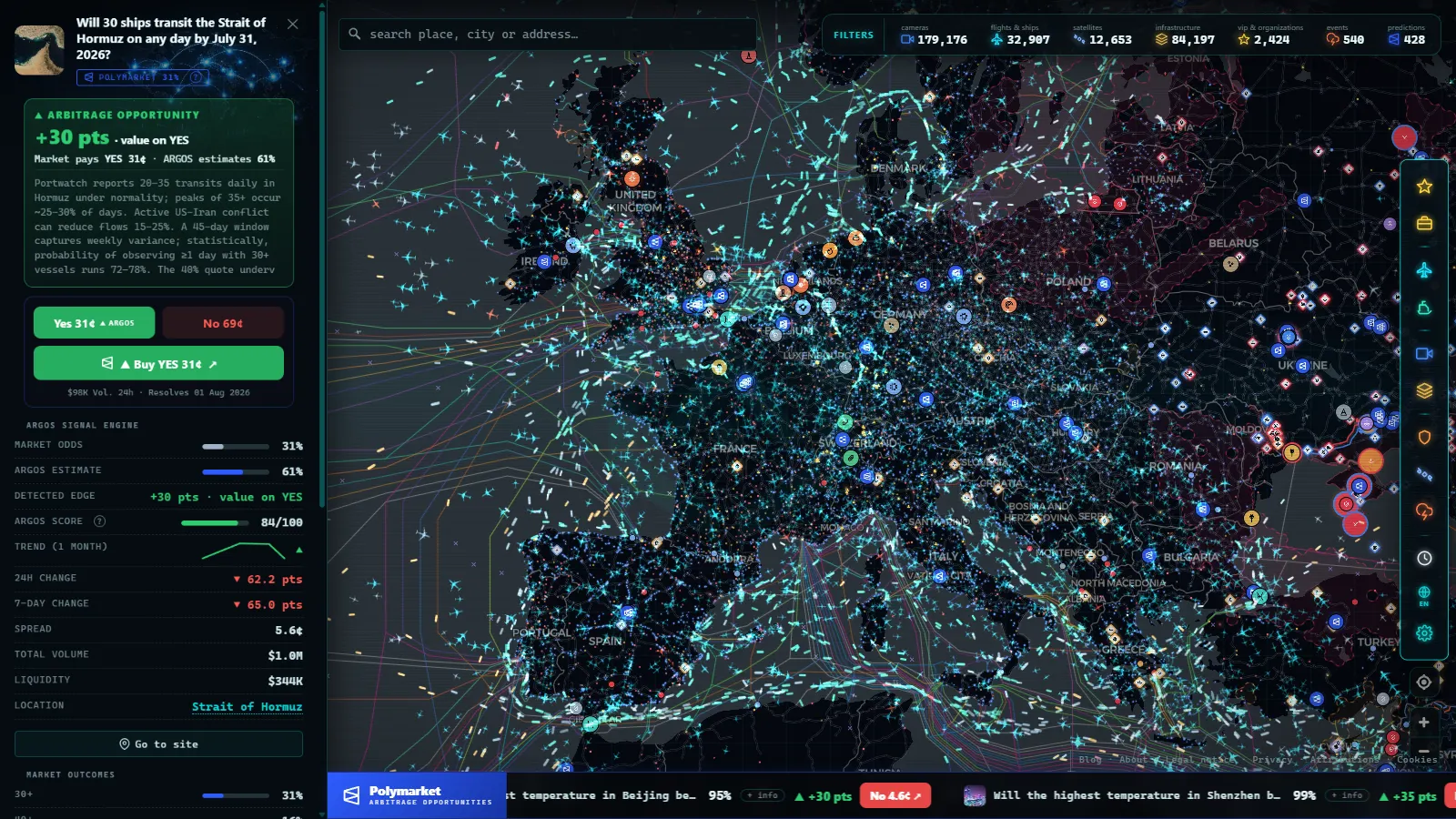
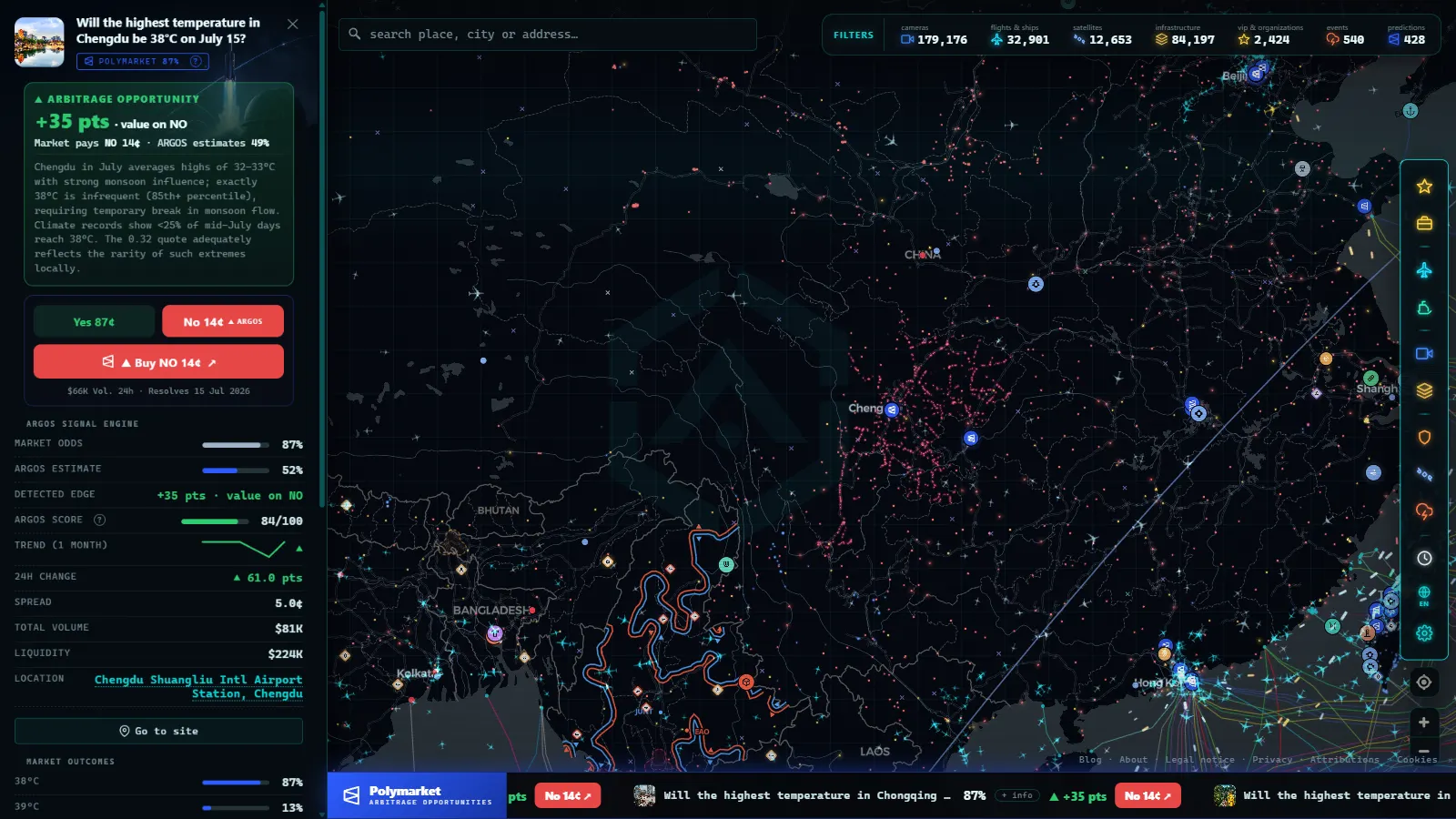
Prediction markets have one property almost nobody exploits: geography. A market about a ceasefire, an election or a hurricane is about a specific place on the planet. That is why the geolocated predictions on Argos Atlas plot Polymarket markets at the exact location of the underlying event, next to the map's other intelligence layers (flights, ships, cameras, events). Each market also carries our own signal, ARGOS, which compares the current market price against an independent estimate of the event, a fast way to spot where the price and the context are telling different stories.
If after all this you want to see it from the inside, you can create a Polymarket account and start by watching small markets before trading; the step-by-step walkthrough is in our guide to getting started on Polymarket. Go slow, keep the stakes small, and treat every trade as a cheap lesson.
This content is informational and does not constitute financial advice or an investment recommendation.
Frequently asked questions
Is Polymarket a betting site?
No. It is an exchange: you trade against other users at market prices, not against a house that sets odds with a built-in margin. You can also sell your position at any time before resolution, just like in a financial market.
How much money do I need to start?
Each share trades between $0 and $1, so technically you can start with very small amounts. The rule that matters is not the minimum but the maximum: only use money you can afford to lose entirely, because a position can go to zero.
Can I sell before a market resolves?
Yes. Shares trade continuously, so you can close your position whenever you want at the current market price, either to lock in a profit or to cut a loss before the outcome becomes final.
Is Polymarket legal in my country?
Availability varies by jurisdiction and has changed over time. Before signing up, check the platform's official terms and the local rules that apply to you.
- How to Deposit Money on Polymarket: USDC, Cards and Options
- Is Polymarket Legal? Availability and Regulation by Country
- Is Polymarket Safe? Security, Custody and On-Chain Transparency
- Polymarket Fees: What Trading Really Costs
- How to Withdraw Your Polymarket Winnings
- How to Use Polymarket Without Knowing Anything About Crypto