Blog · Prediction markets
How to Read Prediction Market Odds (Implied Probability)

A prediction market does not give you opinions: it gives you a number. A YES share at $0.42 is the market telling you "this has a 42% chance of happening, according to the money on the table right now." Learning to read that number (and knowing when to distrust it) is the most fundamental and most profitable skill in this entire space. It is called implied probability, and it is far easier to master than the name suggests.
In this article you will learn to translate prices into probabilities, understand why YES and NO in a market add up to roughly $1, compare these odds with a traditional bookmaker's, and avoid the classic mistake of confusing probability with certainty.
The price is the probability
On platforms like Polymarket, each outcome trades as a share priced between $0 and $1, and every winning share pays exactly $1 at resolution. That mechanic produces the golden rule:
- Share at $0.10 → implied probability of 10%
- Share at $0.42 → implied probability of 42%
- Share at $0.95 → implied probability of 95%
There is no formula to memorize: the price in cents is the percentage. That elegance is one of the big advantages prediction markets hold over traditional odds formats. If you are not yet clear on how the platform works under the hood, start with what is Polymarket and how does it work and come back, this article will be twice as useful.
The reverse reading matters too: the price tells you how much you pay for each potential dollar. Buying at $0.42 means risking 42 cents to win 58 if you are right. The cheaper the share, the bigger the payout if it happens, and the lower the chance that it does. There are no free bargains, only probabilities.
Why YES and NO add up to (almost) $1
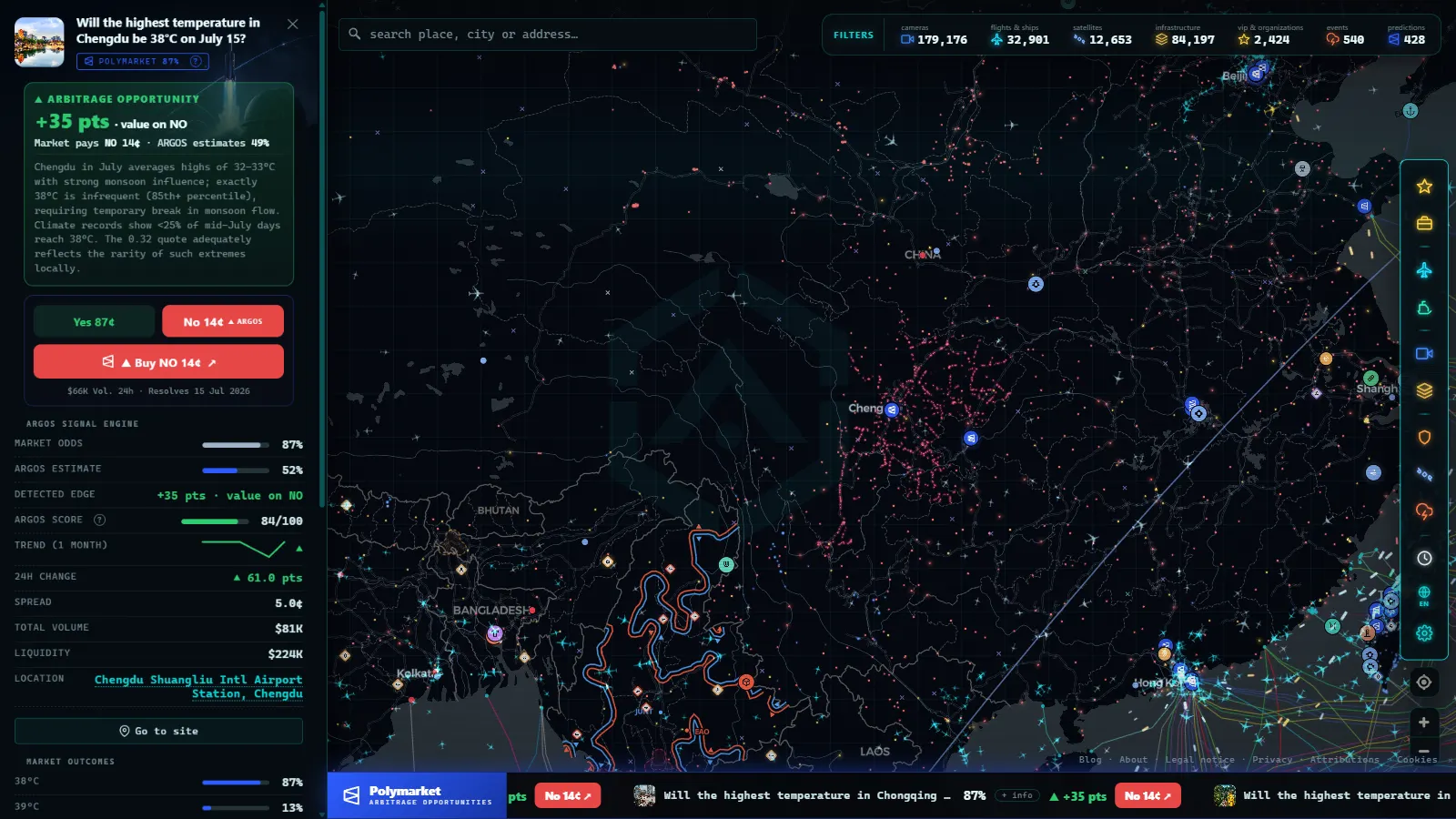
Since there are only two possible outcomes and the winner pays $1, the YES price and the NO price in the same market add up to roughly $1: if YES trades at $0.42, NO will sit near $0.58. When the sum drifts away from that, you are looking at the spread: the gap between what sellers ask and buyers offer in each order book.
That little gap is useful information on its own:
- Sum very close to $1 → liquid market, sharp prices, easy to get in and out.
- Noticeable gap → thin liquidity; the price you see can move against you just from executing your order.
In an illiquid market, implied probability is more noise than signal. Before taking a price seriously, check how much volume sits behind it.
Compare with a bookmaker: the margin shows up
This is where implied probability becomes a Swiss army knife. Traditional decimal odds convert to probability by dividing 1 by the odds: odds of 2.00 imply 50%; odds of 4.00 imply 25%. Run that exercise across every outcome of a match at a bookmaker and you will find something curious: the probabilities add up to more than 100%. That excess is the house margin, cooked directly into the odds.
On an exchange like Polymarket that fixed margin does not exist: prices come from matching orders between users, and YES plus NO adds up to practically $1 (100%). We analyze the full structural difference in prediction markets vs bookmakers, but for reading odds you only need this: whenever you compare prices across platforms, convert everything to implied probability first. It is the only common language.
One operational nuance: trading has costs on an exchange too. Limit orders usually pay lower fees than market orders, and fee schedules have changed over time, check the official page before trading seriously.
Recorded straight off the map, no sound.
Probability is not certainty (and this is where money dies)
The number one beginner mistake: seeing a share at $0.90 and thinking "this is a lock." A 90% implied probability means that, if the market is well calibrated, one in ten events like this does not happen. Buying "sure things" at $0.90-0.95 also carries brutal math: you win pennies when right and lose almost everything when wrong.
The right question is never "will it happen?" but "is my estimate better than the market's?". If you believe an event has a 60% chance and the share trades at $0.42, there is a discrepancy worth exploiting; if it trades at $0.65, there is nothing to do even if the event feels likely to you. That framework (comparing your probability against the implied one) is the foundation of expected value, and we develop it in expected value in betting and predictions.
Where to read odds with context
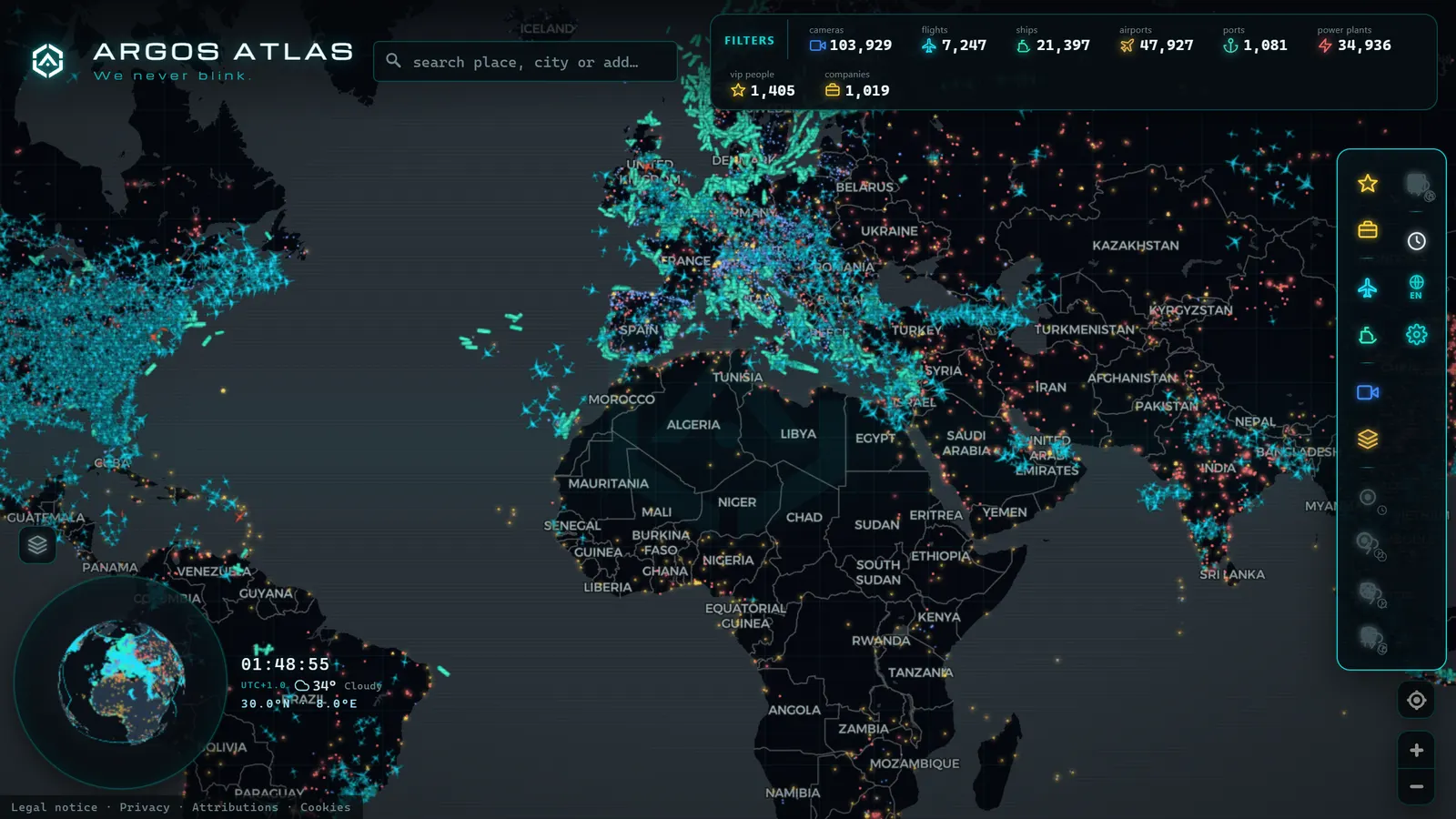
An isolated price is a number floating in a vacuum. The same price next to the event's context is an analysis tool. On the geolocated predictions of Argos Atlas we plot Polymarket markets at the exact point on the map where each event unfolds (the country holding elections, the conflict zone, the hurricane's path) alongside the rest of the real-time intelligence layers. Each market also carries our own signal, ARGOS, which compares the market price against an independent estimate of the event: when the two diverge, you are looking at exactly the kind of discrepancy we just described.
If you want to practice reading with real money on the line, you can browse the markets on Polymarket and start by watching how prices react to news before touching anything. Reading odds is learned by watching; paying too much for them also teaches, but it is the worse method.
This content is informational and does not constitute financial advice or an investment recommendation.
Frequently asked questions
What does it mean when a share costs $0.70?
It means the market estimates roughly a 70% chance the event happens. If you are right, each share pays exactly $1, so you make $0.30 per share; if you are wrong, you lose the $0.70 you paid.
Why don't YES and NO add up to exactly $1?
Because each side has its own order book, and there is a small gap (the spread) between what buyers offer and sellers ask. In liquid markets the sum sits very close to $1; in thinly traded markets the gap can widen.
Does a 90% implied probability mean it will happen?
No. It means that, if the market is well calibrated, events like that one fail about one time in ten. A 90% event not happening does not prove the market was wrong, it proves the 10% exists too.
How do I compare Polymarket prices with bookmaker odds?
Convert the bookmaker's decimal odds into probability (1 divided by the odds) and compare with the share price. Keep in mind a bookmaker's probabilities add up to more than 100% because their margin is baked in.
- Prediction Markets vs Bookmakers: No Fixed Margin
- How to Get Started on Polymarket, Step by Step (2026 Guide)
- How to Deposit Money on Polymarket: USDC, Cards and Options
- Is Polymarket Legal? Availability and Regulation by Country
- Is Polymarket Safe? Security, Custody and On-Chain Transparency
- Polymarket Fees: What Trading Really Costs