Blog · Prediction markets
How to Withdraw Your Polymarket Winnings

You called it. The market resolved in your favor, or your position gained enough, and now you want the part that matters: turning those shares into actual money in your bank account. A Polymarket withdrawal is not complicated, but it crosses two worlds (the platform and the traditional banking system) with a stopover in crypto territory, and that stopover is exactly where you should not improvise.
This guide walks the full route in its generic, prudent version: from shares to USDC, from USDC off the platform, and from USDC to your currency at the bank. No screenshots that expire, no menus that move around, just the logic of the process, which is the part that stays stable, plus the precautions that prevent expensive mistakes.
First: turn your positions into USDC
Before withdrawing anything, your money needs to be in USDC, the stablecoin Polymarket runs on. There are two ways to get there from an open position:
- Redeem winning shares. If the market has already resolved your way, every winning share redeems for exactly $1. That is the founding arithmetic of the system: you bought at $0.40, you were right, you collect $1 per share. Shares on the losing side are worth 0.
- Sell before resolution. You do not have to wait for the outcome: you can sell your shares at the market price at any time and keep the USDC. You collect the current price instead of the full dollar, a trade of potential profit for liquidity that we analyze in selling before resolution.
Either way, the result is the same: a USDC balance ready to leave the platform.
Moving USDC off Polymarket
Polymarket operates on-chain, on the Polygon blockchain, and withdrawing means sending your USDC from your account on the platform to an external address you control: your own wallet, or your account at an exchange. On-screen details may change as the product evolves, so the official documentation is always the reference; what does not change is the key decision you make here: where you send it.
- To your own wallet: you keep direct control of the funds. Makes sense if you plan to trade again or prefer self-custody.
- To an exchange: the logical stopover if your goal is converting to your currency as soon as possible, because that is where conversion happens.
And crypto's precaution number one, which we will repeat because it is worth its weight in gold: confirm that the network you send on and the network the recipient accepts are the same. Sending USDC over the wrong network can mean losing the funds, and blockchains have no undo button.

From USDC to your bank: the exchange's role
USDC is a digital dollar, but your landlord still wants your local currency. The usual bridge is a crypto exchange operating legally in your country with a USDC pair against your currency, or an equivalent route. The generic sequence:
- Send your USDC to the exchange, to the deposit address it gives you (checking the network, once again).
- Sell the USDC for your currency inside the exchange, at the going rate.
- Withdraw to your bank account, usually via bank transfer.
Every exchange has its own fees, timelines and identity verification (KYC) process, which is mandatory at regulated venues and worth completing before you need it in a hurry. If you do not have an exchange yet, choosing one calmly (conversion and bank-withdrawal fees included) is part of the job. The reverse journey, by the way, is nearly symmetrical: it is covered in how to deposit money on Polymarket.
On timing, set a realistic expectation: each leg moves at its own pace. Blockchain transfers tend to confirm quickly, while the final bank transfer depends on your exchange and your bank, and can take longer over weekends or holidays. If you need the money by a specific date, start the process with room to spare: haste is a terrible advisor at exactly the step where mistakes are irreversible.
Recorded straight off the map, no sound.
Common mistakes that cost real money
The shortlist of what causes the most grief, so it does not happen to you:
- Mixing up the sending network. The classic. Verify origin and destination networks before confirming anything.
- Skipping the test transfer. For meaningful amounts, send a small amount first and confirm it arrives. The extra cost is trivial; the insurance is total.
- Miscopying the address. Always copy-paste and check the first and last characters. Never type an address by hand.
- Forgetting the accumulated tolls. Network, conversion and bank withdrawal add up. On small withdrawals, do the math first.
- Ignoring taxes. Converting winnings into your currency generally has tax consequences wherever you are tax-resident. Keep a record of your trades from day one.
Plan the exit before the entrance
One habit that marks the organized trader: knowing how you will get out before you get in. Understanding the full route (shares → USDC → exchange → bank) lets you size positions with a cool head instead of discovering the friction when your money is already stuck halfway.
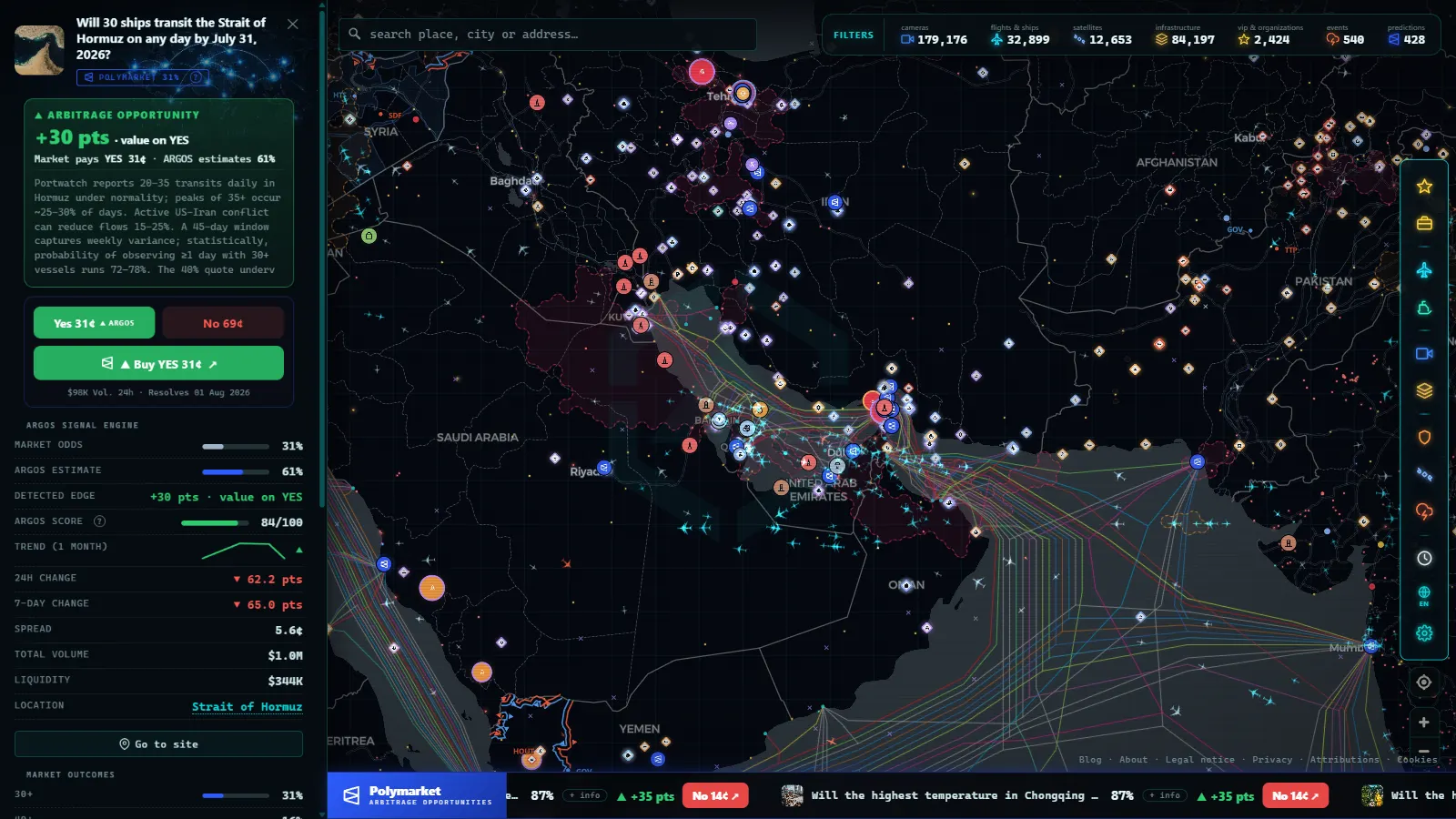
The other half of being organized is entering well. The geolocated predictions on Argos Atlas show Polymarket markets on the exact spot of the event they refer to, with the ARGOS signal comparing the market's odds against an independent estimate: context for deciding before you open your position on Polymarket, which is where what you will later withdraw is actually won or lost.
This content is informational and does not constitute financial advice or an investment recommendation.
Frequently asked questions
How much is each winning share worth when I cash out?
Exactly $1 in USDC. That is the central rule of this kind of prediction market: shares of the winning outcome redeem for $1 each, and shares of the losing side are worth 0. What you bought at $0.60 and got right pays out $1.
Can I withdraw without waiting for the market to resolve?
Yes: you can sell your shares at the current market price at any time and withdraw the resulting USDC. You collect today's price rather than $1, trading part of the potential profit for immediate liquidity.
How do I turn USDC into my local currency?
The usual route goes through a crypto exchange licensed in your country: you send your USDC there, sell it for your currency and withdraw to your bank account. Each exchange has its own fees and timelines, and will require identity verification.
What is the most dangerous part of withdrawing?
Getting the network or the address wrong when moving your USDC: blockchain transfers have no undo button. That is why the universal practice is to confirm the sending and receiving networks match and to test with a small amount first.
- How to Use Polymarket Without Knowing Anything About Crypto
- Prediction Markets Glossary: 25 Terms You Need to Know
- Who Decides the Outcome: How Polymarket Markets Resolve
- Prediction Markets: What They Are and Why They Keep Getting It Right
- Election Markets: How Political Futures Are Traded
- How to Make Money on Polymarket: What Actually Works (and What Doesn't)