Blog · Prediction markets
How to Use Polymarket Without Knowing Anything About Crypto

Let's be honest about the entry barrier: plenty of people who would understand prediction markets perfectly well never try them because the word "crypto" sounds like jargon, scams and red-and-green candlestick charts. If that is you, this article is yours. Using Polymarket without knowing anything about crypto is not just possible, it is the norm. Polymarket's crypto layer is plumbing: necessary, invisible most of the time, and fully graspable in two concepts that fit in two paragraphs.
We will explain those two concepts in plain language, separate what you genuinely need from what you can cheerfully ignore, and leave you with one central idea: the hard work on Polymarket is not the crypto, it is getting predictions right.
Wallet and USDC: the only two concepts you need
A wallet is your own digital money account. The difference from your bank account is who controls it: at the bank, your identity and their branches; in a wallet, a cryptographic key. Think of it as a purse that only your key opens. That has an upside (nobody can touch it without the key) and a responsibility: if you manage the key yourself and lose it, there is no counter to complain at. The good news is that you no longer have to be your own bank the hard way: there are wallets that create themselves during platform signup and manage the key for you, with an experience like any ordinary app. We compare the options, from simplest to most self-reliant, in wallets for Polymarket.
USDC is a digital dollar. Yes, it is technically a cryptocurrency, but from the boring branch of the family: a stablecoin, designed to always be worth one dollar. No rollercoasters: 100 USDC is, for practical purposes, 100 dollars. Polymarket uses USDC precisely for that reason, so you can trade on the probabilities of real-world events without your balance dancing to the crypto market's tune. The full why is in what USDC is and why Polymarket uses it.
That's it. That is the entire mandatory crypto syllabus: a purse with a key, and a digital dollar.
What you actually need to start
The honest list is short:
- A Polymarket account. Signup is built with newcomers in mind: you can create a Polymarket account with zero prior crypto, and the wallet can be generated as part of the process.
- Some USDC. You will need to convert your money into USDC through one of the routes available in your country. Start small: an amount you could lose entirely without it hurting.
- Judgment about some topic. The requirement nobody mentions. Elections, geopolitics, weather, sports: your edge, if you have one, will come from understanding a subject better than average, not from mastering blockchains.
Notice what is not on the list: no trading courses, no special hardware, no programming knowledge.
What you can ignore without guilt
So the jargon stops intimidating you, here is what you do not need:
- Bitcoin, Ethereum and the whole crypto zoo. You will trade only in USDC. Other coins' volatility is not your problem.
- Mining, staking, DeFi, NFTs. Vocabulary from other corners of the crypto world. None of it applies here.
- Technical chart analysis. In a prediction market, the price is a probability about a real event; your tool is information about that event, not candlestick patterns.
- Knowing how a blockchain works inside. Just as you don't know how SWIFT settles your bank transfers, and you live just fine.
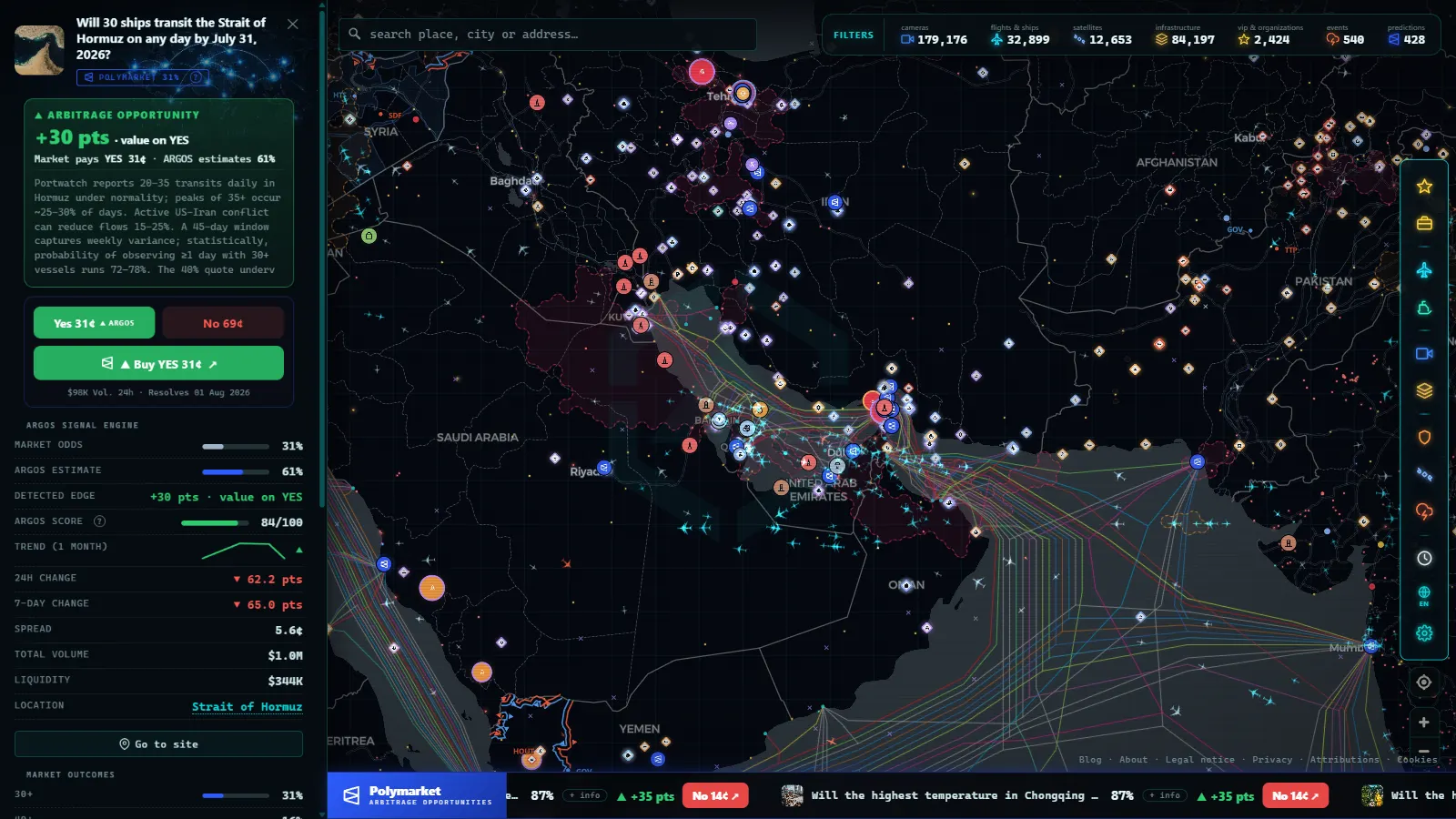
Recorded straight off the map, no sound.
Your first market, understood in one minute
Polymarket's mechanics are simpler than a bookmaker's. Every market asks a question with defined outcomes ("will X happen?"), and each outcome has shares trading between $0 and $1. That price is the probability the market assigns: if YES trades at $0.70, the market is saying "70%". When the market resolves, every share of the winning outcome pays exactly $1 and the losing side's shares are worth 0. Buy YES at $0.70 and be right, and you make $0.30 per share; be wrong and you lose it all.
Two more properties round out the picture. YES and NO prices add up to roughly $1, which keeps the math intuitive: a 70% YES implies a 30% NO. And you are never locked in: unlike a bet slip, you can sell your shares at the market price at any time, taking a profit or cutting a loss before the outcome is even known.
And the obligatory warning, because honesty is the house style: being right is hard. On-chain analysis from 2026 indicates that only around 7-8% of wallets are profitable. Start small, treat your first trades as tuition, and distrust anyone selling this as easy money.
Where to look before your first trade
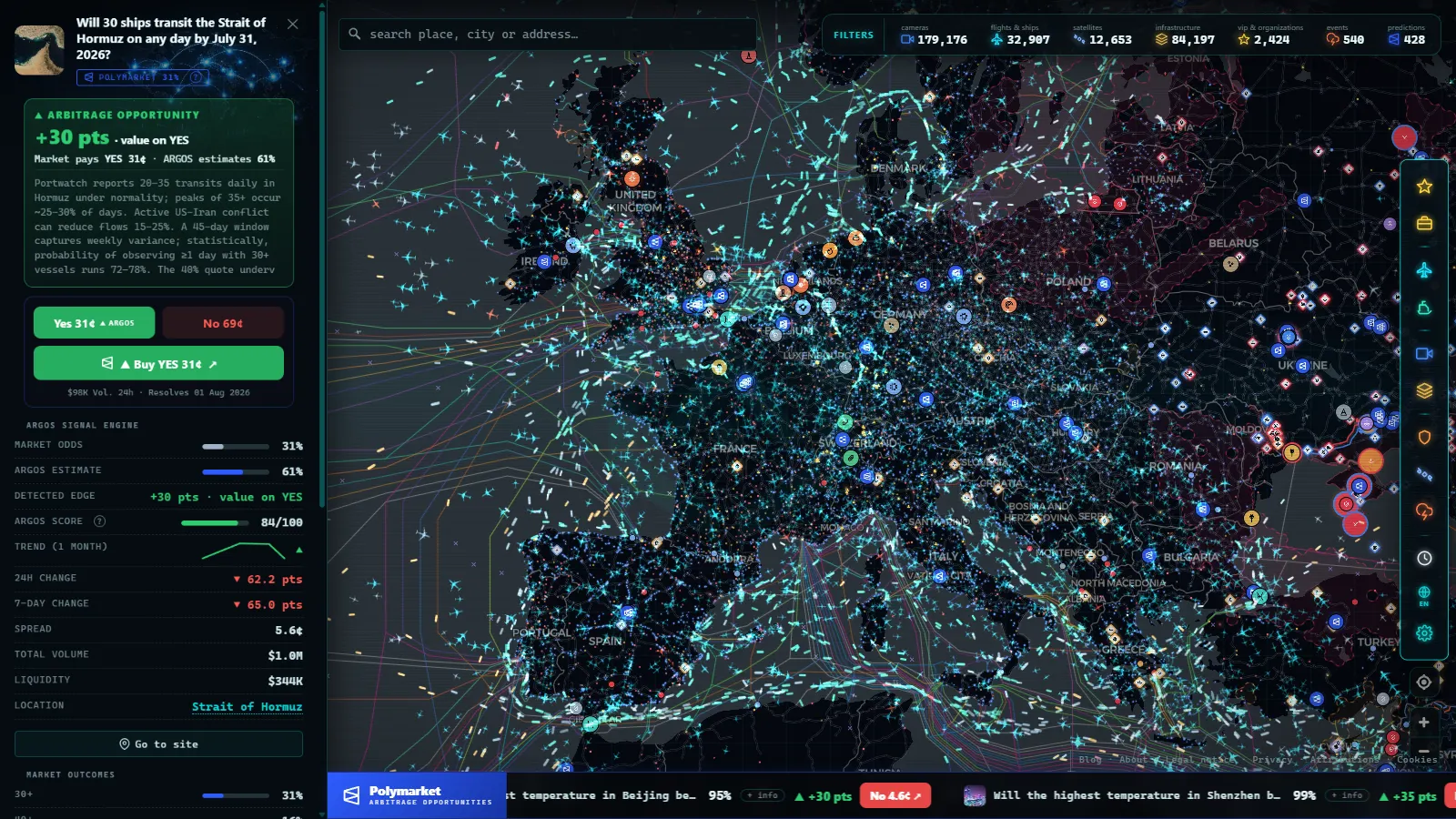
The best habit you can build from day one is cross-checking before trading. The geolocated predictions on Argos Atlas place Polymarket markets on the exact spot on the planet they refer to (the election, the conflict, the storm) alongside the ARGOS signal, which compares the market's odds against an independent estimate. Seeing a prediction in its geographic context, surrounded by the cameras, flights and ships of the area, is a very different (and very much our) way of understanding what is being priced.
The takeaway in one line: crypto is the small toll; judgment is the work. If the two paragraphs on wallets and USDC made sense, you already know all the cryptography this game demands.
This content is informational and does not constitute financial advice or an investment recommendation.
Frequently asked questions
Do I need to buy Bitcoin or Ethereum to use Polymarket?
No. Polymarket runs on USDC, a stablecoin designed to be worth one dollar. You never need exposure to Bitcoin's volatility or any other cryptocurrency: your balance behaves like digital dollars.
What is a wallet, in one sentence?
Your own digital money account, controlled by a key instead of an ID at a branch office. It is where your USDC lives and what you trade with; there are now options that create and manage it for you without you touching anything technical.
Can the crypto part lose me money even if my predictions are right?
Crypto risk exists but stays contained if you act with basic prudence: the expensive mistakes almost always come from sending funds over the wrong network or losing the keys to a self-custodied wallet. Stick to the standard routes and verify before confirming, and the crypto leg becomes the least dangerous part of the process.
What is the bare minimum I need to start?
A Polymarket account, a wallet (which can be created during signup), some USDC and (the part almost nobody mentions) actual judgment about the event you are predicting. The crypto side takes minutes; being right is the real work.
- Prediction Markets Glossary: 25 Terms You Need to Know
- Who Decides the Outcome: How Polymarket Markets Resolve
- Prediction Markets: What They Are and Why They Keep Getting It Right
- Election Markets: How Political Futures Are Traded
- How to Make Money on Polymarket: What Actually Works (and What Doesn't)
- 5 Polymarket Strategies for Beginners (No Hype)