Blog · Prediction markets
Polymarket vs Kalshi: The Complete Comparison

If you've spent more than ten minutes around prediction markets, the question was bound to come up: Polymarket or Kalshi? They are the two flagship platforms of the space, and yet they could hardly be more different: one grew out of crypto and runs on a blockchain; the other is a US-regulated exchange operating in ordinary dollars. The choice matters, because it determines which markets you can trade, how you fund your account, and even how much you can see about what everyone else is doing.
This comparison covers the differences that actually matter (model, markets, access and liquidity) with no hype attached: picking the "right" one won't make you money by itself, but picking the wrong one for your situation can genuinely get in your way.
Two philosophies: on-chain vs regulated exchange
Polymarket was born in crypto and that heritage shapes everything. It runs on-chain on Polygon, the money moving through it is USDC (a dollar-pegged stablecoin), and every position is recorded on the blockchain, public and auditable, meaning anyone can see which wallets hold what. Markets resolve according to written rules published in advance and the UMA oracle, with a dispute window in case a resolution is contested. If you're starting from scratch, our guide to what Polymarket is and how it works covers the basics.
Kalshi is the opposite in spirit: an event-contract exchange regulated in the United States, with named accounts, bank dollars, and an experience closer to a brokerage than to a crypto app. We won't get into the fine print of licenses and jurisdictions (it changes over time, and the official sources are the only reliable reference) but the broad picture is exactly that: a traditional regulatory framework versus open blockchain infrastructure.
Here's the interesting part: despite opposite philosophies, the product is the same. Shares trade between $0 and $1, the price equals the event's implied probability, every winning share pays exactly $1, and YES plus NO on the same market adds up to roughly $1.
What you can trade on each platform
The differences here are about catalog, not mechanics:
- Polymarket covers politics and elections worldwide, geopolitics, sports, crypto, the economy and pop culture, with plenty of multi-outcome markets (many candidates, many teams). We break the full range down in the types of markets on Polymarket.
- Kalshi shines on US economic and financial events (rate decisions, macro data, indicators) plus politics, weather and culture, always in the event-contract format of a regulated marketplace.
If global news and geopolitical events are your thing, Polymarket's catalog is usually broader. If you want to trade US macro data inside a regulated environment, Kalshi is playing at home.
Access and deposits: bank dollars or USDC
Access is probably the most practical difference. Signing up for Kalshi feels like opening a brokerage account: identification, a bank account, dollar deposits. Polymarket requires a wallet and USDC, though onboarding has become much smoother, you no longer need any crypto expertise to open a Polymarket account and make a first deposit.
The non-negotiable caveat: availability varies by jurisdiction for both platforms. Kalshi has historically been oriented toward US users, and Polymarket has its own territorial restrictions, a landscape that has shifted over time. Before depositing a single dollar, read each platform's official terms and confirm you can legally trade from your country.
Recorded straight off the map, no sound.
Liquidity, fees and the trading experience
Liquidity isn't distributed by platform, it's distributed by market. A front-page political event can have an extremely deep order book while a niche market barely trades, and that's true in both houses. The useful question isn't "which platform has more total volume" but how much depth exists in the specific market you want to trade.
On fees, stay cautious: they have changed over time on both platforms, so check the official pages before trading. One principle does hold: limit orders usually pay lower fees than market orders, and they give you control over your entry price. Getting comfortable with them is one of the few free advantages available in this game.
On transparency, Polymarket wins by design: being on-chain, you can audit any wallet's positions and money flows. On Kalshi you trade with the privacy (and the opacity) of a traditional exchange.
The angle few people mention: using them together
Two liquid markets on the same events opens an obvious door: price comparison. When the same event trades at different prices on two platforms, that gap is information, and sometimes opportunity. Academic research documented over $40 million in arbitrage profit on Polymarket between April 2024 and April 2025; cross-platform prediction arbitrage is a discipline of its own, with real operational risks and costs.
Keep your feet on the ground, though: 2026 on-chain analysis estimates that only about 7-8% of Polymarket wallets are profitable. Most people lose. No platform comparison changes that arithmetic, only method and discipline do.
So which one fits you?
- Kalshi if you're in the United States, prefer bank dollars and a regulated venue, and care about macro markets.
- Polymarket if you want the broadest catalog of global events, value on-chain transparency, and don't mind handling USDC.
- Both, if they're available where you live and you want to compare prices systematically.
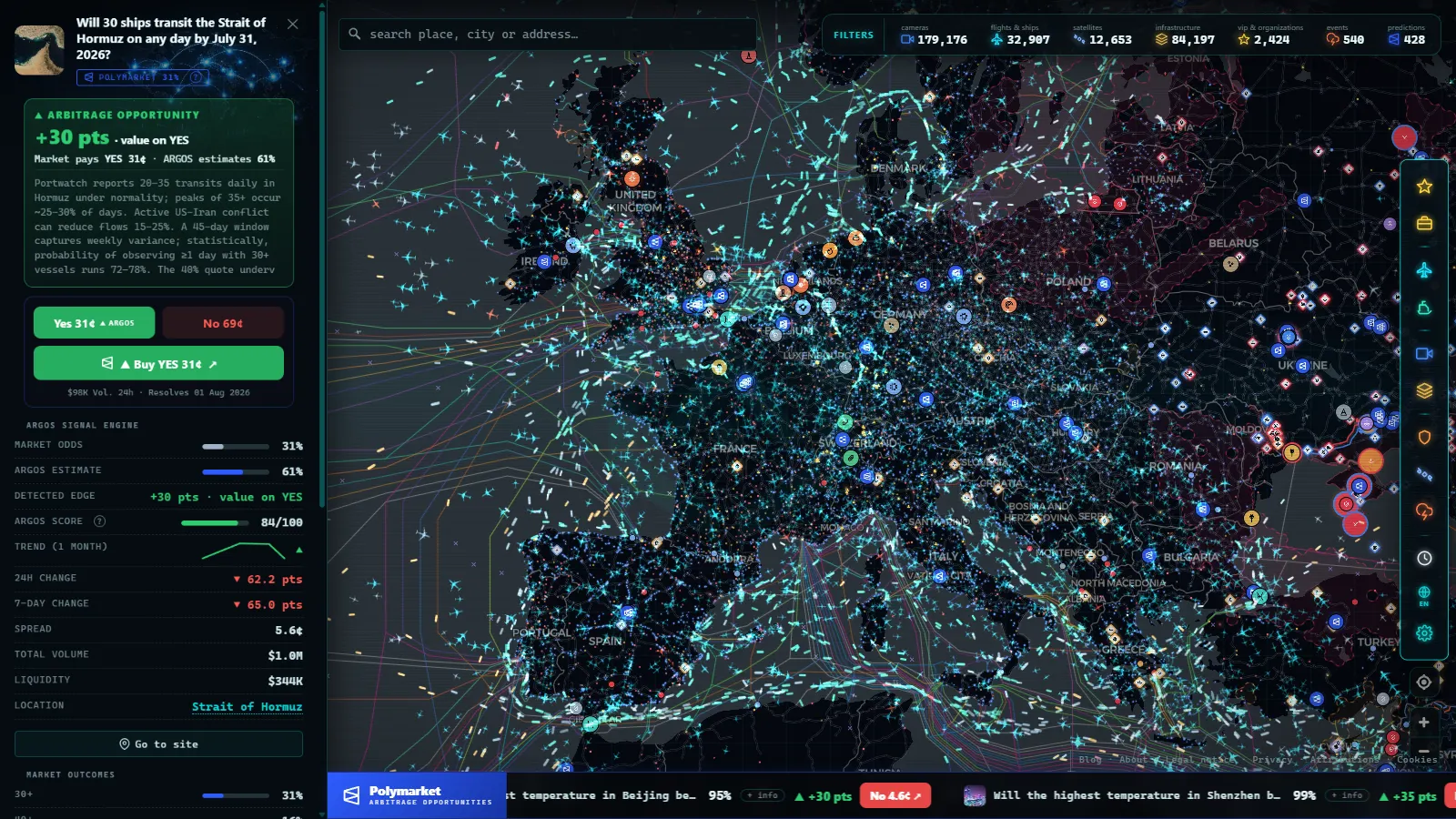
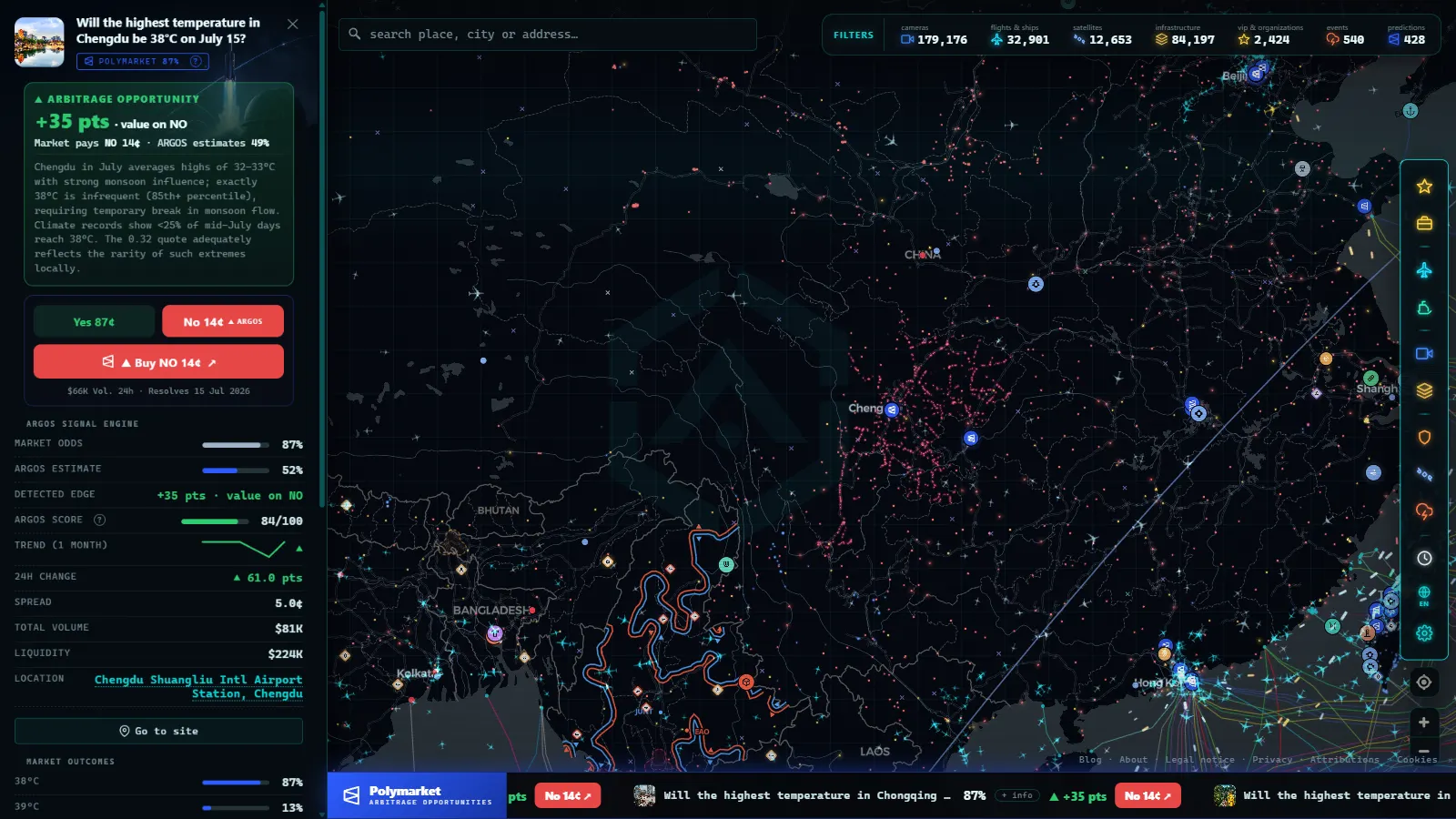
And there's a complementary third path: following the markets on the ground. On the geolocated predictions map in Argos Atlas you'll see Polymarket markets pinned to the exact location of the event (an election, a conflict, a launch) alongside the ARGOS signal, which compares the market's odds against an independent estimate and flags prices that look out of line with the context. Seeing the probability and the place on the same screen changes how you read both.
This content is informational and does not constitute financial advice or an investment recommendation.
Frequently asked questions
What is the main difference between Polymarket and Kalshi?
The underlying model. Polymarket runs on-chain on Polygon, settles in USDC, and every position is public and auditable; Kalshi is a US-regulated exchange that operates in dollars with a brokerage-style experience. On both, you trade event contracts where each winning share pays exactly $1.
Can I use both Polymarket and Kalshi?
Yes, as long as both are available where you live. Comparing prices across platforms is common practice: academic research documented over $40 million in arbitrage profit on Polymarket between April 2024 and April 2025. Check availability in your country before funding either account.
Do I need to know crypto to use Kalshi?
No. Kalshi runs on regular dollars with traditional deposits, no wallets or stablecoins involved. Polymarket is the one built on USDC over Polygon, though its onboarding has been simplified and you don't need to be a crypto expert either.
Which platform has more liquidity?
It depends on the specific market. Polymarket has concentrated enormous volume in politics, geopolitics and sports (the 2026 World Cup is moving hundreds of millions) while Kalshi is strong on US economic and financial events. Always check order-book depth before you trade.
- The Types of Markets on Polymarket (and Which Move the Most Money)
- Sports Betting vs Prediction Trading: Two Different Mindsets
- The 2026 World Cup in Prediction Markets: Hundreds of Millions at Stake
- Taxes and Prediction Markets: What You Should Keep in Mind
- What Is USDC and Why Polymarket Runs on It
- Crypto Wallets for Polymarket: What You Need to Know