Blog · Prediction markets
Crypto Prediction Markets: Price Exposure Without Buying the Asset

You have a view on bitcoin's price (that it will hold a level, that it won't reach another) but you don't want to open an exchange account, custody private keys, or let a 30% weekly drawdown ruin your quarter. Crypto prediction markets exist for exactly that case: they turn your view into a contract with a closed question, a date and a fixed payout. "Will bitcoin close above $X on date Y?" You buy YES or NO, and on the appointed date you collect $1 per share if you were right, or nothing if you weren't.
It's a form of price exposure without buying the asset, with properties very different from holding bitcoin. Different doesn't mean better: it means worth understanding before you commit money.
From opinion to contract: how it works
The mechanics are those of any binary prediction market. Each share trades between $0 and $1, and that price is the implied probability the market assigns to the event: a YES at $0.35 means the market sees a 35% chance of bitcoin clearing that threshold by that date. YES and NO add up to roughly $1, and every winning share pays exactly $1 at resolution.
The common crypto formats: fixed-date thresholds ("above $X on date Y?"), monthly closing ranges, and questions about industry milestones. In all of them, the mental exercise is the same: if you estimate (with numbers, not faith) that the true probability is 50% while the market prices it at 35%, that gap may deserve a position. If your number and the price agree, there's nothing to trade. That discipline (trading the gap between your estimate and the price, rather than your feelings about bitcoin) is what separates prediction from cheerleading.
What "without buying the asset" really means
Compared with buying and holding bitcoin, the prediction contract changes four structural things:
- Loss capped by design. Your maximum loss is what you paid for the shares. No liquidations, no margin calls, no losses beyond your stake.
- Fixed payout. Whether bitcoin clears the threshold by $100 or by $20,000, you collect the same: $1 per share. You give up "the more it rises, the more I make" in exchange for knowing exactly what you can win and lose from minute one.
- No custody of the asset. You don't need a bitcoin wallet or a trading exchange account. The honest nuance: you do operate on crypto rails, because Polymarket runs on-chain (on Polygon) and positions are bought and settled in USDC, a dollar-pegged stablecoin, details in what USDC is and why Polymarket uses it. A side benefit of that design: positions are public and auditable.
- An expiry date. Holding bitcoin doesn't expire; your contract does. You can be "right" about the direction and still lose because the move arrived a week late. In these markets it's not enough to get the what right, you have to get the when right too.
Capped risk does not mean small risk
A defined maximum loss doesn't make this conservative. The contract is all or nothing: at resolution there is no middle ground, and a market that reaches its date with the price hugging the threshold is a coin flip with bitcoin's volatility blowing on it. On top of that, short-term crypto prediction is notoriously hard: the market price already condenses the views of thousands of traders, and beating it consistently is the exception, 2026 on-chain analysis estimates only about 7-8% of Polymarket wallets are profitable.
The practical consequence is textbook: small positions, size fixed by a written rule (a conservative fraction of the Kelly criterion is a good starting point) and never money you can't afford to lose entirely, because in a binary market losing it entirely is a perfectly normal outcome. A useful mental test before every trade: imagine the position expiring worthless tomorrow. If that outcome would change your month (or your mood) the size is wrong, no matter how confident you feel about the thesis.
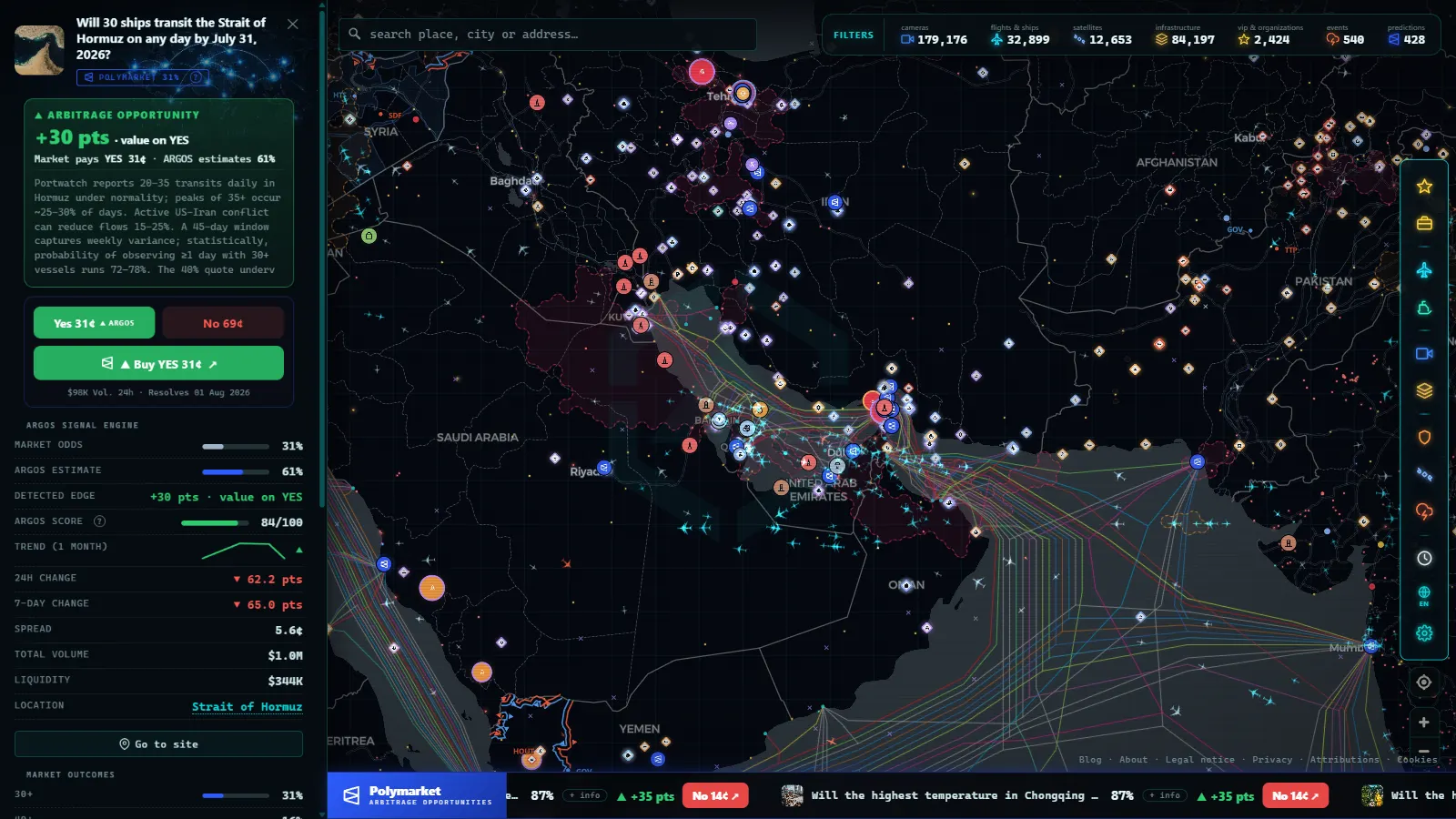
Recorded straight off the map, no sound.
You don't have to ride to resolution
One nuance that changes the strategy completely: shares can be sold before the date. If you bought YES at $0.35 and the news pushes the market to $0.60, you can close there and pocket the appreciation without gambling on the final all-or-nothing. It's the difference between placing a bet and managing a position, and we unpack it in selling before resolution.
Two execution details that work in your favor: limit orders usually pay lower fees than market orders, and in thin markets the spread can eat several points of your theoretical margin, check the order book before you enter, not after.
The context is global (and you can see it on a map)
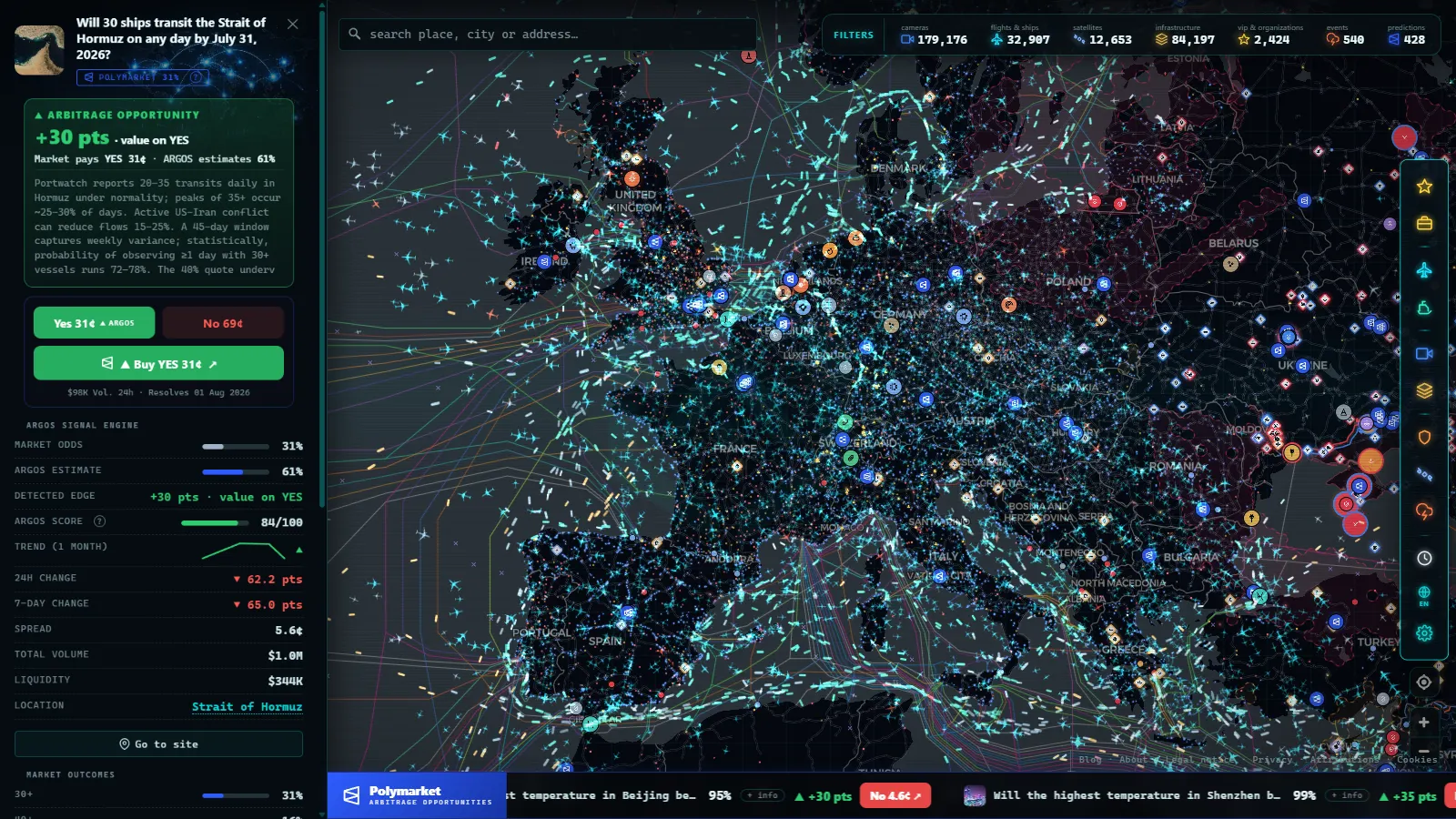
Bitcoin's price doesn't live in a vacuum: it moves on regulatory decisions, platform hacks, macro shifts and geopolitical crises, events that happen in specific places in the world. On the geolocated predictions of Argos Atlas you can see Polymarket markets pinned at the exact location of each event, with the ARGOS signal comparing the market's odds against an independent estimate: useful context for connecting the headline that moves the price with the market that prices it. And if you decide to go from watching to trading, you can create a Polymarket account and start with amounts you treat as tuition.
This content is informational and does not constitute financial advice or an investment recommendation.
Frequently asked questions
Is this the same as buying bitcoin?
No. When you buy bitcoin, your result rises and falls with every dollar of the price, with no expiry date. In a prediction market you buy a binary contract with a question, a date and a fixed payout: if you're right you collect $1 per share, whether you were right by a little or by a lot.
Do I need bitcoin or a bitcoin wallet to participate?
No. On Polymarket you never touch the asset you're predicting: positions are bought and settled in USDC, a dollar-pegged stablecoin, on the Polygon network. You predict bitcoin without custodying bitcoin.
Can I lose more than I put in?
No: buying shares, your maximum loss is exactly what you paid for them. That's the key structural difference versus leveraged crypto trading, where losses can exceed your deposit.
Are prediction markets good at forecasting bitcoin's price?
They aggregate the views of thousands of traders into an implied probability, which tends to be a reasonable reference, but they're no oracle. Short-term bitcoin price moves are notoriously hard to predict for anyone, markets included.
- Polymarket vs Kalshi: The Complete Comparison
- Polymarket vs Betfair Exchange: Crypto Predictions vs Classic Betting
- The Types of Markets on Polymarket (and Which Move the Most Money)
- Sports Betting vs Prediction Trading: Two Different Mindsets
- The 2026 World Cup in Prediction Markets: Hundreds of Millions at Stake
- Taxes and Prediction Markets: What You Should Keep in Mind