Blog · Prediction markets
Weather Prediction Markets: Trading the Degrees

Betting on what tomorrow's thermometer will read in a major city sounds like a bar joke, but it's a recurring and surprisingly active category of prediction markets: daily high temperatures, hurricane tracks, monthly records. And it has something no other category offers: meteorology is one of the few domains where an amateur has public access to the very same models the professionals use.
That doesn't make it easy money (you'll see why shortly) but it does make it one of the most instructive arenas for understanding how a prediction market really works: written rules, one official number that governs, and an outcome that leaves no room for punditry.
What exactly trades in a weather market
The most common formats, from shortest to longest horizon:
- Daily high temperature in a city, usually sliced into brackets ("between 86 and 89°F", "90°F or above"). Each bracket trades as a share from $0 to $1, the price reflects the probability the market assigns it, and the winning bracket pays exactly $1.
- Hurricanes and extreme events: where a storm will make landfall, what category it will reach, how many named storms a season will produce.
- Records and longer-range climate: whether a month or a year will be the hottest on record, among others.
The mechanics are those of any binary market: YES and NO add up to roughly $1, so buying NO at $0.80 amounts to saying the event has less than a 20% chance. If these formats are new to you, the types of Polymarket markets covers the full catalogue.
The official reading governs (and it's not your weather app)
Here's the trap almost every beginner falls into: the market doesn't resolve on "what the weather was like", but on the reading from the source named in the written rules, usually one specific official weather station, with a defined time window and time zone. Your app can show 88°F while the reference station, a few miles away, records 90°F: the station wins, every time.
If readings are ambiguous or contested, resolution runs through the UMA oracle, with its dispute window before becoming final. We explain the full process in how Polymarket markets get resolved; for weather, the practical moral fits in one sentence: read which station, which cutoff and which source each market fixes before you commit a cent.
Where your edge might come from (honestly)
What makes weather exceptional is the symmetry of information: the major forecast models (Europe's ECMWF, America's GFS) publish runs several times a day, and anyone can read them. Historical climatology, which works as your base rate, is public too. Given that, the realistic sources of edge are:
- Reading speed: prices don't always adjust instantly when a fresh model run comes out; whoever interprets it first collects.
- Knowing the models' flaws: every model has known biases in specific setups (temperature inversions, coastal breezes); knowing when to distrust them is information the price may not carry.
- Base-rate discipline: when the market drifts on vibes ("it feels so hot today"), climatology provides the anchor.
There's a fourth, humbler edge worth naming: patience. Weather markets reward the trader who skips the ambiguous days and waits for the setups where the models agree and the price hasn't caught up. Most days, the correct trade is no trade at all.
The honest warning: these markets attract specialists running automated pipelines that read the models for them, faster than you. Assume you're competing against them. As a training ground, though, it's hard to beat: short horizon, objective outcome, feedback within hours, ideal for practicing the habits of superforecasting without waiting months to learn whether you were right.
Recorded straight off the map, no sound.
The most geographic category of all, seen on a map
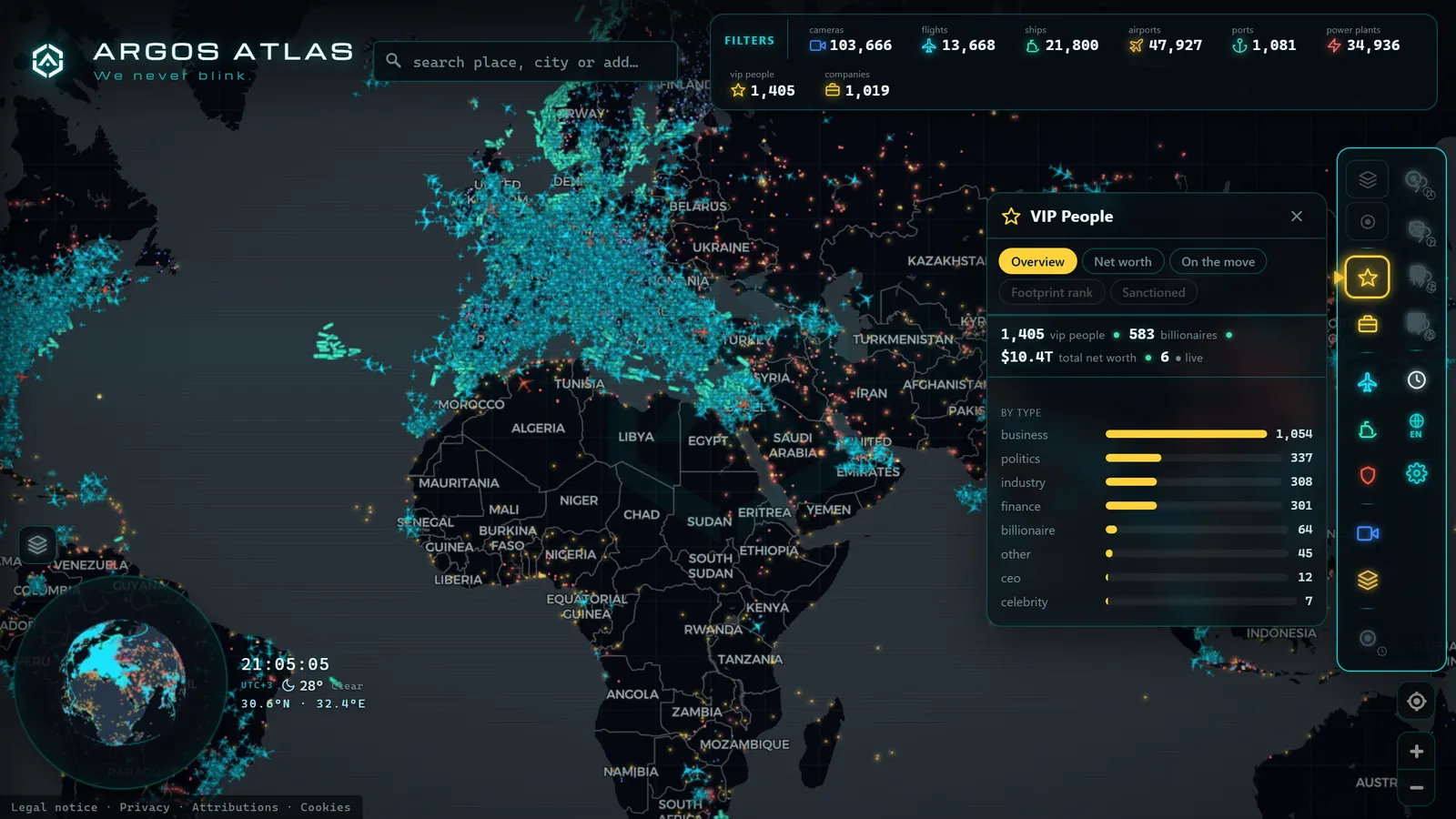
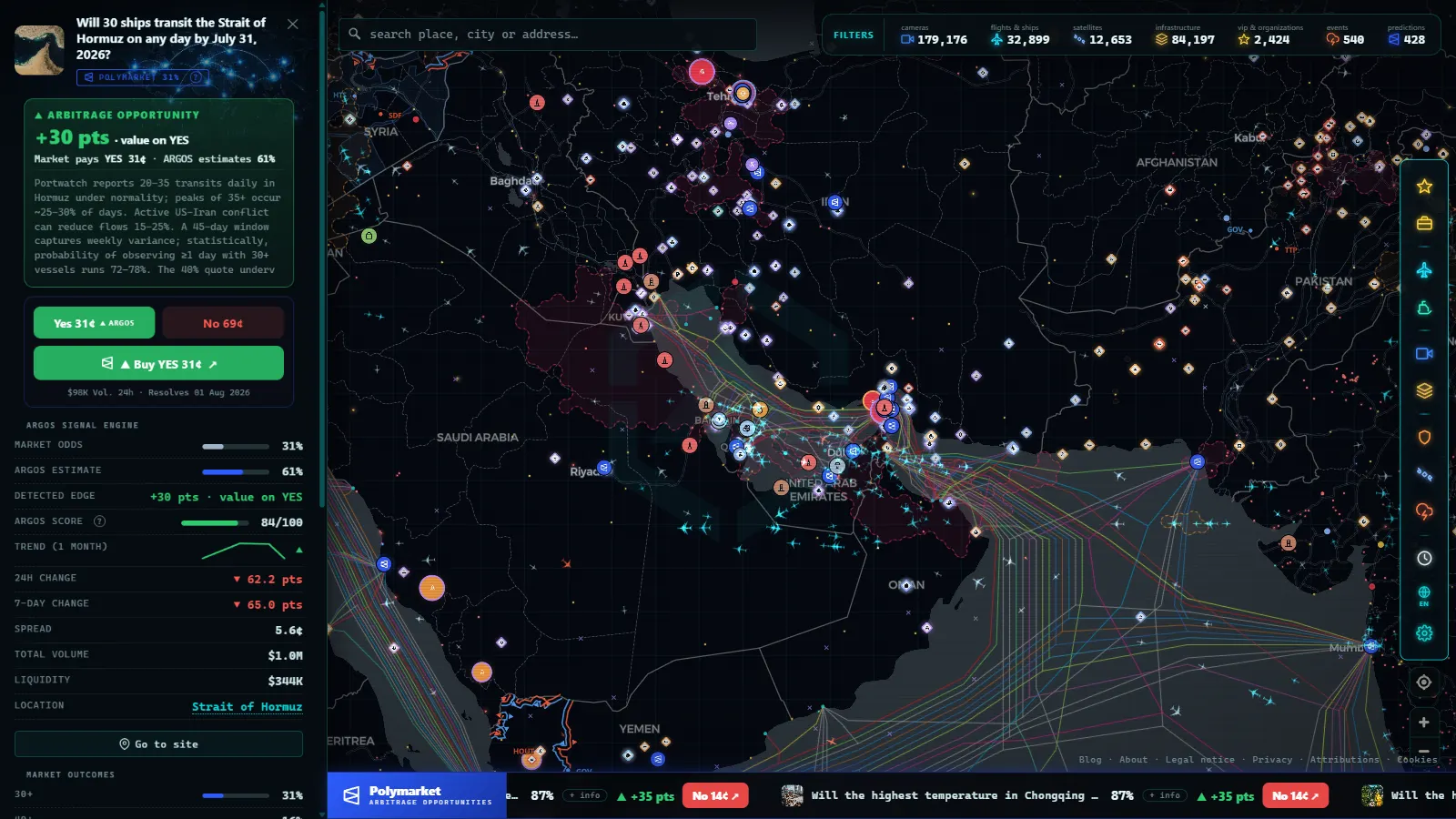
A market about where a hurricane will make landfall is, literally, a question about a point on the map. That's why weather gains the most from being geolocated: on the Argos Atlas prediction map, Polymarket markets appear pinned at the exact location of the event (the threatened coastline, the city under the thermometer) alongside the ARGOS signal, which compares the market's odds against an independent estimate. Seeing the prediction on the ground, next to the area's cameras and its ship and flight traffic, gives you context no market list can. It's also a natural way to discover weather markets you would never have found scrolling a list.
The risks specific to trading the degrees
Before diving in, four quirks that make this category unforgiving:
- The one-degree cliff: half a degree separates collecting $1 from collecting $0. There are no consolation prizes for "almost".
- Thinner liquidity than politics or sports: spreads can eat your theoretical margin. Limit orders help (they usually pay lower fees than market orders) but they don't work miracles.
- Very short windows: in a daily market there's barely time to sell out if you're wrong; many positions ride to resolution whether you like it or not.
- Data quirks: stations go down, readings get corrected after the fact. The written rules decide, and not always the way you expected.
If your curiosity survives all that, you can open a Polymarket account, start with minimal amounts, and treat your first markets as what they are: hands-on meteorology lessons with cheap tuition, as long as your position size keeps it cheap.
This content is informational and does not constitute financial advice or an investment recommendation.
Frequently asked questions
What data resolves a temperature market?
Whatever source the market's written rules name: usually one specific official weather station, over one specific time window. It can differ from what your weather app shows, so read the rule before you trade, not after.
Can I make money just by checking my weather app?
Very unlikely: your app uses the same public information as everyone else, and these markets attract specialists who read model outputs the moment they're published. If an edge exists, it takes more depth than a glance at your phone.
What happens if the official reading is ambiguous or later corrected?
The market's written rules govern, and disputes are channeled through the UMA oracle, which includes a dispute window before resolution becomes final. That's why it matters so much to read which source and which cutoff each market fixes.
Why is weather a good training ground for forecasting?
Because it combines a short horizon, an objective outcome and public data: within hours or days you know whether you were right, and against which number. It's fast, clean feedback for training calibration, something politics can take months to give you.
- Polymarket vs Kalshi: The Complete Comparison
- Polymarket vs Betfair Exchange: Crypto Predictions vs Classic Betting
- Sports Betting vs Prediction Trading: Two Different Mindsets
- The 2026 World Cup in Prediction Markets: Hundreds of Millions at Stake
- Taxes and Prediction Markets: What You Should Keep in Mind
- What Is USDC and Why Polymarket Runs on It