Blog · Prediction markets
Who Decides the Outcome: How Polymarket Markets Resolve

Picture this: you buy YES on an election market, your candidate wins according to every newspaper... and the market resolves NO. Not a glitch, the written rules required official certification of the result, not a media front page. In prediction markets, the gap between what you think you bet on and what the contract actually says can cost you your entire position.
That is why this piece matters more than any strategy article: here is who decides outcomes on Polymarket, how the chain of written rules → UMA oracle → dispute window works, and why the fine print gets read before you commit a dollar.
The contract is the text, not the headline
Every Polymarket market has two layers. The first is the headline: "Will X win the election?", "Will there be a ceasefire before year end?". That is marketing, short, memorable, deliberately simplified.
The second layer is the resolution rules: a written text that defines precisely what counts as YES, which source will verify it and what deadline applies. That is where you learn whether "winning" means official certification or a media call, what happens if the event is postponed, and how odd scenarios are handled.
The golden rule is simple: you trade the text, not the headline. When the two agree, no problem. When they diverge (and sometimes they do) the text wins. Every time.
The UMA oracle: how reality gets onto the blockchain
Polymarket runs on-chain, on the Polygon network, which creates a genuine problem: a blockchain cannot "see" the world. Smart contracts understand numbers and signatures, not vote counts or goals. You need a bridge between reality and the chain, and that bridge is called an oracle.
The one Polymarket uses is UMA, an "optimistic" oracle. Its logic is elegant:
- The event happens and someone proposes an outcome, backing it with a deposit they lose if the proposal is shown to be wrong.
- The proposal sits in public view for a period of time: the dispute window.
- If nobody challenges it, it is presumed correct and the market resolves. Most markets end exactly this way, quietly.
"Optimistic" is not naivety, it is efficiency: the system assumes proposals are honest because lying costs money and anyone can catch you.
The dispute window: the emergency brake
What if a proposal is wrong, or self-serving? That is where the brake kicks in: during the dispute window, any participant can challenge the proposed outcome, staking their own deposit in turn. The dispute then escalates to a vote among UMA token holders, who decide which reading of the rules is correct.
For you as a trader, this has two practical consequences:
- Resolution is not instant. Between the event and the payout there is a proposal and a challenge period, longer still if a dispute erupts.
- The price can move during that limbo. A market the news considers "already decided" may trade at $0.97 instead of $1.00 while formal resolution grinds forward. That gap is the price of residual uncertainty, an opportunity for some traders, a trap for others.
Recorded straight off the map, no sound.
Why you read the fine print BEFORE trading
Most nasty surprises in prediction markets come not from exotic manipulation but from something far more mundane: people who never read the rules. The usual tripwires:
- The deadline. "Will X happen?" almost always means "will X happen by a certain date?". If it happens a day late, the market resolves NO even though your thesis was right.
- The source of truth. If the rules name a specific official body, it does not matter what a hundred outlets report, that source rules.
- Definitions. Does "announcing" count as "doing"? Is a verbal agreement an "agreement"? The text usually says; your intuition does not.
- Edge cases. Postponements, ties, resignations, cancellations. Well-written markets anticipate them; read those clauses before they apply to you.
Buying without reading the rules is one of the classics we cover in the most common beginner mistakes, and probably the most expensive one per dollar invested. And if you want reassurance that this system has a track record and public auditability behind it, we take a calm look at security in is Polymarket trustworthy?.

The 60-second checklist before buying a share
Before you view the market on Polymarket and hit buy, spend one minute on this:
- Read the full rules, not just the headline.
- Identify the resolution source: which body or data point decides?
- Note the deadline and check it against your thesis: does your scenario arrive in time?
- Imagine the ambiguous case: if the outcome is weird, how does the text resolve it?
- Check liquidity and the spread, and if the jargon is new to you, the prediction markets glossary covers all of it.
- Plan your exit: remember you can sell before resolution once the price reflects your thesis.
Sixty seconds. The best effort-to-payoff ratio in this entire niche.
Follow the event, not just the price
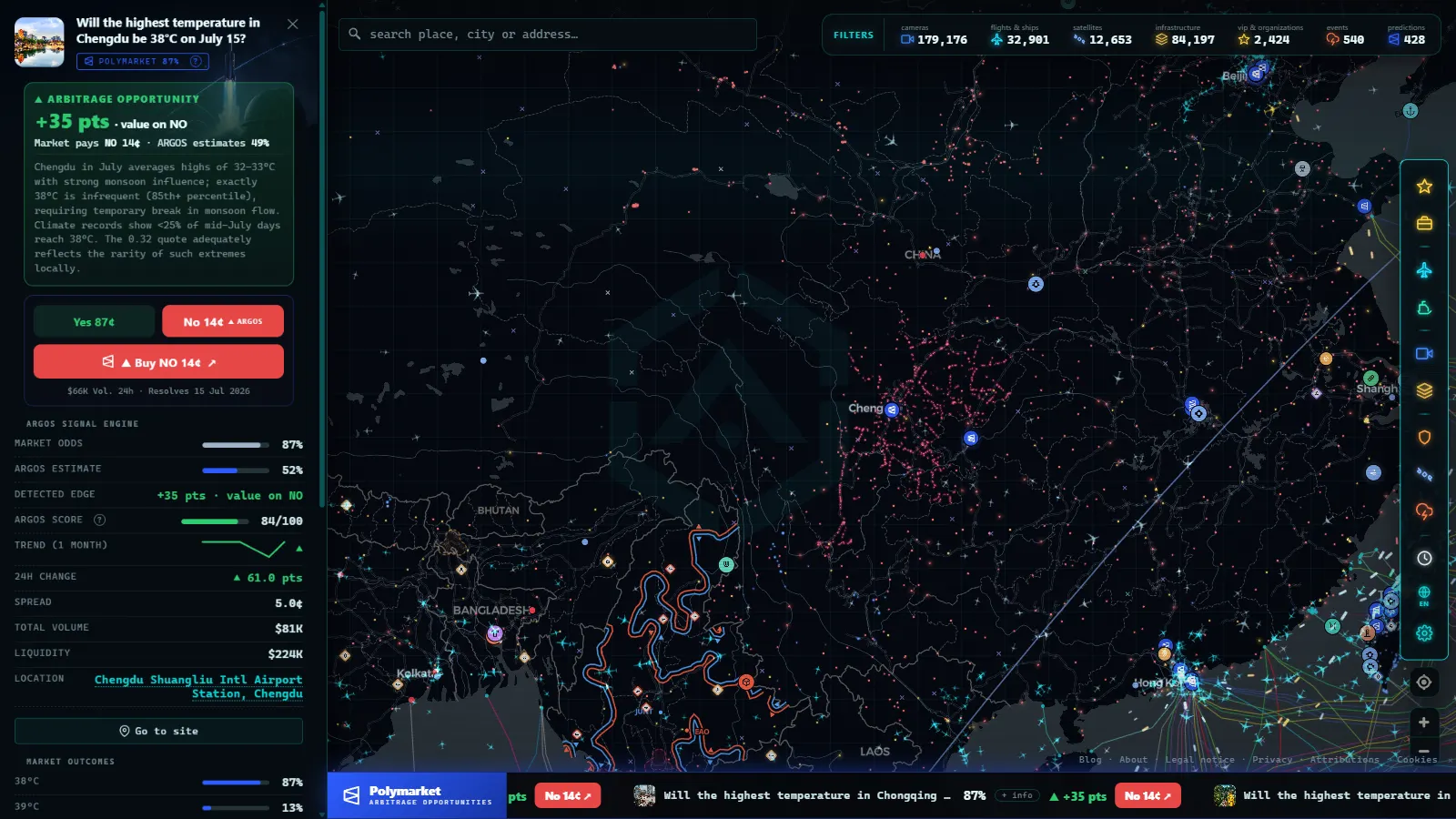
There is one last angle almost nobody works: resolution depends on facts unfolding at a specific place in the world, and watching that place gives you context the price only absorbs with a lag. On the geolocated predictions of Argos Atlas, every Polymarket market is pinned to the exact location of the event it refers to (alongside the cameras, flights and ships in the area) and paired with the in-house ARGOS signal, which compares the market's odds against an independent estimate to flag divergences. Watching the market and the ground at the same time means understanding what is actually being resolved.
This content is informational and does not constitute financial advice or an investment recommendation.
Frequently asked questions
Who decides the outcome of a Polymarket market?
Nobody decides by fiat. The outcome is fixed by the market's written rules, enforced through the UMA oracle: someone proposes a result backed by a deposit and, if nobody disputes it within the window, it is confirmed on-chain.
Can a market resolve incorrectly?
The system is designed to make lying expensive, and the vast majority of markets resolve without controversy. When trouble does happen it usually stems from ambiguous wording, not fraud: the text allowed two readings and one of them caught you off guard. That is why you read the fine print before trading, not after.
How long does resolution take?
It is not instant. After the event, someone proposes the outcome and a dispute window opens; payment only happens once it expires unchallenged, or once any dispute is settled. The exact timeline depends on the market and on whether there is controversy.
Do I have to wait for resolution to get my money back?
No. While the market is open you can sell your shares to another participant at the going price. Many traders close positions as soon as the price reflects their thesis and never wait for formal resolution.
- Prediction Markets: What They Are and Why They Keep Getting It Right
- Election Markets: How Political Futures Are Traded
- How to Make Money on Polymarket: What Actually Works (and What Doesn't)
- 5 Polymarket Strategies for Beginners (No Hype)
- Arbitrage in Prediction Markets: What It Is and How to Spot It
- Cross-Platform Arbitrage: When YES + NO Cost Less Than $1