Blog · Prediction markets
Prediction Markets Glossary: 25 Terms You Need to Know

Prediction markets have a bad habit of mixing sportsbook slang, trading-desk jargon and crypto vocabulary in the same sentence. If you have just landed on Polymarket and half the screen feels like a foreign language (share, spread, oracle, negative risk) relax: nobody is born knowing this, and the whole language fits on one page.
This glossary collects the 25 terms you actually need, grouped by theme and explained in plain English. Read it once end to end, then come back whenever a word trips you up. That is what it is for.
The basics: what you are actually buying
- Prediction market: a market where people trade contracts on whether a specific event will happen, an election, an economic release, a cup final. Nobody sets the price from above; it emerges from what participants are willing to pay.
- Share: the individual contract. On Polymarket it costs between $0 and $1, and every winning share pays out exactly $1 at resolution. Buy YES at $0.30 and, if the event happens, you make $0.70 per share; if it doesn't, you lose your $0.30.
- Implied probability: the price, read directly as a probability. A share at $0.62 means the market estimates a 62% chance. By design, YES plus NO in the same market adds up to roughly $1.
- Resolution: the process by which the market closes and the outcome is officially declared. Until that moment everything is just price; afterwards, every share is worth $1 or $0.
Who decides the outcome
- Market rules: the written text defining exactly what counts as YES, according to which source and by what deadline. This is the real contract; the market's headline is just the shop window.
- Oracle: the mechanism that brings reality onto the blockchain. Smart contracts cannot "see" who won an election; something has to certify it.
- UMA: the oracle Polymarket uses. It works in "optimistic" mode: someone proposes an outcome backed by a deposit and, if nobody challenges it in time, it stands.
- Dispute window: the period after a proposal during which anyone can challenge the outcome and force a review. If this machinery sounds important (it is) we wrote a full guide on how Polymarket markets resolve.
The price engine: orders and liquidity
- Order book: the list of pending buy and sell orders at every price. It is the market's X-ray: you can see how much money is waiting on each side.
- Market order: you buy or sell right now, at the best available price. Fast, but you pay for the speed.
- Limit order: you set your price and wait for someone to cross. It takes patience and comes with a bonus: limit orders usually pay lower fees than market orders.
- Maker: whoever adds liquidity with resting orders.
- Taker: whoever consumes it by executing against existing orders.
- Spread: the gap between the best bid and the best ask. The tighter it is, the cheaper it is to get in and out.
- Liquidity: how much money is willing to trade without moving the price. A liquid market absorbs your order; an illiquid one feels every dollar of it.
- Slippage: the difference between the price you expected and the one you got because your order ate through several levels of the book. In thin markets it can sting.
The fastest way to make these concepts stick is to watch a real order book: you can open Polymarket and study any large market without risking a cent.
Recorded straight off the map, no sound.
The trader's toolbox
- Edge: your genuine advantage over the market price, whether from better information or better analysis. Without edge, trading is paying spread and fees to flip coins.
- Expected value (EV): what you would earn on average if you could repeat the same trade a thousand times. It is the compass that separates profitable plays from lucky streaks; we go deep on it in expected value applied to betting.
- Arbitrage: exploiting price inconsistencies to lock in profit without betting on an outcome. Not just theory: academic research documented more than $40 million in arbitrage profit on Polymarket between April 2024 and April 2025.
- Negative risk: in markets with many options (several candidates, say), the situation where the NO prices add up in a way that lets you build a position that wins no matter what.
- Selling before resolution: you are not obliged to wait for the end. If the price moves your way, you can close the position and pocket the difference; if it moves against you, you can cut the damage.
Money and crypto plumbing
- USDC: the stablecoin used to trade on Polymarket. A token that represents one US dollar, forget the volatility of other cryptocurrencies.
- Wallet: your digital wallet, where your funds and positions live.
- On-chain: recorded on a public blockchain (Polygon, in this case). The practical consequence: positions and transactions are public and auditable, for better and for worse.
- Bankroll: the total money you dedicate to trading, kept apart from your household finances. How much to risk per trade matters as much as what to buy; the classic starting point is bankroll management with the Kelly criterion.
Where to see these terms in action
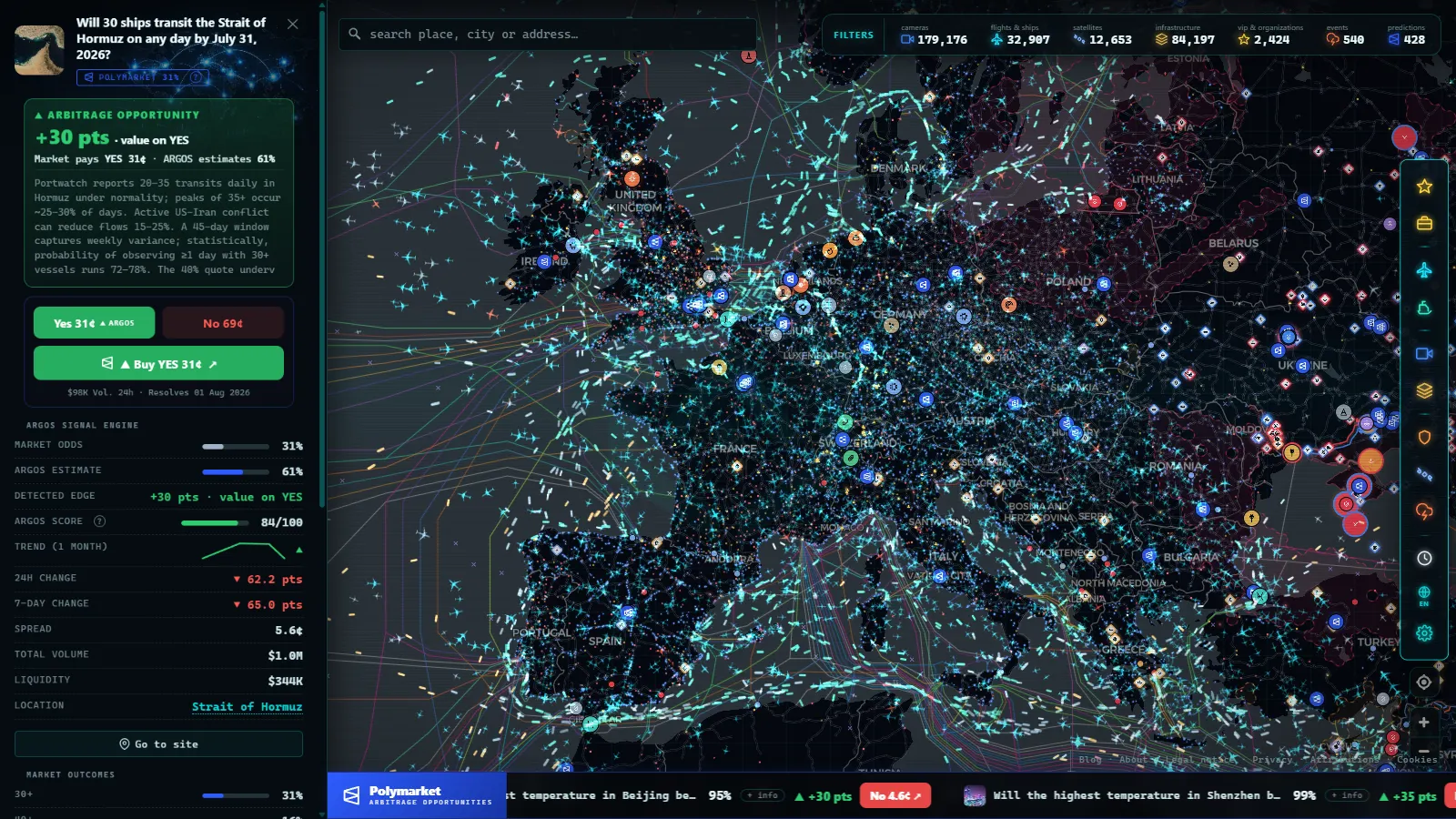
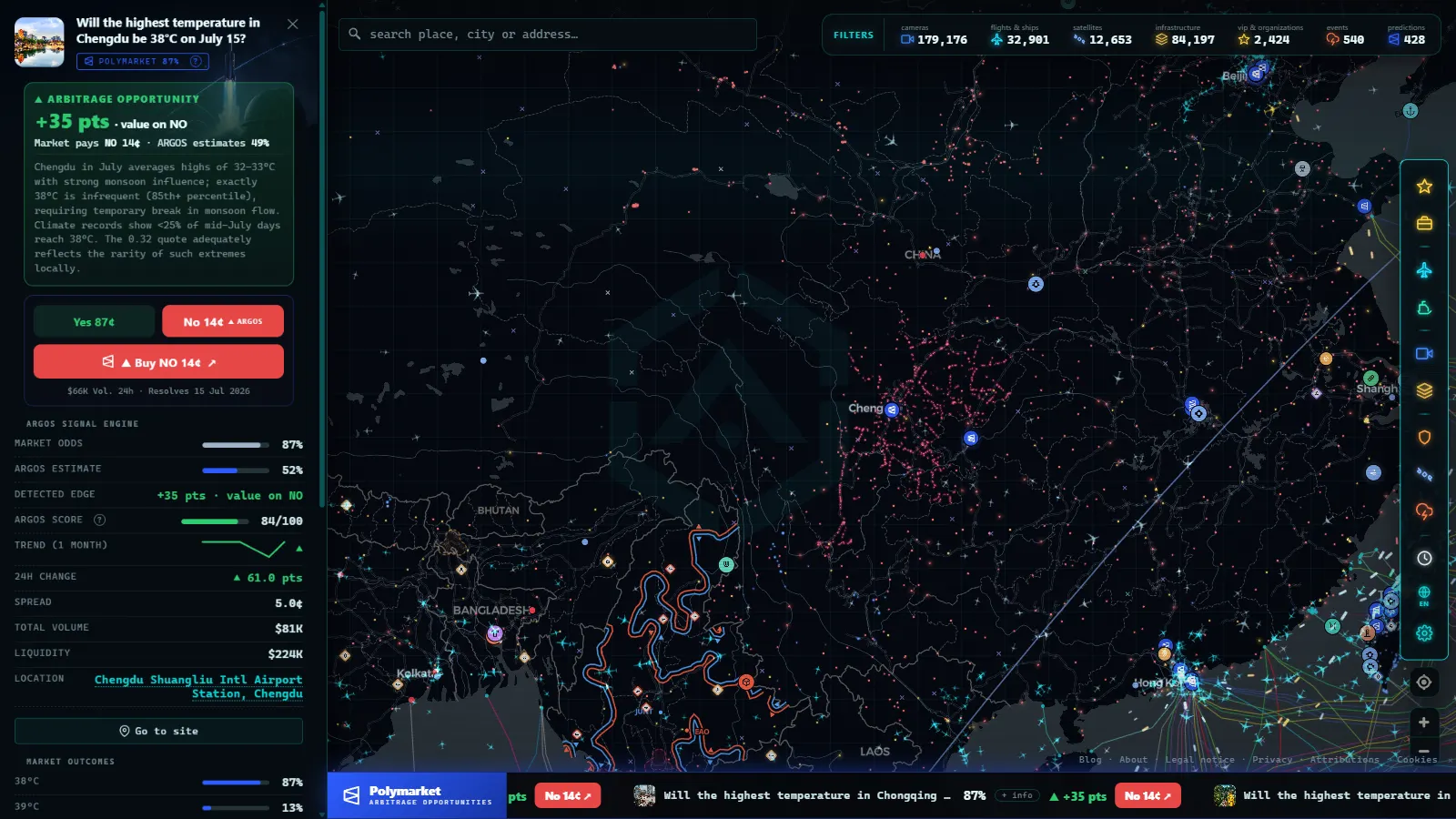
Theory settles in when you watch the words at work on real events. On the geolocated predictions of Argos Atlas, the markets layer pins every Polymarket market to the exact spot on the globe where its event is unfolding, alongside the in-house ARGOS signal, which compares the market's odds against an independent estimate to flag where value might be hiding. Probabilities, spreads and volume stop being abstract columns once you see them on the map of the event itself.
One honest closing note: knowing the vocabulary saves you from silly mistakes, but it does not hand you an edge. Most people who trade these markets lose money; the language is the entrance, not the finish line.
This content is informational and does not constitute financial advice or an investment recommendation.
Frequently asked questions
What is a share in a prediction market?
It is the basic contract being traded. On Polymarket a share costs between $0 and $1, and every winning share pays out exactly $1 when the market resolves. The price doubles as an implied probability: a share trading at $0.40 reflects an estimated 40% chance.
What is the difference between a maker and a taker?
A maker adds liquidity by placing limit orders that sit in the book; a taker consumes liquidity by executing against existing orders. It matters for your costs: limit orders usually pay lower fees than market orders.
What does negative risk mean?
It arises in markets with many options, such as an election with several candidates. If the NO prices add up the right way, you can build a position that profits no matter who wins. It is a form of arbitrage, rare, and fiercely competed for.
Do I need to understand crypto to follow these terms?
No. Three ideas cover it: you trade with USDC (a digital dollar), your funds live in a wallet, and everything is recorded on-chain, meaning on a public, auditable ledger. The rest of the vocabulary comes from markets, not from crypto.
- Who Decides the Outcome: How Polymarket Markets Resolve
- Prediction Markets: What They Are and Why They Keep Getting It Right
- Election Markets: How Political Futures Are Traded
- How to Make Money on Polymarket: What Actually Works (and What Doesn't)
- Arbitrage in Prediction Markets: What It Is and How to Spot It
- Cross-Platform Arbitrage: When YES + NO Cost Less Than $1