Blog · OSINT & verification
How to Verify a Viral Video: A Practical Visual Verification Guide
A striking video lands on your screen: a disaster, a confrontation, something "happening right now." Before believing it (and long before sharing it) there is a process anyone can apply to verify a video and decide whether it is what it claims to be. You do not need to be a journalist or have special software: video verification rests on four questions, a handful of free techniques, and above all the habit of pausing thirty seconds before hitting "forward."
This guide gives you the complete procedure, the same skeleton used by fact-checking teams worldwide, adapted so you can apply it from wherever you are. Because most fake videos are not masterpieces of manipulation: they are old tricks that fall apart under two well-executed checks.
The Four Questions of Verification
All video fact-checking reduces to answering four questions, in this order:
- Who published it? Provenance: what is the original source and how reliable is it?
- When was it filmed? Time: is the video from the date it claims, or is it recycled material?
- Where was it filmed? Location: is the attributed location the real one?
- What does it actually show? Context: does what is visible mean what the headline asserts?
A video is only verified when all four answers are solid. And here is the insight that changes everything: the vast majority of audiovisual disinformation fails on questions two, three, and four, not on the authenticity of the material. The video is usually real; what is false is the wrapper.
Question 1: Provenance, Who Published It First?
The first move is to trace the river back to its source. The account that brought the video to you is almost never the one that filmed it: between the original witness and your screen there is typically a chain of amplifier accounts that trim, re-label, and often distort.
The main tool is reverse frame search: capture three or four representative frames from the video (the opening shot, the key moment, a frame with distinctive elements) and upload them to several reverse image search engines. Use more than one, because their indexes differ. What you are looking for is earlier appearances: if the same material circulated months or years ago, you will find it, and any claim of currency collapses.
While tracing, evaluate the accounts involved. Does the supposed original source have a history consistent with being in that place? Does it publish its own material or only rebroadcast? Do the accounts amplifying it show a pattern of sharing unverified content? Distinguishing the witness from the megaphone is half the verification.
Question 2: Time, Is It From When It Claims?
If reverse search has not dated the video, read the internal clues. A video is full of hidden clocks for those who know how to look.
The weather that day. Meteorological records from national weather services are public: if the video claims to be "from yesterday in a particular city" but shows bright sunshine on a day that saw heavy rainfall there, the date is false. This is one of the most devastating checks, and one of the least used. In the US, the National Weather Service archives are freely accessible; the UK Met Office and Meteo-France offer similar public records.
Shadows. The length and direction of shadows indicate the sun's elevation, which narrows the time window and can contradict the claimed hour. Solar ephemeris tools allow you to cross-reference shadow direction, location, and date with precision.
Clothing, vegetation, and props. Winter coats in a video supposedly shot in summer, bare trees on a date when they should be in full leaf, out-of-season Christmas lights, event posters with visible dates. Every seasonal element is an involuntary witness.
From the ARGOS ATLAS channel.
Question 3: Location, Where Was It Really Filmed?
Relocating a video (presenting footage from one country as if it were from another) is one of the most profitable and frequent forms of deception. To debunk it, apply the same visual analysis techniques used to geolocate a photo: inventory clues (language of signs, license plates, architecture, street furniture, background terrain), form a regional hypothesis, and confirm it with satellite view and street-level imagery.
Video has an advantage over a photograph: movement. A panning shot reveals the geometry of streets and intersections, which you can compare with the actual layout on the map. If the camera sweeps around and the buildings do not match the urban grid of the claimed location, the video has been relocated, however convincing the headline.
Question 4: Context, The Deception That Actually Works
This deserves plain statement: the most common trick is not a deepfake; it is a genuine video, old or from a different place, paired with a false headline. Manufacturing a convincing synthetic video is expensive and technically demanding; recycling an authentic one with a lie on top is free and equally effective. That is why the question "what does it actually show?" is as important as the previous three.
The classic variants: a military drill presented as a real attack, a film shoot repackaged as "frontline footage," a years-old celebration sold as a reaction to today's news, a cropped shot that conceals precisely the detail that would change the interpretation. In every case the material is genuine and the lie is in the frame. The defense: find the longest available version of the video, locate the original publication, and read what it said before someone swapped the headline.
Cross-Referencing with Live Sources: When the Video Claims "It's Happening Now"
There is a category of video that allows an especially direct form of verification: the one that claims to show something currently unfolding. "The highway is shut right now," "the port is overwhelmed," "a historic snowstorm is hitting this city at this moment." Against that claim, you have the option of looking at the present through independent real-time sources.
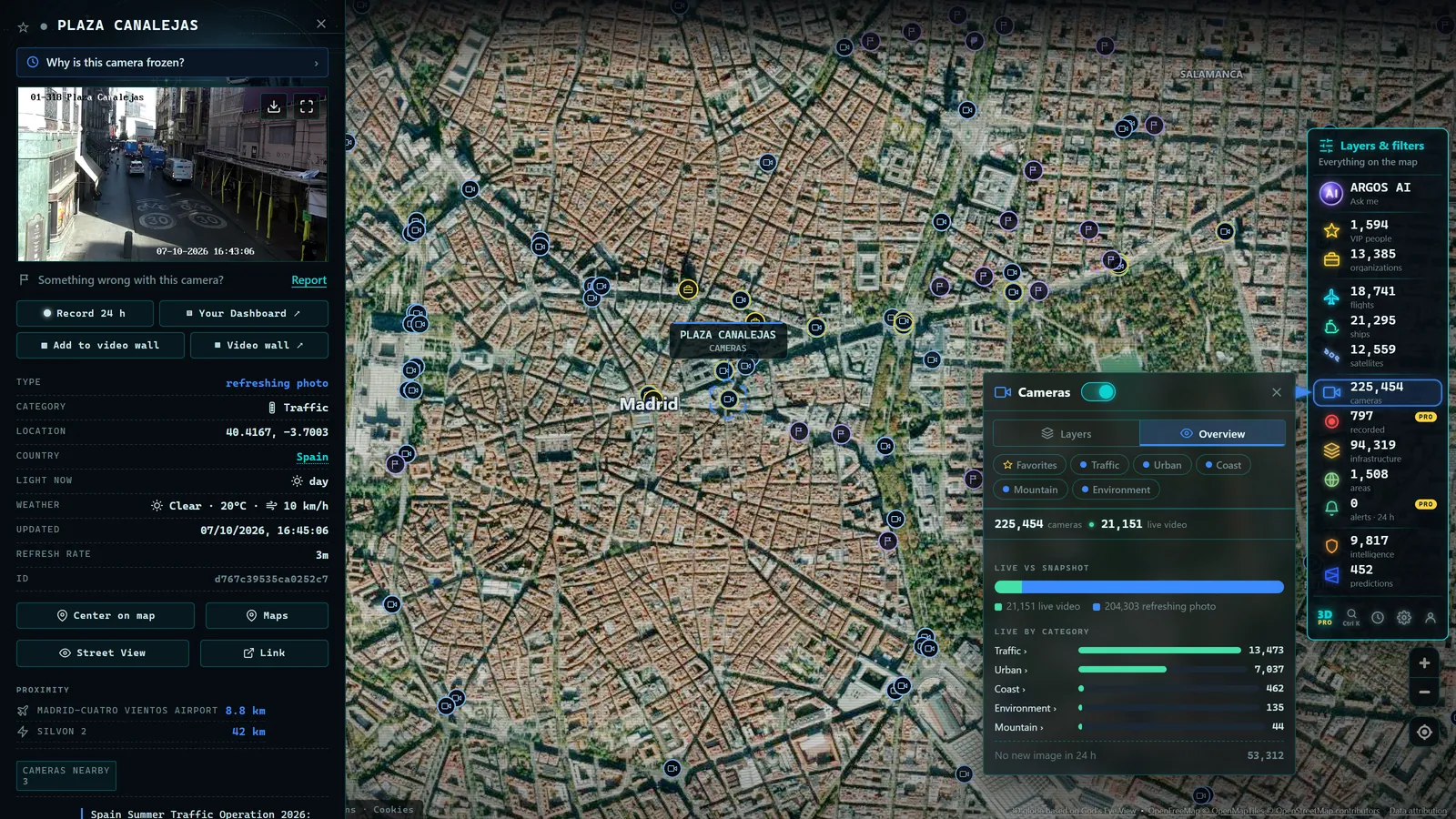
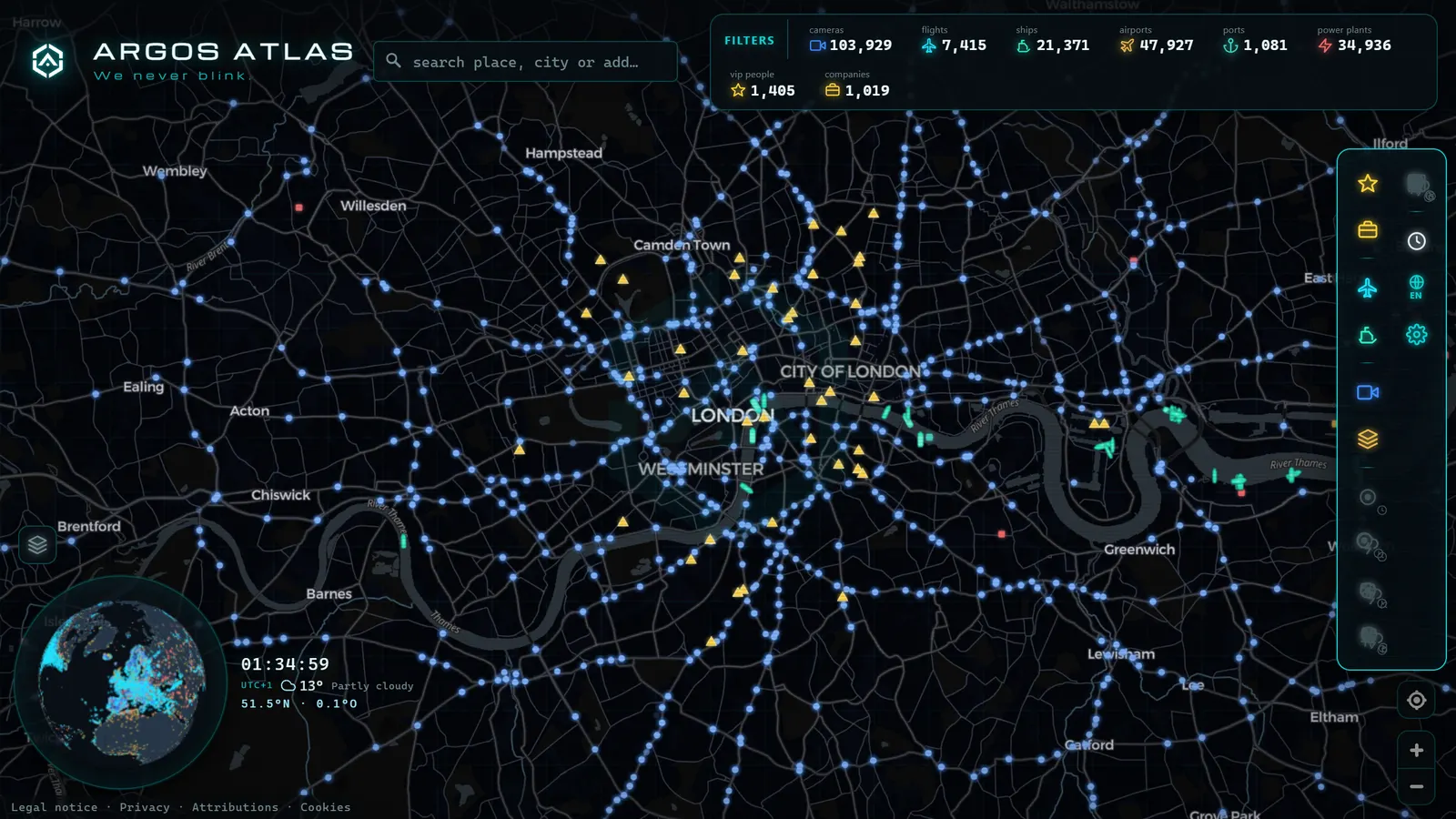
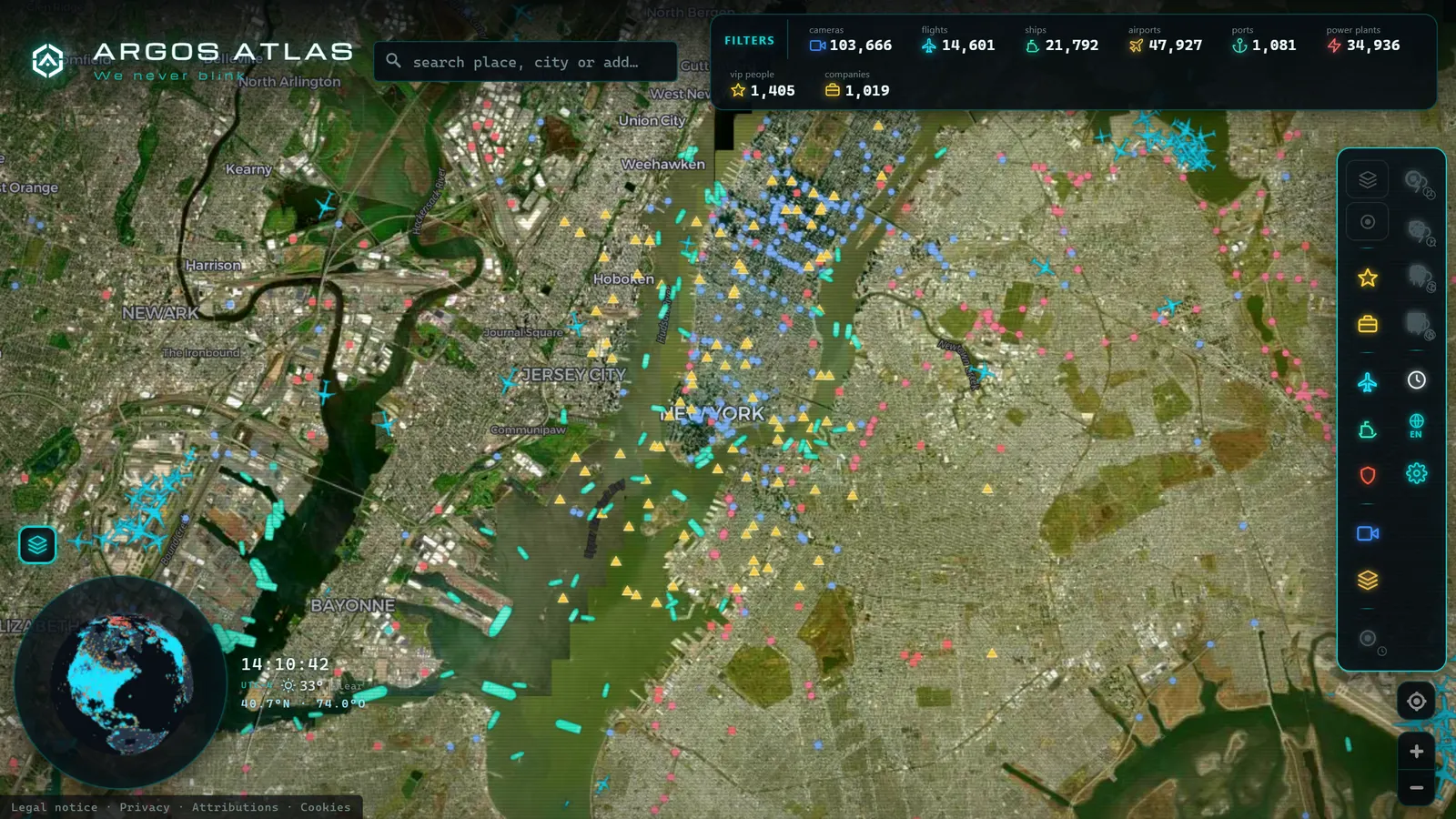
Live public cameras are the first resource: thousands of official bodies (transport departments, city councils, port authorities) publish traffic and urban cameras with known locations. If a video claims a road in Chicago, London, or Paris is blocked, cameras on that stretch either confirm or deny it within a minute. Real-time traffic data, flight tracking (civil aircraft broadcast their position via ADS-B, visible on platforms like Flightradar24), and ship positions (AIS data openly available via MarineTraffic and similar) complete the picture: if the video insists that an airport is paralyzed but open-source flight data shows normal operations, the claim collapses on its own.
This cross-reference between a viral video and live sources deserves its own chapter, and it has one: the guide on live cameras as a journalism verification tool lays out the complete workflow, with its possibilities and its honest limits. As a preview: platforms like ARGOS ATLAS aggregate thousands of official cameras, flights, and ship positions on a single map, turning "let me check what is actually happening in that area right now" into an operation of seconds.
Signs of Manipulation and AI (With an Honest Caveat)
What if the video is not real but fabricated? There are indicative signals worth knowing, always with a prior caveat: visual detection is becoming steadily less reliable, because generative systems improve at a pace the human eye cannot match.
That said, the classic signals still catch careless productions: visual artifacts (trembling edges, textures that "boil," strange transitions between frames), impossible physics (objects that deform unnaturally, liquids and fabric that move wrong, collisions without consequences), hands and text (variable numbers of fingers, signs with nonsensical characters, though recent generators have improved significantly here), and incoherent lighting (shadows pointing in different directions, reflections that do not correspond to the scene).
The practical conclusion is important: do not build your verdict on artifact detection. A video with no visible defects is not necessarily authentic, and one with aggressive compression may look suspicious while being entirely genuine. A solid verdict comes from provenance and corroboration: who published it first, when, and whether independent sources confirm the event. Synthetic content rarely survives that test, regardless of whether it shows six fingers.
The Mental Checklist Before Sharing
Everything above compresses into a routine that fits in your head. Before accepting (or forwarding) a striking video, run through it:
- Source: can I identify the original publication, or only chains of forwards?
- Date: does reverse frame search find earlier appearances of the material?
- Location: do the visual clues match the attributed location?
- Coherence: do weather, shadows, and season align with the declared date?
- Context: have I seen the full version or only a crop with a headline?
- Present: if it claims "this is happening now," do cameras or live data from the area confirm it?
- Emotion: is the video designed to outrage or frighten me? That is precisely the signal to slow down.
If a single answer fails, the video is not verified. And an unverified video is treated as what it is: an unproven claim, not news. To deepen the available toolkit, the guide on free OSINT tools covers the essential resources at no cost.
Frequently Asked Questions
How do I know if a video is old?
The primary approach is reverse frame search: capture several moments from the video and search them in reverse image engines; if the material circulated before, earlier publications with their dates will appear. Supplement with internal clues: official weather records for the claimed location on that date, shadows, season-appropriate clothing, vegetation, and signs with visible dates. Remember the principle: the earliest appearance you find marks the temporal limit, the video cannot be more recent than its first publication.
What is reverse frame search?
It is the video adaptation of reverse image search. Because search engines do not index videos frame by frame, the analyst manually extracts representative screenshots (opening shot, key moment, frames with distinctive elements) and uploads them to reverse image engines to locate earlier appearances of the material. It is the most productive technique in the discipline because it attacks the most common deception directly: the genuine video recycled with a false context.
Can an AI-generated video be detected?
It is becoming increasingly difficult by eye. There are indicative signals (visual artifacts, impossible physics, distorted hands and text, incoherent lighting) that are useful against careless productions, but synthetic generation improves faster than the human capacity to detect it, and automated detection tools are not infallible either. That is why the solid method does not rest on hunting for defects but on provenance and corroboration: identifiable origin, confirmed date, and independent sources that support the event.
What should I do before sharing an impactful video?
Impose a pause and three questions: who is publishing it and does an identifiable original source exist? Is the date and location confirmed by a reverse search or reliable sources? Have I seen the full context or only a cropped clip with a headline? If you cannot answer affirmatively, do not share yet. Disinformation feeds on the speed of forwards; verification lives in the pause. Thirty seconds of your doubt are worth more than a thousand subsequent corrections.
Conclusion
Verifying a video requires no forensic laboratory, it requires method. Four questions (who, when, where, what) one star technique (reverse frame search) cross-referencing with live sources when the video claims to show something current, and the humility to know that the eye alone is no longer sufficient against synthetic content, so provenance rules. With that routine internalized, most audiovisual hoaxes come apart in minutes, because almost none is built to withstand a methodical look.
And when the video says "this is happening right now," remember that you can look at the present yourself: open the map, navigate to the area, and check with official public cameras, live flights, and ship positions whether reality backs the headline. Few verifications are as direct as seeing the location with your own eyes.
Frequently asked questions
How do I know if a video is old?
Extract key frames and run a reverse image search: if the video circulated before, earlier publications with their dates will appear. Supplement with internal clues, weather records for that location on the claimed date, season-appropriate clothing, vegetation, event signage. The earliest appearance you find marks the outer limit: the video cannot be more recent than its first publication.
What is reverse frame search?
It is the video adaptation of reverse image search. Since search engines do not index videos frame by frame, the analyst manually extracts representative screenshots (opening shot, key moment, frames with distinctive elements) and uploads them to reverse search engines to find earlier appearances of the material. It is the most effective technique in the discipline because it directly attacks the most common deception: a genuine video recycled with a false context.
Can an AI-generated video be detected?
It is increasingly difficult by eye. There are indicative signals (distorted hands and text, impossible physics, incoherent lighting), but synthetic generation improves faster than human detection. That is why solid verification does not rest on spotting artifacts but on provenance: who published it first, when, and whether independent sources corroborate the event.
What should I do before sharing an impactful video?
Apply a minimum pause: who is publishing it, is there an identifiable original source, are the date and location confirmed by a reliable party? If you cannot answer, do not share yet. Disinformation depends on speed; verification depends on the pause.
- The Ethics of OSINT: What Is Legal to Investigate with Open Sources
- How to Get Started With OSINT: Beginner's Guide & Free Tools
- OSINT Examples: 8 Techniques You Can Try Today
- Ukraine War Map, Live: Front Lines and Black Sea Ships
- Area 51 Live Map: What Open Sources Really Show Over Groom Lake
- Kyiv Live Map: Closed Airspace, Live Grid, 90 Days of Events