Blog · Prediction markets
The 10 Beginner Mistakes in Prediction Markets

Buying YES or NO on a future event looks like the easiest thing in the world: pick a market, click a button, wait. That is exactly why prediction markets attract so many newcomers, and exactly why most of them lose. Beginner mistakes are rarely spectacular. They are small, repeated and quiet, and together they grind a bankroll down to nothing.
The good news: almost all of them are avoidable. Here are the ten that come up most often, grouped by type, with a concrete way to dodge each one. None requires genius. Just method.
Conceptual mistakes: not understanding what you're buying
1. Betting on what you want to happen. The most human error of all. A prediction market doesn't pay you for wishful thinking; it pays you for estimating probabilities better than everyone else. A share's price (between $0 and $1) is the implied probability the market assigns to the event, and every winning share pays exactly $1. If you buy YES because you'd love it to happen, you're paying for a feeling, not an edge.
2. Treating a low price as a bargain. YES at $0.04 isn't "cheap", the market is telling you that outcome has roughly a 4% chance. The price already reflects publicly available information. Buying only makes sense when you have a specific, checkable reason the market is wrong, not a vague "for four cents, what's the harm?"
3. Skipping the resolution rules. Every market resolves according to written rules, and on Polymarket resolution runs through the UMA oracle, complete with a dispute window. Plenty of beginners call the underlying event correctly and still lose on the fine print: deadlines, official sources, exact definitions of what counts. Read the rules before you commit a dollar, not after.
Money mistakes
4. Betting too much on a single market. Even good estimates face variance: a 70% bet fails three times out of ten. If each failure takes a quarter of your bankroll, no winning streak can save you. The fix has a name and a formula, we walk through the numbers in bankroll management and the Kelly criterion.
5. Mixing your bankroll with living money. Your bankroll should be a separate, pre-defined amount you could lose entirely without changing your life. Trade with money you actually need and your decisions stop being analysis and start being anxiety.
6. Chasing losses. Lose a bet, double the next one "to get it back," and within three steps a bad day becomes a crater. Losses are part of the game; trying to recover them fast isn't a strategy, it's the classic mechanism of ruin.
Execution mistakes
7. Always using market orders. The fast button carries an invisible cost: the spread. Buying "right now" means accepting the worst available price at that moment. Limit orders let you set your own price and usually pay lower fees on top. In thin markets, the difference between the two can eat your entire edge.
8. Entering illiquid markets. A low-volume market has wide spreads and can trap you: getting in is easy, but when you want out there may be nobody on the other side at a reasonable price. Before entering, look at the order book and ask yourself how you plan to exit. A useful habit: compare the size you intend to trade with the depth at the top of the book, if your position is bigger than what the book can absorb, you are the liquidity, and the market will charge you for it.
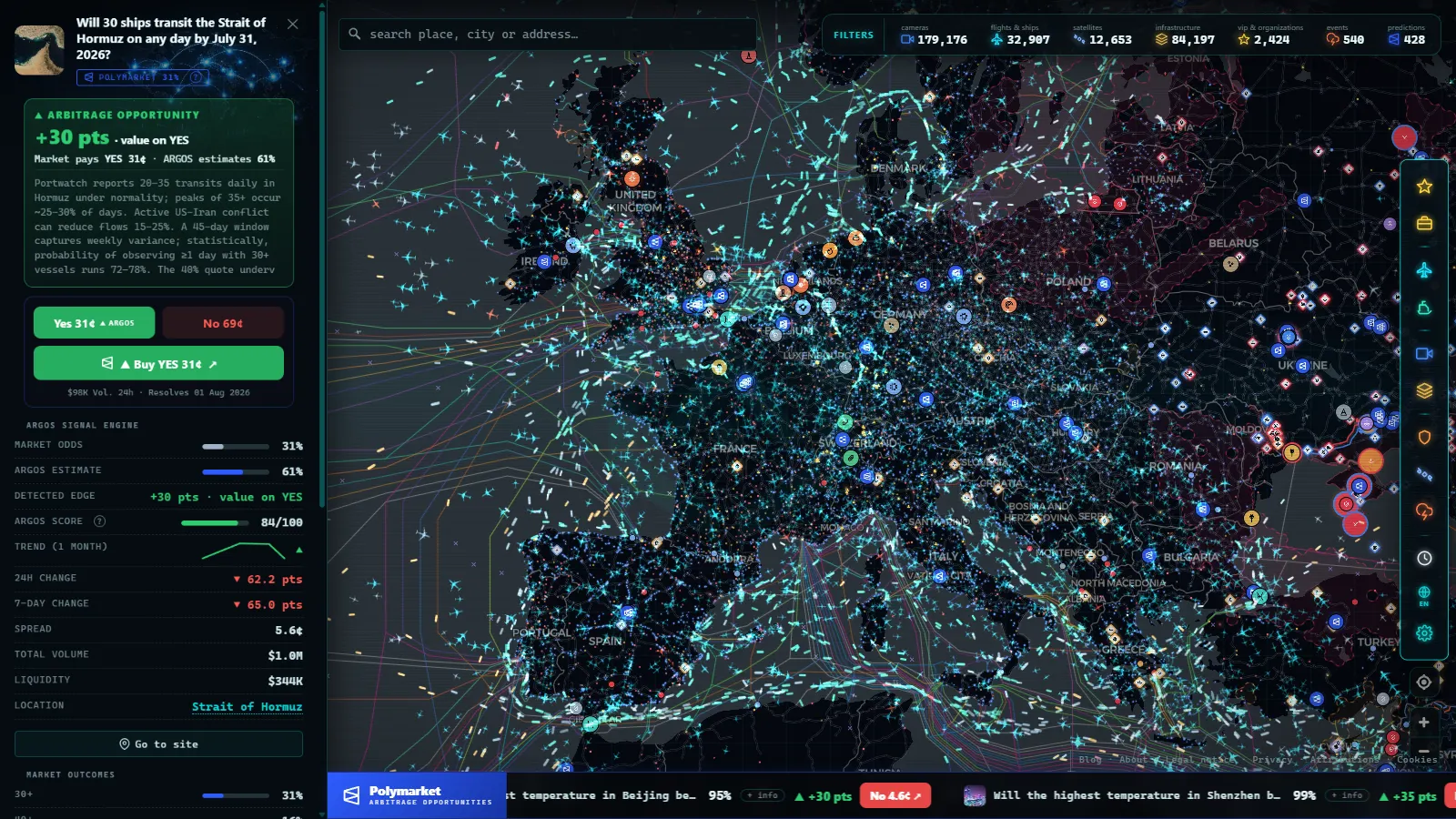
Recorded straight off the map, no sound.
Process mistakes: the invisible ones
9. Not keeping records. Without a log, your memory will tell you a flattering story: you'll remember the wins and rationalize the losses. Write down every trade (market, price, your estimated probability, your reasoning) and review the whole set monthly. It's the only way to know whether you have real edge or recent luck.
10. Blindly copying other people's positions. On Polymarket, positions are public and auditable, and it's tempting to mirror whoever is winning. But you arrive late to their price, you won't see their exit until it has already happened, and you know nothing about their risk management. Studying good traders is useful; imitating them without judgment is not.

How to start on the right foot
If one thing connects all ten mistakes, it's the absence of method. The antidote fits in four lines:
- Start small and accept that learning has a cost. The data is stubborn: according to a 2026 on-chain analysis, only about 7-8% of wallets are profitable, we break it down in how many people actually make money on Polymarket.
- Specialize in one type of market you genuinely understand instead of grazing on everything.
- Look for independent context before accepting the market's price. Argos Atlas's geolocated predictions place each Polymarket market at the exact location of the underlying event, alongside a proprietary signal ("ARGOS") that compares the market's odds with an independent estimate, a quick contrast that tells you when something deserves a closer look.
- Define your bankroll before you enter. If you decide to open a Polymarket account, deposit only that amount and treat it like tuition for a course: you may earn it back and more, but its first job is to teach you.
Prediction markets reward statistical humility: estimate, measure, adjust. The ten mistakes on this list are, at bottom, ten ways of skipping that cycle. Avoid them and you're already ahead of most of the field.
This content is informational and does not constitute financial advice or an investment recommendation.
Frequently asked questions
What is the single most expensive beginner mistake?
Betting too big on one market. You can make almost every other mistake and survive long enough to fix it, but if half your bankroll rides on one position and it fails, there is nothing left to fix. Bet sizing matters more than any single call.
How much money do I need to start with prediction markets?
Only what you can afford to lose entirely. There is no magic minimum: the mechanics are identical with 20 dollars or 2,000. Starting small buys you the most valuable thing a beginner can own, cheap experience.
Are prediction markets just gambling?
Every individual event involves luck, but long-run results depend on estimating probabilities better than the market price. That is a trainable skill, which does not remove the risk: most participants still lose money.
How do I know whether I'm actually improving?
Keep a log. Record every trade with the entry price, your estimated probability and the reason behind it. After a few dozen trades you can compare your estimates against reality and see whether your judgment adds anything beyond the market price.
- Bankroll Management and the Kelly Criterion for Prediction Markets
- Limit Orders on Polymarket: The Quiet Way to Pay Less
- How Many People Actually Make Money on Polymarket? The Real Data
- Selling Before Resolution: Taking Profits in Prediction Markets
- Weather Prediction Markets: Trading the Degrees
- Crypto Prediction Markets: Price Exposure Without Buying the Asset