Blog · Traffic cameras
Santiago Traffic Cameras: Local Traffic Updates Live from Chile
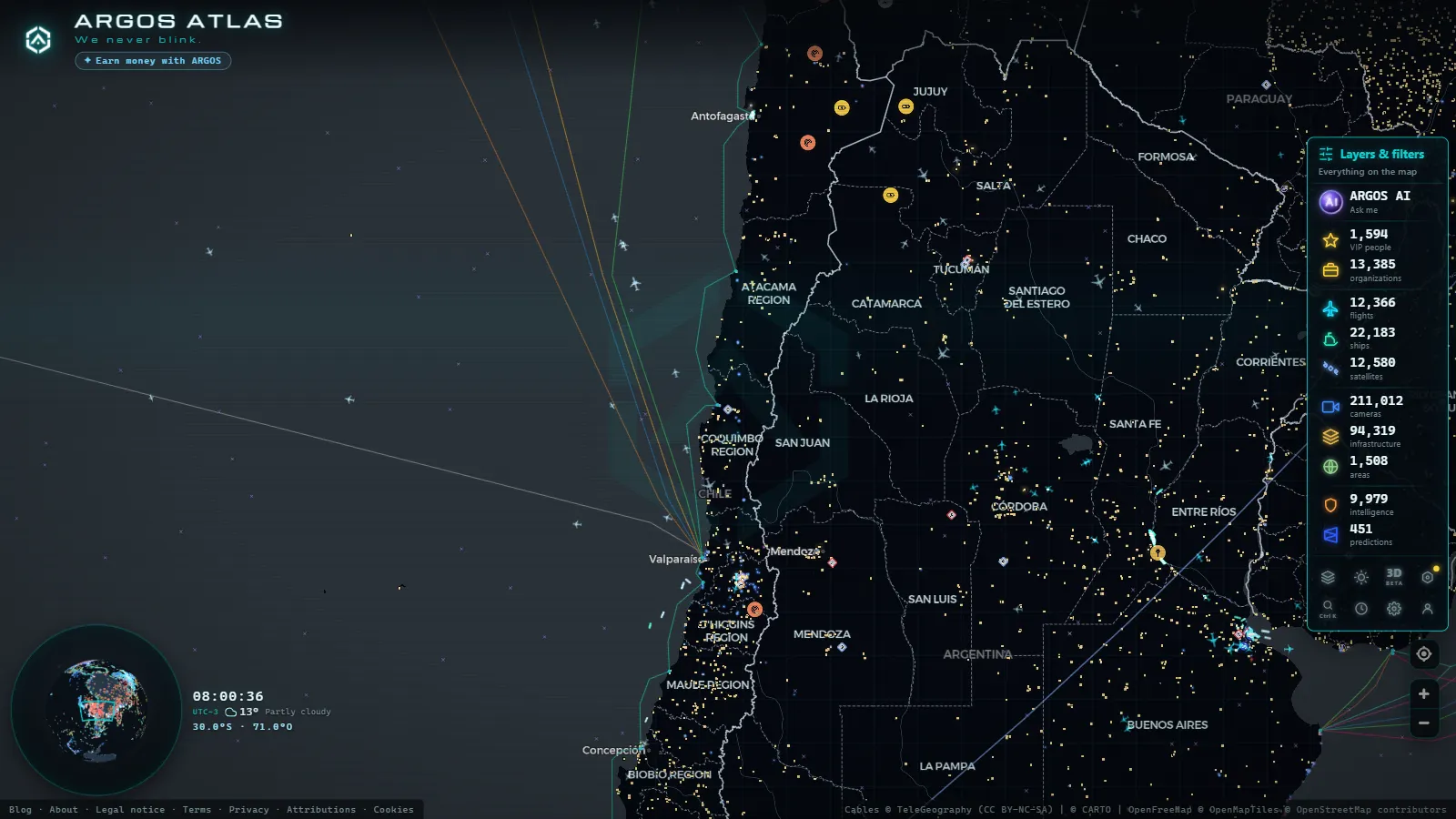
Santiago's motorway network: a model of privatised urban mobility
Santiago, Chile, is home to one of the most extensive networks of privately operated urban motorways in the world. Unlike most Latin American capitals, where surface roads and public transit dominate, Santiago built its urban mobility model around a series of high-speed concession motorways that cut through and beneath the city, funded by toll revenue and governed by contracts with the Ministry of Public Works.
That model has produced something unusual: a city of seven million people where real-time traffic monitoring is largely handled by private operators, each running their own CCTV infrastructure, their own control centres and their own public information portals. Understanding how these pieces fit together is the first step to making sense of Santiago's road data, and to knowing where to look when traffic grinds to a halt.
Autopistas Urbanas: the concessionaire backbone
Autopistas Urbanas is the commercial brand covering several of Santiago's most heavily used concession routes: Autopista Central, Vespucio Norte Express, Vespucio Sur and Autopista Vespucio Oriente, among others. Together these routes form a rough ring-and-spoke system that allows drivers to cross the city at motorway speeds, in theory.
The CCTV infrastructure deployed along these routes is substantial. Overhead gantries carry pan-tilt-zoom cameras at regular intervals; licence plate recognition systems sit at toll plazas and key access points; and variable message signs translate the data generated by those cameras into real-time guidance for drivers.
The operator's public-facing portal publishes camera snapshots from the busiest pinch points (access ramps from Ruta 68, the Alameda interchange and tunnel portals) refreshed every few minutes. For most drivers, this is the quickest way to check conditions before leaving home.
What the cameras actually measure
Beyond the still images published online, the camera systems feed a broader traffic management workflow:
- Incident detection: automated video analytics flag stationary vehicles, debris or wrong-way drivers and alert the control room.
- Speed profiling: inductive loops and camera-based readings generate average speed data by segment, which feeds into navigation apps via data-sharing agreements.
- Flow optimisation: operators can adjust variable message signs and, in some cases, access control barriers in response to congestion patterns detected by the cameras.
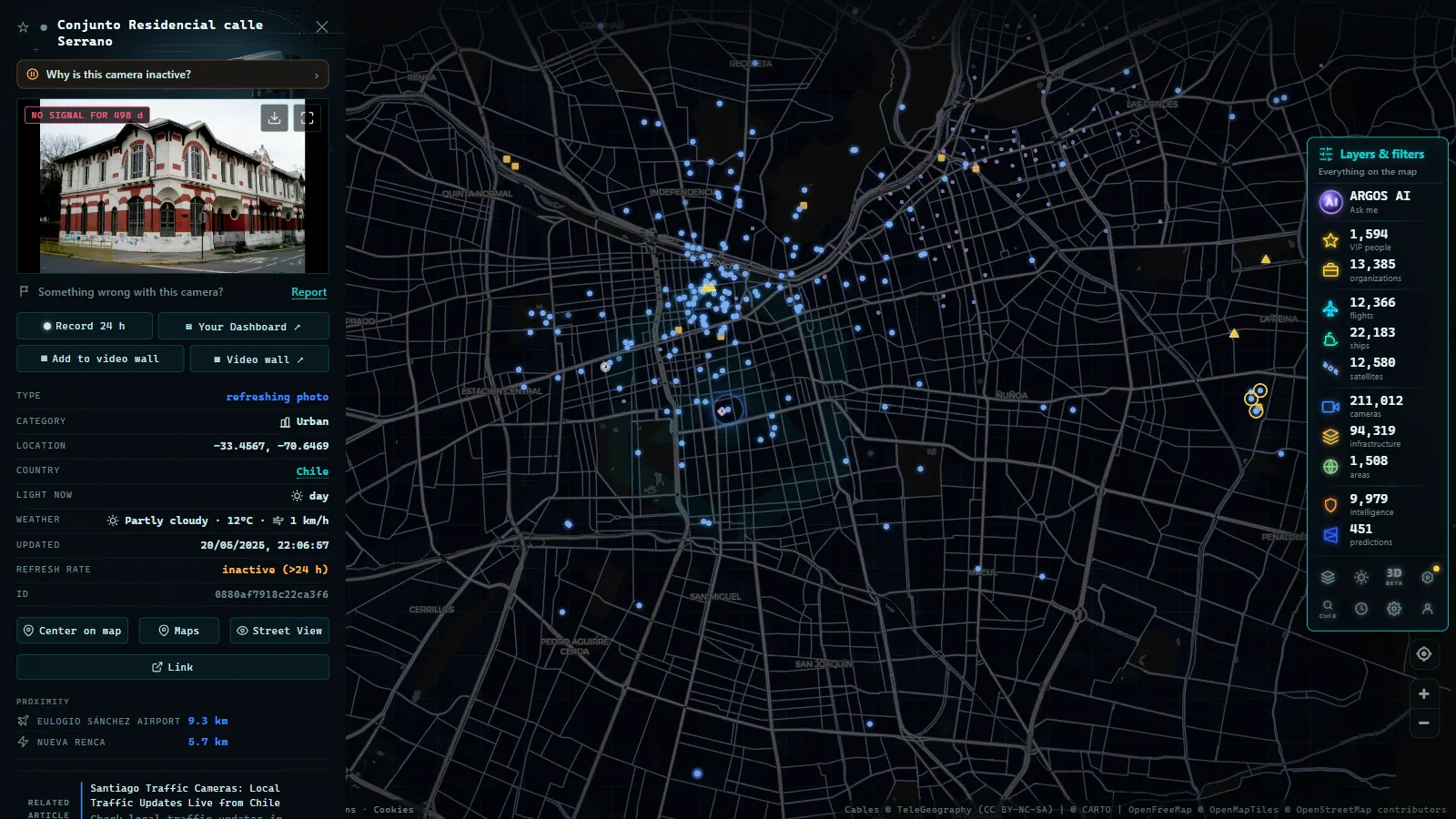
Costanera Norte: cameras above and below the Mapocho
Costanera Norte is arguably Santiago's most strategically important urban motorway. Running roughly east-west along the Mapocho River, it connects the affluent eastern suburbs with the city centre and the western districts, partly at surface level and partly through a series of tunnels. The combination of open-air and underground sections makes it one of the most technically demanding environments for traffic monitoring in Chile.
"Managing a tunnel motorway is a fundamentally different challenge from surface road monitoring. Every second of visibility gap is a safety risk, which is why Costanera Norte's tunnel CCTV infrastructure is among the most densely deployed in South America."
Inside the tunnels, cameras serve purposes beyond congestion measurement. Fire detection, ventilation control and emergency access coordination all depend on operators having continuous visual coverage of the tunnel interior. The control room monitors these feeds around the clock, with automatic alerts triggered by smoke, stopped vehicles or any anomaly detected by video analytics software.
For the general public, Costanera Norte publishes selected exterior feeds (the Kennedy Avenue access point, the La Pirámide interchange and the Vespucio junction are among the most frequently checked) through its driver information portal. Interior tunnel feeds remain restricted to the operator's control room.
From the ARGOS ATLAS channel.
AM Túnel: specialist tunnel operations
AM Túnel is another key operator in Santiago's concession landscape, responsible for specific tunnel sections with their own dedicated monitoring infrastructure. Tunnel operations require a higher density of CCTV coverage than surface roads (typically one camera every 50 to 100 metres) because evacuation planning, ventilation management and emergency coordination all depend on continuous visual contact with every point in the tube.
AM Túnel's systems integrate camera feeds with environmental sensors measuring air quality, temperature and visibility. This data informs both real-time operational decisions and long-term infrastructure maintenance planning. While the camera feeds themselves are not publicly accessible, the operational data they generate flows into the broader Santiago traffic management ecosystem through protocols coordinated by COSAM.
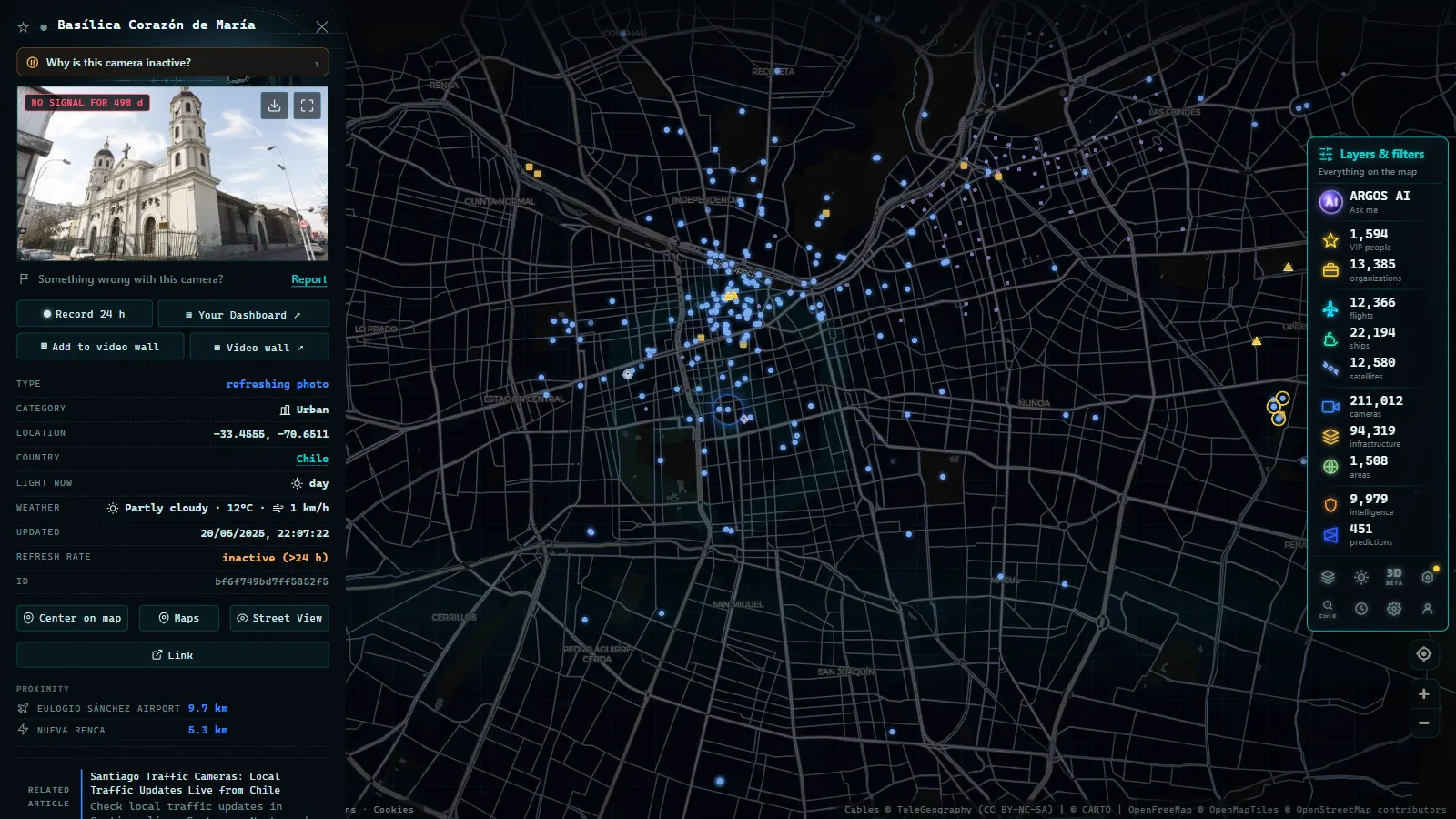
COSAM: the metropolitan coordination layer
No discussion of Santiago traffic cameras is complete without COSAM, the Centro de Operación del Sistema de Autopistas Metropolitanas. COSAM is not itself an operator of motorways; it is the coordination layer that sits above the individual concessionaires, enabling them to respond coherently to incidents that affect multiple routes simultaneously.
When an accident on Autopista Central generates a spillover onto Vespucio Norte, it is COSAM that coordinates the response: alerting both operators, synchronising variable message signs across both routes and liaising with Carabineros de Chile and emergency services. The camera feeds from all the major concessions are accessible to COSAM operators during incident management, giving them a system-wide picture that no single concessionaire has on its own.
COSAM does not operate a public camera portal, but its activity is visible in the incident alerts that propagate to navigation apps, local radio stations and the social media accounts of the individual operators.
The Ministry of Public Works as regulator
The Ministerio de Obras Públicas (MOP) sits at the top of the governance pyramid. As the concession-granting authority, it sets the technical standards that operators must meet, including CCTV density requirements, data retention periods and incident response time benchmarks.
Through its Dirección de Concesiones, the MOP has supervisory access to operator systems and can audit camera infrastructure as part of its compliance monitoring role. It also publishes aggregated performance statistics: incident response times, system availability rates and anonymised speed data. This information is publicly available and useful for researchers studying urban mobility policy, even if it does not include live camera imagery.
Fragmentation and the integration challenge
The multi-operator model that makes Santiago's motorways function efficiently also creates a significant information fragmentation problem for end users. A driver wanting to check conditions across their full journey (say, from the eastern suburbs via Costanera Norte and then south on Autopista Central) needs to consult at least two separate operator portals, and possibly more if municipal roads are involved.
Tools like ARGOS ATLAS address this fragmentation by aggregating traffic camera sources from multiple cities and operators into a single map interface. Rather than navigating between operator portals, users can get local traffic updates for any road from the cameras themselves, with Santiago's feeds sitting alongside traffic data from other Latin American cities (Buenos Aires, Lima, Bogotá) in a unified view. For researchers, urban planners and curious citizens, this kind of comparative visibility is increasingly valuable as cities compete to share best practices in road management.
You can explore Santiago's traffic monitoring landscape through ARGOS ATLAS and compare it with similar concession-based motorway systems in other cities, seeing how different governance models shape the availability and quality of public traffic data.
Privacy and the limits of public access
Chile's traffic camera framework draws a legal distinction between vehicular flow monitoring and personal surveillance. Cameras deployed under concession agreements are authorised for traffic management purposes, detecting vehicles, not identifying occupants. Licence plate data captured at toll plazas is subject to privacy protocols defined in the concession contracts and overseen by the MOP.
That said, the technical capabilities of modern traffic cameras have advanced considerably. Contemporary systems can read plates at 120 km/h, run AI-based behavioural detection and potentially integrate with other data streams in ways the original concession contracts did not anticipate. Understanding the infrastructure that surrounds daily commuting is no longer a niche interest, it is part of informed urban citizenship.
Conclusion
Santiago, Chile, has built one of Latin America's most sophisticated urban traffic monitoring networks, distributed across private operators like Autopistas Urbanas, Costanera Norte and AM Túnel, coordinated through COSAM and overseen by the Ministry of Public Works. Each layer serves a distinct function, and together they keep a major metropolis moving.
Exploring this network through ARGOS ATLAS places Santiago's monitoring infrastructure in global context, letting you see how the concession model shapes data availability and what it means for drivers, researchers and policymakers who want to understand urban mobility at scale.
Frequently asked questions
Where can I watch live traffic cameras in Santiago, Chile?
Live traffic camera feeds from Santiago are available through the Autopistas Urbanas and Costanera Norte operator portals, as well as ARGOS ATLAS, which aggregates road monitoring sources from across the region into a single interactive map.
What is COSAM in Santiago's road network?
COSAM stands for Centro de Operación del Sistema de Autopistas Metropolitanas, the Metropolitan Motorway Operations Centre. It coordinates incident response and traffic management across the multiple concession operators that run Santiago's urban motorways.
Are Costanera Norte tunnel cameras accessible to the public?
The interior tunnel cameras are restricted to the operator's control room for safety reasons. However, selected exterior camera feeds at congested points are published on the Costanera Norte operator portal for public information.
- Live Traffic Lima, Peru: Watch Real-Time Cameras Now
- Traffic Cameras in Ecuador: Quito, Guayaquil and the Troncal de la Sierra Highway
- Caracas Traffic Cameras Live: Francisco Fajardo & Caminante
- Traffic Cameras in Uruguay and Montevideo: A Complete Guide
- Traffic Cameras in Costa Rica: COSEVI, Route 27 and the Country's Most Monitored Roads
- Live Traffic Cameras in Medellin: Metro, Mountain Autopistas and Aerial Cable Cars