Blog · Critical infrastructure
Europe's Major Seaports: Rotterdam, Antwerp, Hamburg, Valencia, Algeciras and Piraeus
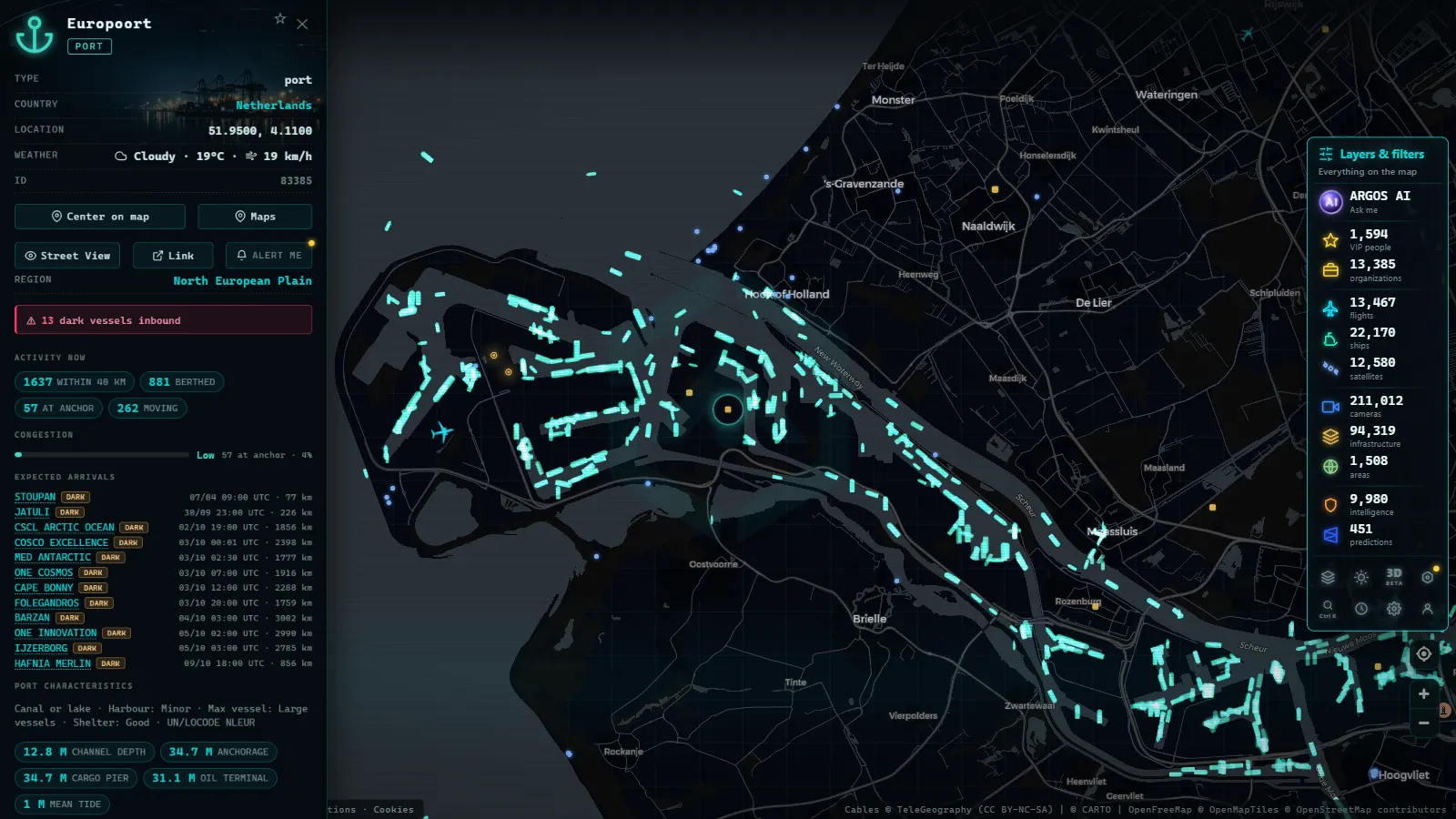
Europe's major seaports are more than infrastructure, they are the physical nodes through which global trade is routed, priced and sometimes held hostage by congestion, geopolitics or weather. Understanding how Rotterdam differs from Piraeus, or why Algeciras punches well above its industrial weight, is to understand the mechanics of the modern economy at its most concrete.
The essentials, in 20 seconds
- Rotterdam: Europe's largest container port, about 15 million TEU a year across the Maasvlakte 2 terminals.
- Antwerp-Bruges: Europe's second-largest, around 12 million TEU, home to the continent's largest chemical storage zone.
- Hamburg: Europe's third-largest port at roughly 8.5 million TEU, now shadowed by COSCO's stake in the Tollerort terminal.
- Algeciras: a transshipment hub of about 5.5 million TEU at the Strait of Gibraltar, where more than 100,000 vessels pass each year.
- Piraeus: the eastern Mediterranean's largest port, just over 5 million TEU, majority-controlled by COSCO since 2016.
Rotterdam: Europe's Benchmark Port
Rotterdam processes approximately 15 million TEU (twenty-foot equivalent units) per year, making it Europe's largest container port and one of the top ten globally. Positioned at the Rhine-Meuse delta, it serves a hinterland encompassing Germany, Belgium, Switzerland, Austria and large parts of central Europe, a combined consumer and manufacturing base that few ports on earth can match.
The port extends over 40 kilometres of waterfront, culminating in the Maasvlakte 2 terminals, land reclaimed from the North Sea in the early 2010s specifically to handle ultra-large container vessels. These terminals operate with automated gantry cranes, autonomous guided vehicles and digital inventory systems that dramatically compress vessel turnaround times.
"Rotterdam is not merely a port; it is a machine city engineered to move the world. Every container that arrives follows a path traced with surgical precision."
The dedicated Betuwe freight railway connects Rotterdam directly to the German rail network, allowing containers to reach the Ruhr industrial heartland within hours. An extensive inland waterway network extends that reach to over 600 river destinations across western Europe.
Antwerp-Bruges: Europe's Chemical Gateway
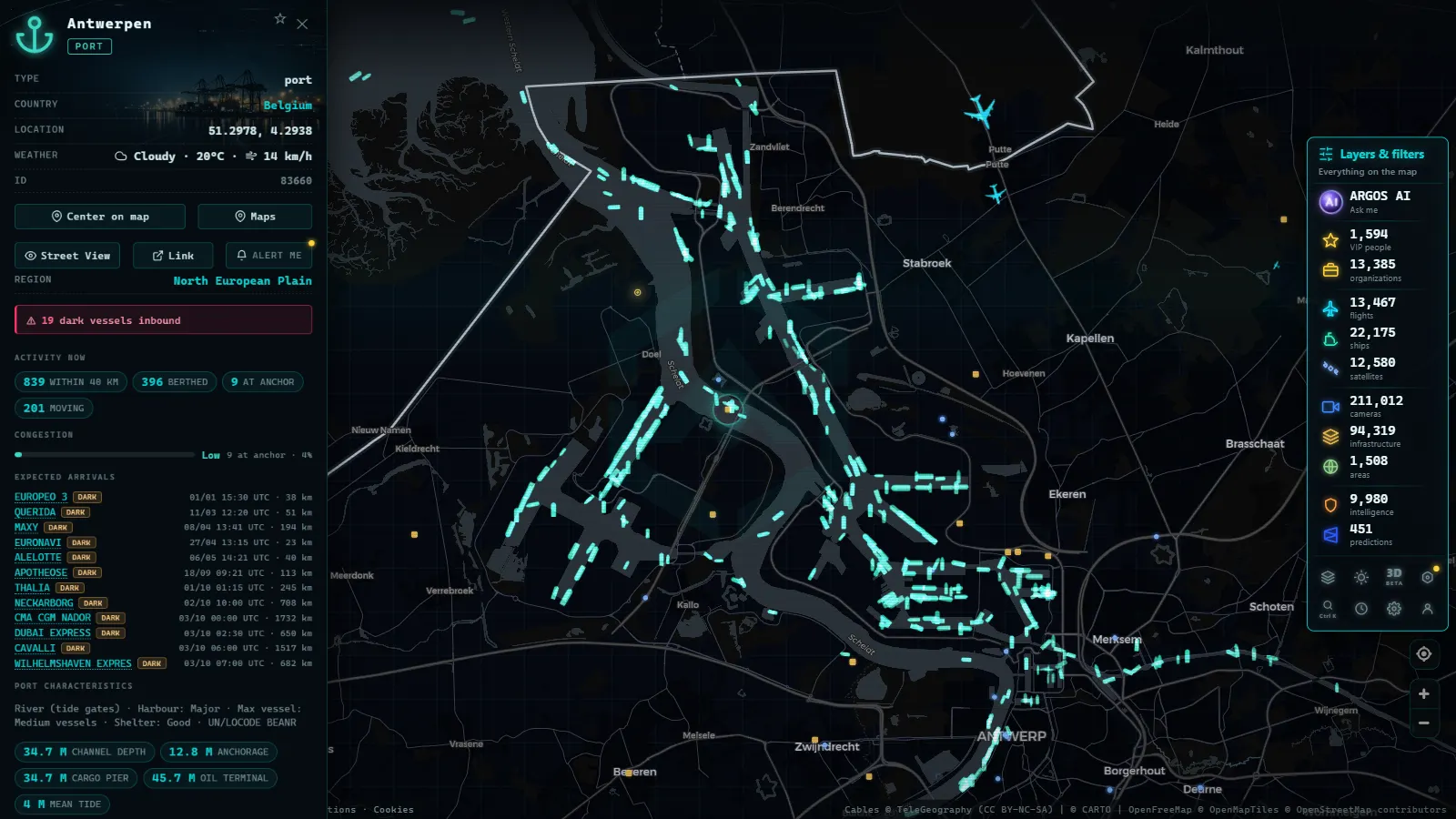
The Port of Antwerp, administratively merged with the Port of Bruges in 2022 to form Antwerp-Bruges, processes around 12 million TEU annually and ranks as Europe's second-largest container port. Its clearest differentiator from Rotterdam is not scale but specialisation: Antwerp hosts the world's largest chemical storage zone outside Asia.
The Antwerp basin houses more than 300 petrochemical and chemical companies interconnected by underground pipelines that allow liquid transfers between facilities without trucks or trains. This integration between port infrastructure and adjacent industry creates an ecosystem that is extraordinarily difficult to replicate elsewhere.
On the container side, MSC PSA European Terminal and Antwerp Gateway are the highest-capacity installations, both the subject of continuous automation investment. Access via the Scheldt estuary ensures deep-draught vessels can reach the port directly from the North Sea.
From the ARGOS ATLAS channel.
Hamburg: Germany's Port and the Asian Capital Question
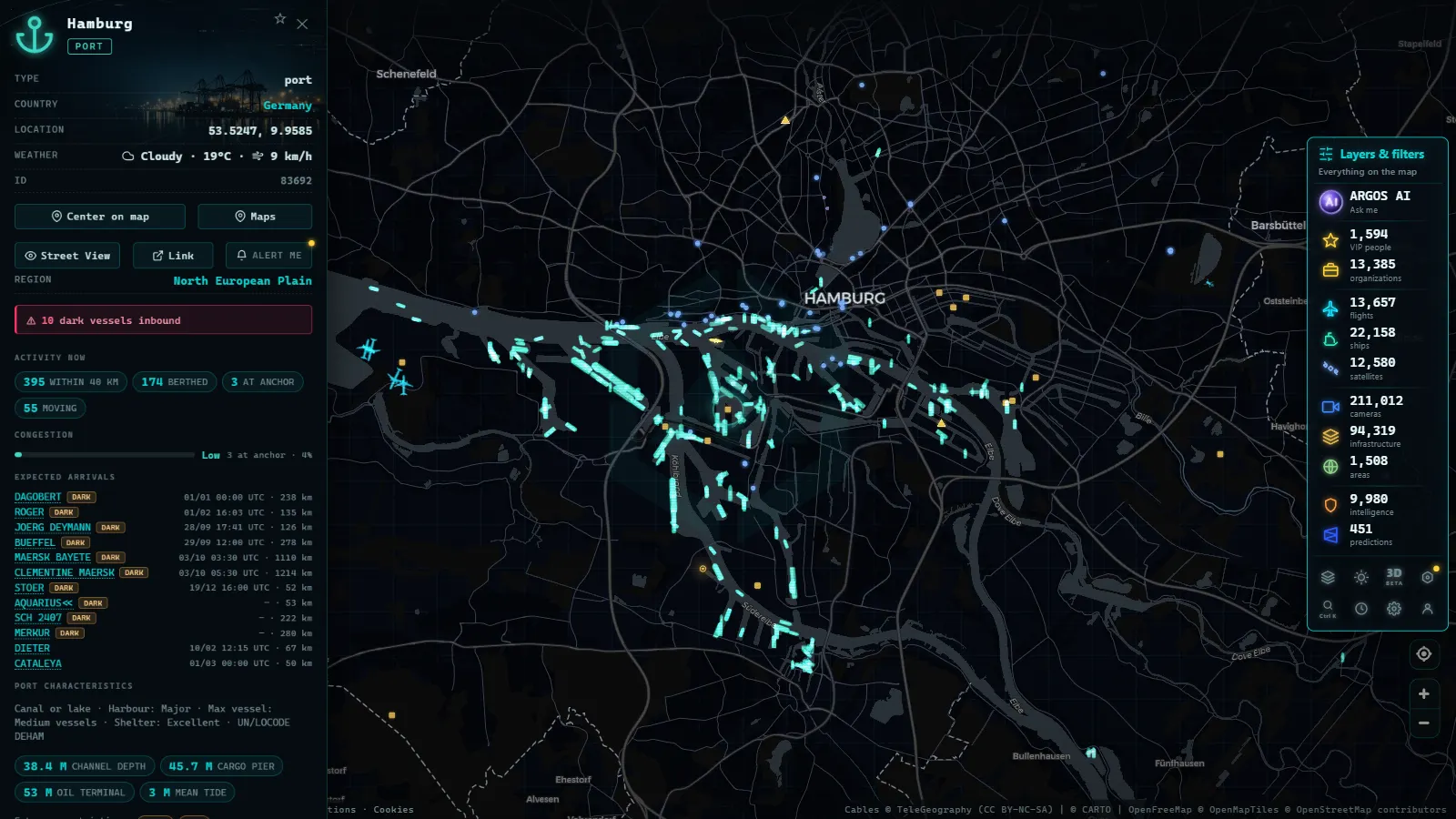
Hamburg was for decades the undisputed reference port of northern Europe. It remains the third-largest in Europe at roughly 8.5 million TEU per year, but faces structural headwinds. The depth of the Elbe has historically restricted access for the largest container ships, and successive dredging projects have generated persistent environmental and political friction.
The most geopolitically significant recent development at Hamburg is COSCO's stake in the Tollerort terminal. The entry of Chinese state capital into a critical European logistics node triggered intense debate about strategic sovereignty, a debate that has not been resolved and is unlikely to be.
Hamburg's hinterland is particularly dense and northward-oriented: from here, freight services supply the Czech Republic, Poland, the Baltic states and Scandinavia through a combination of rail and short-sea shipping.
Valencia: Spain's Leading Port and the Mediterranean's Western Hub
Valencia is Spain's busiest container port and Europe's sixth-largest, handling volumes approaching 6 million TEU. Its position in the western Mediterranean makes it a key node on the routes connecting Asia with southern Europe and North Africa.
The port operates three major container terminals: MSC Terminal Valencia, Noatum (Qatari-owned) and the Grimaldi ro-ro terminal for wheeled cargo. The rail connection along the Mediterranean Corridor (still being completed) is the critical variable for reducing road congestion around the port.
A distinguishing feature of Valencia's cargo profile is its diversity: alongside containers, it is one of Europe's leading vehicle-handling ports, and moves significant volumes of dry and liquid bulk, along with passenger ferry traffic to the Balearic Islands.
The Northern Extension Controversy
The proposed northern expansion of Valencia's port has generated one of Spain's most contentious planning disputes. The project would add terminals capable of receiving the largest container vessels afloat, but critics point to the environmental impact on the northern beach and coastline. The controversy reflects a tension between logistics competitiveness and urban quality that many European port cities are navigating simultaneously.
Algeciras: Sentinel of the Strait
Algeciras processes around 5.5 million TEU per year, but its strategic importance substantially outweighs that figure. The Strait of Gibraltar is one of the busiest maritime chokepoints on earth: more than 100,000 vessels transit it annually, making Algeciras an observation post of exceptional value for anyone tracking global trade flows.
Algeciras operates primarily as a transshipment hub. Large container vessels that cannot make multiple port calls discharge part of their cargo here; feeder vessels of smaller draught then redistribute that cargo to ports across the Mediterranean, North Africa and the South Atlantic. APM Terminals, Maersk's port subsidiary, manages the highest-volume installations.
The proximity of Tanger Med (the Moroccan port just across the strait) creates intense competition but also a functional complementarity that has transformed the Bay of Algeciras into a binational logistics ecosystem. Tanger Med has overtaken Algeciras in overall throughput in recent years, adding further competitive pressure.
Piraeus: China's Southern European Foothold
Piraeus is the eastern Mediterranean's largest port and one of the most debated infrastructure projects in Europe. Since 2016, COSCO, the Chinese state-owned shipping conglomerate, has controlled the majority stake in the port authority after acquiring the container terminals and subsequently expanding its position.
Processing just over 5 million TEU per year, Piraeus has been transformed over the past decade: from a port in relative decline to a competitive hub with rail and road connections reaching into the Balkans, central Europe and the Black Sea region. Chinese investment has funded new terminals, modern equipment and improvements to inland freight rail.
The Piraeus case raises questions that Europe will face repeatedly in coming decades: how much capital from non-democratic economies can its critical infrastructure absorb before strategic autonomy is meaningfully compromised? The answer remains contested across European institutions.
Tracking These Ports on ARGOS ATLAS
All six ports generate continuous AIS traffic that can be monitored in real time. ARGOS ATLAS integrates positioning data from container ships, tankers, bulk carriers and passenger vessels, allowing you to observe inbound and outbound flows at each of these nodes.
You can use the map to watch vessels queuing at anchor off Rotterdam during periods of high congestion, track how many container ships are transiting the Strait of Gibraltar toward Algeciras at any given moment, or observe traffic patterns around Piraeus according to Middle East and Asian route schedules.
This live visualisation turns abstract statistics (millions of TEU, throughput rankings) into observable movement: ships with names, flags, destinations and speeds.
The Competitive Landscape
These six ports do not only compete with each other. They face growing pressure from Tanger Med, which has already surpassed several of them in some metrics, and from the northern Adriatic ports (Trieste, Koper, Rijeka) which are positioning themselves on shorter rail corridors to central Europe as an alternative gateway for Asian cargo.
Port infrastructure is, at its core, a geopolitical bet. The nations and companies that control major ports influence freight prices, delivery times and, in extreme scenarios, the flow of essential supplies. The investments made in Rotterdam's Maasvlakte 2, COSCO's Piraeus expansion or Maersk's Algeciras terminals are not merely commercial decisions, they are wagers on where trade will flow and who will control its routing.
Explore live vessel movements at ARGOS ATLAS. The ships currently entering and leaving Rotterdam, Hamburg or Algeciras are visible right now, their public AIS data available to anyone willing to look.
Frequently asked questions
Which is the largest port in Europe?
Rotterdam is Europe's largest port by container volume, processing around 15 million TEU annually. It is the only European port that consistently ranks among the world's top ten, and it serves as the primary gateway for a hinterland stretching across Germany, Belgium, Switzerland and much of central Europe.
Why is Algeciras so strategically important despite Spain not being the largest industrial economy?
Algeciras owes its significance to its location at the Strait of Gibraltar, where Atlantic and Mediterranean routes converge. It operates primarily as a transshipment hub, redistributing cargo from large vessels to feeder services heading to North Africa, southern Europe and Latin America.
How can I track ships entering and leaving these ports in real time?
ARGOS ATLAS provides a live map with AIS tracking of container ships, tankers and bulk carriers. You can filter by vessel type and watch traffic around Rotterdam, Hamburg, Valencia, Algeciras, Piraeus and all major European ports directly in your browser.
- Europe's Busiest Airports: Heathrow, Charles de Gaulle, Schiphol, Frankfurt, Istanbul and Madrid-Barajas
- Canada's Major Seaports: Vancouver, Prince Rupert, Montreal and Halifax
- Spain Airport Codes: IATA & ICAO + Live View
- Biggest Airports in the US: Ranked List (Live Map)
- The Biggest Airports in the World: 2025 Passenger Ranking
- Iran on a Live Map: Airports, Flights and Hormuz Ships