Blog · Prediction markets
Implied Probability: How to Calculate It and Why It Saves You Money

Every time you look at odds (on Polymarket, at a bookmaker, anywhere) you are looking at a probability dressed up as a price. Implied probability is what you get when you remove the costume: converting that number into the percentage chance it is actually quoting. It is the most basic operation in this entire world and, at the same time, the one that saves the most money, because it lets you answer the only question worth asking before risking a dollar: does the payout compensate for the real chance of being right?
The good news: it takes seconds to compute, and in prediction markets, you don't even have to compute it. Let's go step by step.
What implied probability actually is
Every price carries a built-in opinion about the future. When someone offers to pay you $2.50 for every dollar staked if your call is right, they are telling you (implicitly) what probability they assign to that event. Implied probability is that hidden percentage: the probability at which the offered price would be fair, neither a bargain nor a rip-off.
That is where its practical power comes from: once extracted, you can compare it against your own estimate. If the price implies 40% and you, for good reasons, estimate 55%, the price is cheap. If it implies 40% and you estimate 25%, it is expensive. Skip that intermediate step and you are just comparing hunches against numbers wearing a disguise.
In prediction markets, the price IS the probability
Prediction markets have a pedagogical head start here. On Polymarket, every share trades between $0 and $1 and pays exactly $1 if it wins. Direct consequence: the share price literally is its implied probability, no conversion formula needed.
- YES share at $0.32 → the market is quoting a 32% chance.
- NO share at $0.68 → a 68% chance the event doesn't happen.
Notice, too, that the pair adds up to roughly one dollar: YES + NO ≈ $1. That identity (a consequence of every winning share paying $1) is the mathematical signature of a market with no hidden margin. File it away, because we are coming back to it. For the details of why prices move and who moves them, see how odds work in prediction markets.
Converting decimal and American odds
Outside prediction markets, probability comes encrypted in odds formats. The conversions worth keeping at hand:
- Decimal (European) odds: implied probability = 1 ÷ odds. Examples: odds 2.00 → 50%; odds 2.50 → 40%; odds 1.25 → 80%; odds 5.00 → 20%.
- Positive American odds (e.g. +150): 100 ÷ (odds + 100) → 100/250 = 40%.
- Negative American odds (e.g. −200): |odds| ÷ (|odds| + 100) → 200/300 = 66.7%.
Mastering the decimal case covers 90% of situations: divide 1 by the odds and you are thinking in percentages, the language in which opinions about the future can actually be compared.
Recorded straight off the map, no sound.
The overround: the bookmaker's invisible tax
Now the part that genuinely saves money. Run this experiment on any bookmaker's event: convert every price to implied probability and add them up. The sum won't be 100%. It will be more (say 105-110%) and that excess has a name: the overround, the operator's structural margin. If an event sums to 107%, bettors are collectively paying a 7-point toll, whoever wins. The odds you see don't reflect the operator's estimated probability: they reflect that probability plus their commission, spread across every outcome.
Prediction markets work differently: since participants trade against each other, YES + NO ≈ $1, the sum sits around 100%, and the cost of trading is concentrated in the visible bid-ask spread (plus explicit fees, which have changed over time; check the official page). The full comparison lives in prediction markets vs bookmakers, but the moral fits right here: knowing how to compute implied probability is what lets you see the toll before you pay it.
How it saves you money in practice
Reduced to a routine, the discipline has three steps: extract the implied probability from the price, form your own estimate through independent means, and act only when the gap between the two is large and explainable. That gap is precisely the trade's expected value; no gap, no reason to enter, however exciting the event.
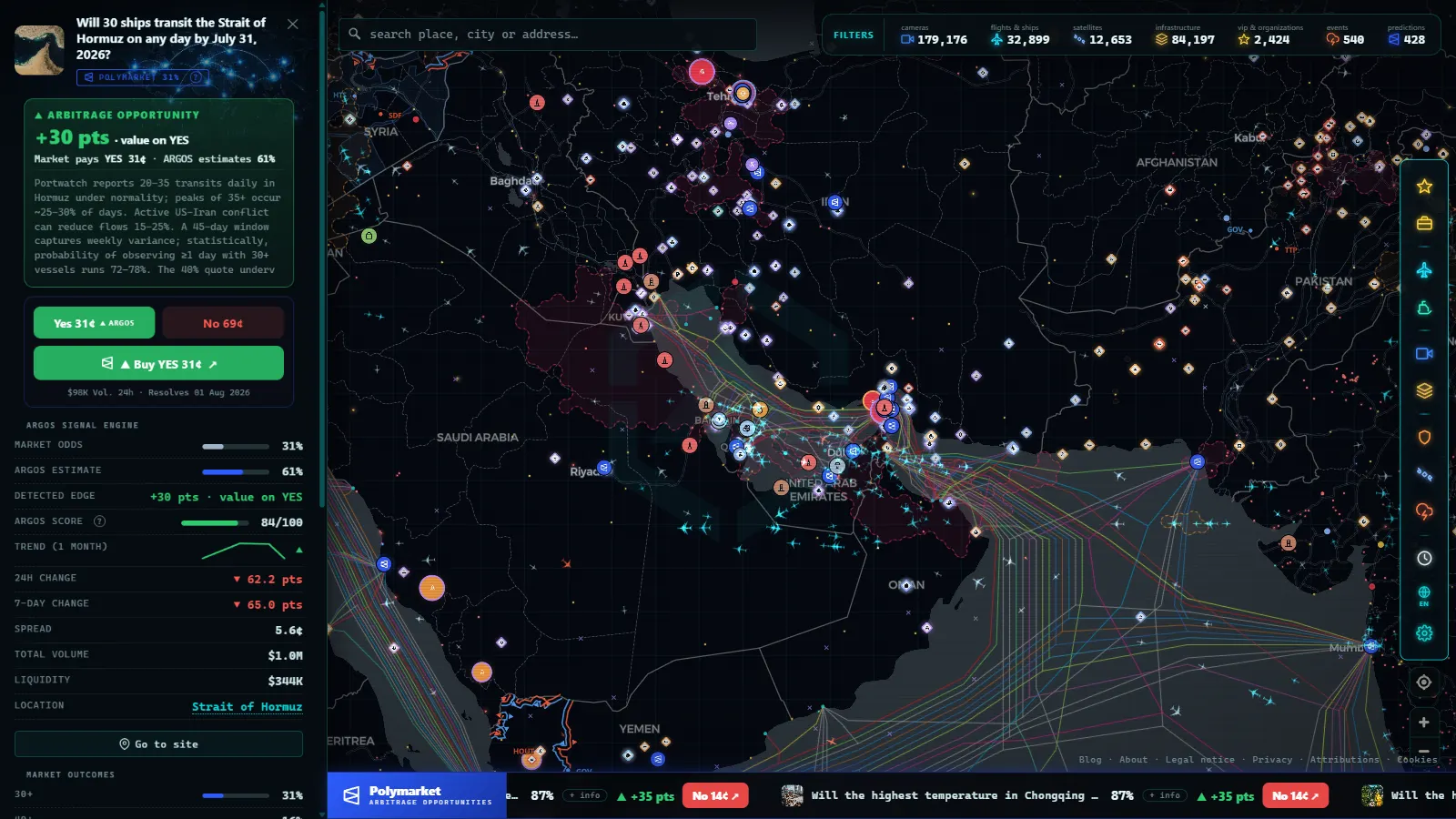
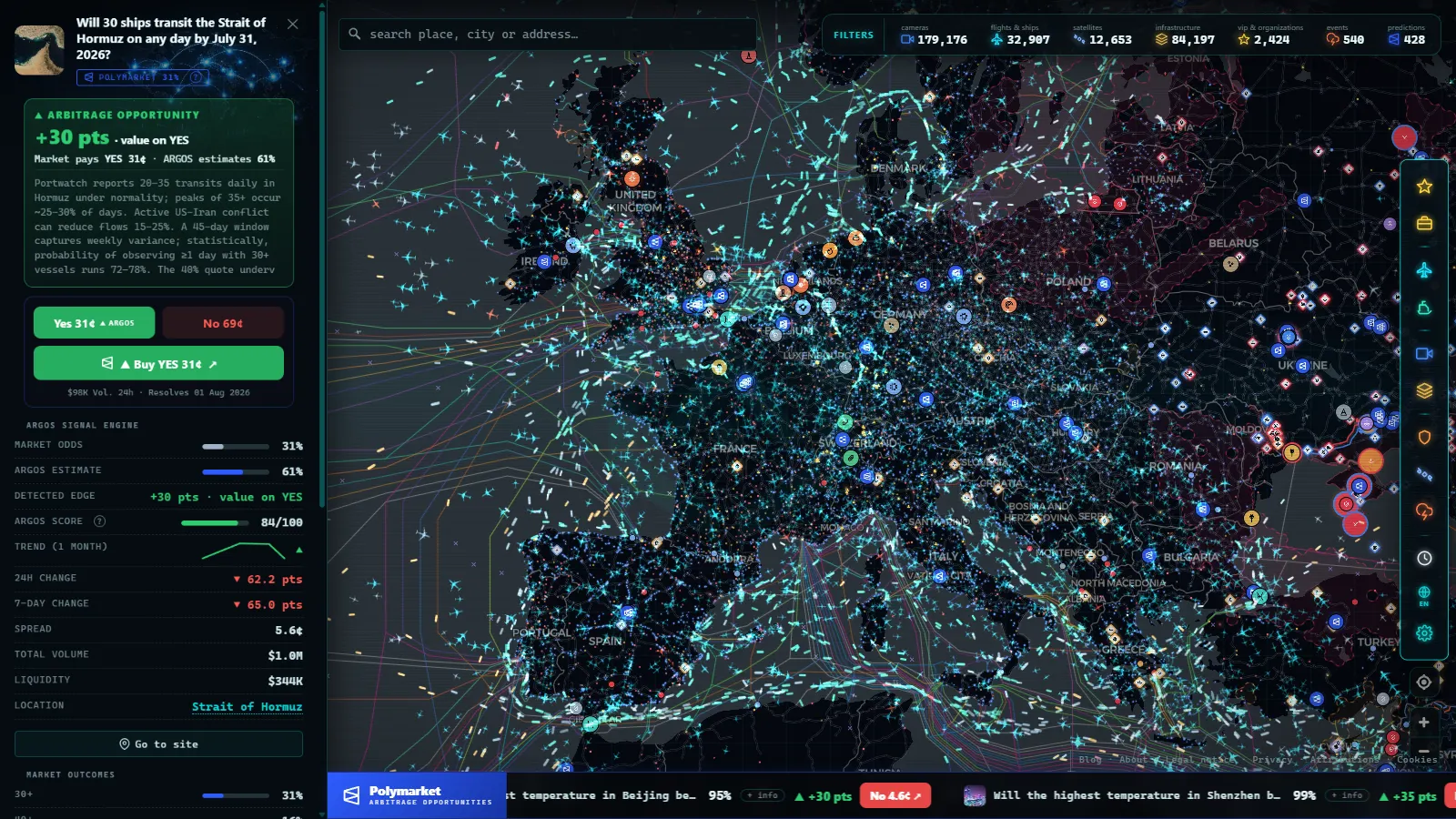
Step two is the hard one, and context helps. The geolocated predictions of Argos Atlas display every Polymarket market on the exact location of its event (an election, a conflict, a hurricane) alongside the ARGOS signal, which performs this article's comparison continuously: it contrasts the implied probability in the price against an independent estimate built from the map's own data, and flags the divergences. When one of those flags catches your eye, the circuit is the usual one: do your own analysis, and if the numbers hold, check the market on Polymarket with its live price and spread.
One final piece of honesty: implied probability tells you what the market thinks, not what will happen. Markets get it wrong, thin ones more often. Your job is neither to obey the price nor to ignore it: it is to measure it, compare it, and keep only the occasions where your analysis and the arithmetic push in the same direction. Do that for months on end, and it is what separates an expensive hobby from a profitable discipline.
This content is informational and does not constitute financial advice or an investment recommendation.
Frequently asked questions
What is the formula for implied probability?
It depends on the format. In a prediction market there is no formula: the share price already is the probability ($0.32 = 32%). With decimal odds, divide 1 by the odds: odds of 2.50 imply 1/2.50 = 40%. That single conversion is the most useful one you can memorize.
Why do a bookmaker's probabilities add up to more than 100%?
Because they include the operator's margin (the overround). Convert every price on an event and the sum might come to, say, 107%, those 7 points are the structural toll bettors pay collectively. In a prediction market, YES + NO cost roughly $1: no hidden margin, just the visible spread.
Is the Polymarket price always the true probability?
No: it is the crowd's best aggregate estimate at that moment, not revealed truth. Markets get things wrong, especially thin ones, or ones whipped around by headlines. That gap between price and true probability is exactly what methodical traders live on.
Do I need an implied probability calculator?
For decimal odds, no: dividing 1 by the odds is mental math or a phone calculator. Tools help when you compare many markets at once or convert American odds formats, but understanding the operation matters more than automating it.
- The 10 Beginner Mistakes in Prediction Markets
- Bankroll Management and the Kelly Criterion for Prediction Markets
- Limit Orders on Polymarket: The Quiet Way to Pay Less
- How Many People Actually Make Money on Polymarket? The Real Data
- Selling Before Resolution: Taking Profits in Prediction Markets
- Weather Prediction Markets: Trading the Degrees