Blog · Wealth, jets & yachts
The Carbon Footprint of Private Jets: What We Know and How It Is Estimated

Few objects better capture the contemporary climate debate than a private jet. The carbon footprint of private jets has become front-page material, the subject of academic studies, and the focus of automated accounts that estimate the emissions of every celebrity departure. Yet between the outrage and the staunch defence, what often gets lost is the essential question: what do we actually know, how are the figures that circulate constructed, and what context do they need to be read honestly? This article attempts exactly that: explaining the method, its limits, and the debate, without inflating numbers and without downplaying the problem.
Why the Private Jet Became a Climate Symbol
The basic arithmetic is difficult to dispute. A commercial aircraft spreads its fuel consumption across hundreds of passengers; a private jet spreads it across a handful of seats, many of which are often not even fully occupied. The result, as studies on private aviation consistently show, is that emissions per passenger on a private flight are several times higher than those of an equivalent commercial flight. The exact multiplier varies depending on the aircraft, the route, and occupancy, which is why serious publications speak in ranges rather than a single figure.
Two further aggravating factors compound that per-seat intensity. The first is frequency. Those who have a private jet fly more, because the marginal cost of each journey in time and friction is minimal. The second is distance. A notable share of private flights are short hops of less than an hour, on corridors where train or road alternatives exist. It is the combination of very few seats, high flight frequency, and avoidable routes that made the private jet a symbol, more than the absolute size of its emissions.
It is worth stating from the outset, in the interest of honest analysis: the problem with private jets is not that they represent the planet's largest emitter (they are nowhere near that) but that they concentrate the highest emissions intensity per person found anywhere in transport.
How an Emission Is Estimated from Open Data
The emissions figures published by tracking accounts do not come from fuel tanks: they come from an estimation chain built on public data. The method is well documented and amounts, in essence, to a four-step recipe:
- Identify the aircraft type. The ADS-B signal broadcast by the plane makes it possible to determine the model. A small light jet does not consume the same fuel as a large long-range heavy aircraft.
- Assign an average fuel consumption per hour. Every model has reference consumption figures drawn from technical documentation and industry databases. This is an average: actual consumption varies with weight, altitude, and flight profile.
- Measure flight duration. Open tracking data enters here: the ADS-B trail records take-off and landing times to the nearest minute.
- Convert fuel to CO2. Burning kerosene produces a known and stable quantity of carbon dioxide per unit of fuel, so the final step is a multiplication using standard conversion factors.
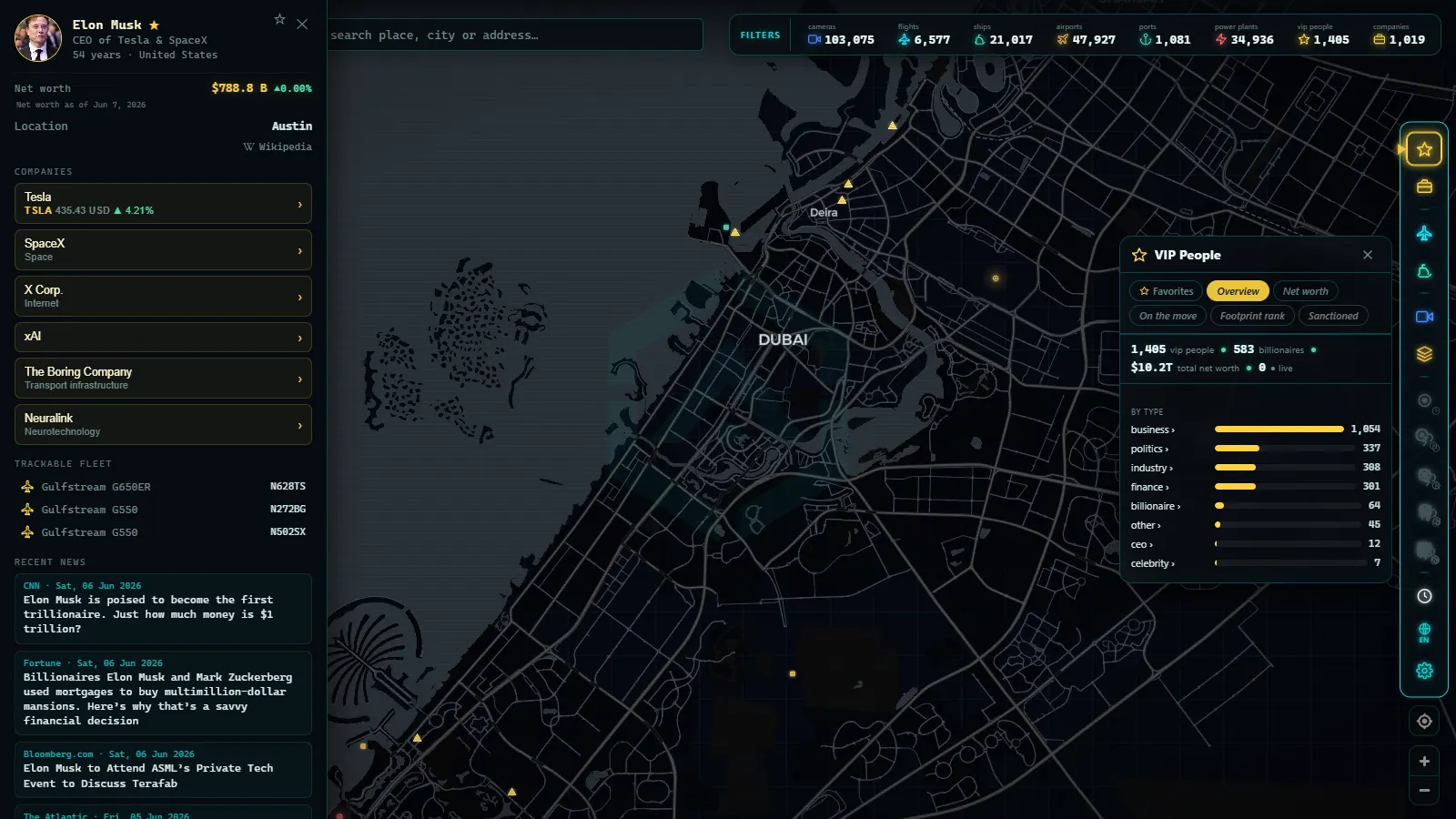
Consumption per hour, multiplied by hours flown, multiplied by the conversion factor: that is the entire mechanism. The elegance of the approach is that every piece is public (the model is identified by the signal, the consumption by the technical documentation, the duration by the receivers) so anyone can reproduce and challenge the calculation.
What the Method Captures Well, and What It Does Not
The method deserves the same scrutiny we would apply to any estimate. Its strengths: it provides a reasonable order of magnitude, it is reproducible, it is consistent across flights (errors are distributed in a similar way) and it rests on verifiable data. For comparing routes, detecting usage patterns, or totalling a fleet's emissions over a year, it works.
Its limits are equally clear. The method does not observe actual occupancy: it does not know whether eight people or one were on board, so per-passenger figures are hypotheses. It also does not see payload, exact fuel loaded, or distinguish a repositioning flight with no passengers (so-called empty legs, common in executive aviation) from one with a full cabin. And the average consumption figures per model smooth over real differences between individual aircraft and operating styles.
An honest estimate says two things simultaneously: what the calculation yields and how much it might be wrong.
The reasonable conclusion: these figures serve the public debate (trends, comparisons, orders of magnitude) and are not suited to auditing the fuel tank of a specific flight. Those who present them as exact measurements overstate their precision; those who dismiss them as merely imprecise also distort the picture.
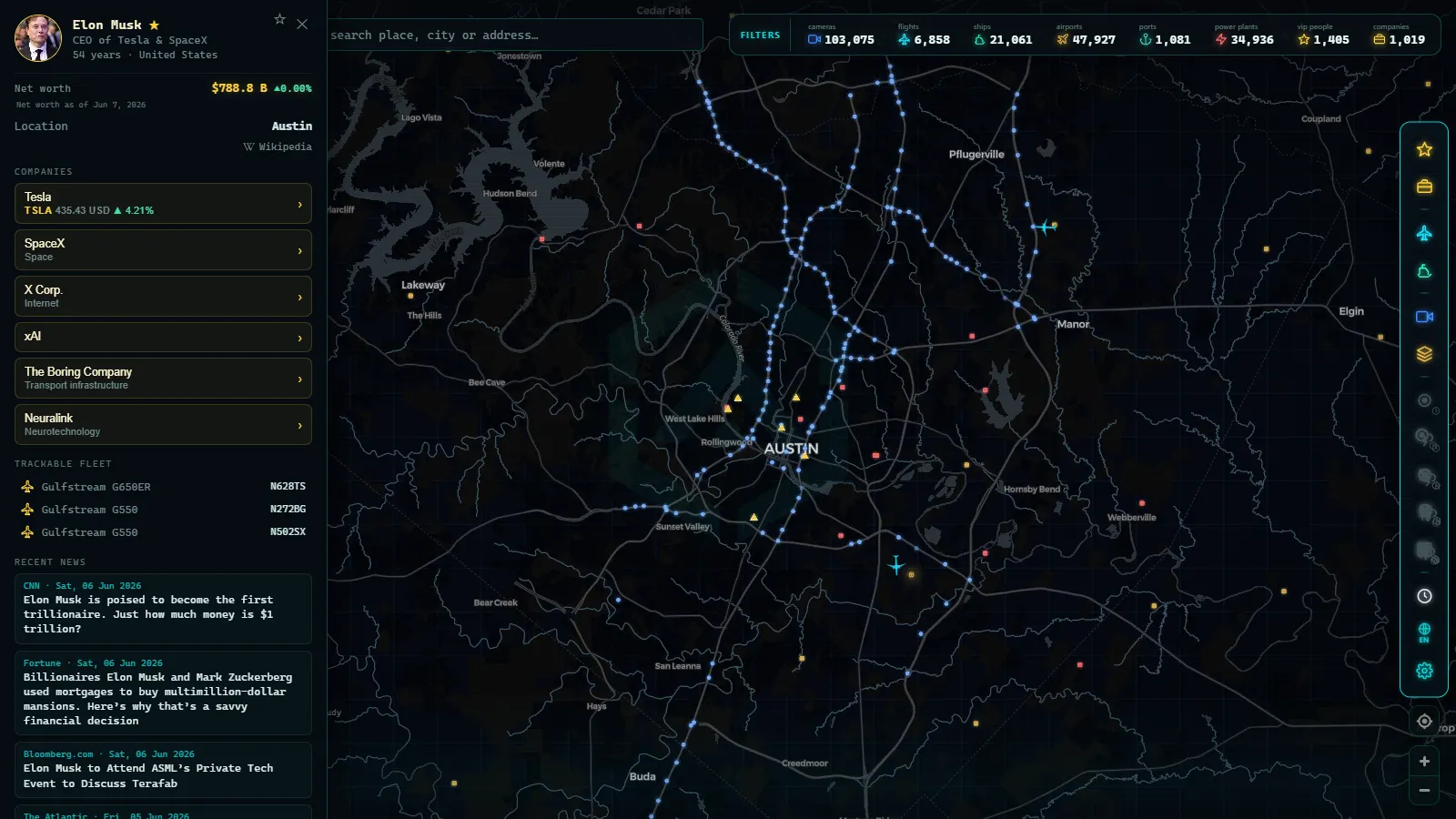
Recorded straight off the map, no sound.
The Cases That Ignited the Debate
The issue entered global conversation when tracking accounts began publishing, alongside each departure, an emissions estimate and the flight duration. Ultra-short celebrity flights turned out to be the most combustible material: trips of a few minutes between nearby airports, perfectly replaceable by an hour's drive.
The most widely cited episode occurred in 2022, when the flight log of a prominent American celebrity (covering just a handful of minutes) spread across international media and fixed in the collective imagination the image of the short private-jet hop as a gesture of climate extravagance. That same year, several rankings compiled by accounts and media outlets from open data pointed to musicians, athletes, and business figures for the frequency and brevity of their flights, triggering a stream of statements, clarifications (borrowed aircraft, shared jets) and partial apologies.
Beyond the noise, these cases demonstrated something important: that climate scrutiny of private aviation no longer depends on leaks or confessions, but on data that anyone can consult. How those flight trails are obtained is explained in detail in how to track private jets of celebrities.
Honest Context
A rigorous analysis requires both halves of the picture. The first: aviation as a whole represents a modest fraction of global CO2 emissions (sector analyses place it at a small percentage of the total) and private aviation is in turn a fraction of that fraction. Anyone presenting private jets as the primary driver of climate change is distorting the scale of the problem.
The second half: within that fraction, private aviation exhibits the highest per-capita intensity found anywhere. A few tens of thousands of people generate, through this means, individual emissions that exceed the transport footprint of an average citizen by orders of magnitude. That is where the real nerve of the debate lies: not global accounting, but inequality. The discussion about private jets is, at its core, a discussion about who may emit how much and with what justification, and about the value of example when those with the loudest voices are also those who emit the most per head.
Both things are true simultaneously, and holding them together is the only honest analysis available.
Industry Responses
The industry and its clients have not stood still, though the effectiveness of each response varies considerably:
- Carbon offsets. Funding projects that absorb or avoid emissions (reforestation, clean energy) to "neutralise" flights. This is the most widespread response and the most contested: multiple analyses have questioned the quality, permanence, and real additionality of many offset projects, and the emerging consensus is that offsetting is not equivalent to reducing.
- Sustainable aviation fuels (SAF). Fuels produced from waste materials, biomass, or synthetic processes, which can substantially cut net emissions. Their current problem is twofold: they are scarce and expensive, and still represent a minimal share of the fuel aviation actually consumes.
- Restrictions and taxation. Several countries have proposed (and in some cases implemented) limits on short flights with viable rail alternatives, specific levies on private aviation, or restrictions at certain airports. This is a regulatory landscape in rapid evolution and political dispute.
None of these avenues, in isolation, solves the equation; together they sketch the likely direction of the sector over the next decade: flying will cost more, emitting will take more explaining, and the data will keep watching.
Open Data as the Engine of the Debate
There is a deeper lesson here that extends well beyond jets: without open data, there would be no conversation. This entire debate exists because aircraft broadcast their position via ADS-B in the clear, and because thousands of volunteer receivers convert that signal into public records, as explained in what ADS-B is and how it enables flight tracking. If tracking depended on closed official sources, private aviation emissions would today be a footnote in sector reports, not a topic of global conversation.
The same pattern repeats at sea with superyachts and their AIS trail, which we analyse in how superyachts are identified: the technical infrastructure of transparency precedes the public debate and makes it possible.
What the Informed Observer Can Do
If the subject interests you, the best stance is that of the methodical observer: look at the data directly, understand how the estimates are constructed, distinguish an order of magnitude from a fabricated decimal, and be sceptical of both alarmism without scale and denial without figures. Public scrutiny of emissions is legitimate and useful; individual pile-ons, in addition to sometimes being unfair, tend to impoverish the very debate they claim to serve.
The data is out there, in the open, waiting for serious readers. That is the good news of this entire story.
Frequently Asked Questions
How much more does a private jet pollute compared to a commercial flight?
Per passenger, several times more: that is the consistent finding across studies on private aviation. The reason is structural, a commercial aircraft spreads its consumption across hundreds of seats while a private jet spreads it across very few, often partially occupied. The exact multiplier depends on the aircraft model, the distance, and how many people are aboard, which is why rigorous sources work in ranges rather than a single figure.
How are the emissions of a specific flight calculated?
Through an estimation chain built on open data: the ADS-B signal identifies the aircraft model and records flight duration; technical documentation supplies an average fuel consumption per hour for that model; and a standard conversion factor translates the fuel burned into CO2. The result is an order-of-magnitude estimate, reproducible by anyone, that does not observe actual occupancy or the exact conditions of the flight.
Do carbon offsets work?
It is the most contested question in the sector. In theory, funding projects that absorb or avoid emissions neutralises those of the flight; in practice, multiple analyses have identified serious quality problems with many projects: reductions that would have occurred anyway, absorption that does not persist, double-counted accounting. The cautious summary: offsets can contribute something if the projects are rigorous, but they do not substitute for real reductions in flights and consumption.
Why are short flights criticised so heavily?
Because they are the case where the emission is most avoidable. Take-off and climb are the highest-consumption phases of any flight, and on a trip of a few minutes they weigh proportionally very heavily; at the same time, short hops are precisely those that most often have a reasonable train or road alternative. A private-jet hop between two neighbouring cities combines maximum emission intensity with minimum necessity, and for that reason draws the sharpest criticism.
What "Private Jet Carbon Footprint" Actually Means, and How It Compares to Flying Commercial
The carbon footprint of a private jet is the mass of CO2 (and related warming gases) released by burning jet fuel during a flight, usually reported either as a total per flight or, more usefully, as emissions per passenger. That second figure is what makes the comparison with commercial aviation meaningful: a private jet carries far fewer people, so whatever fuel it burns, even if that amount is modest in absolute terms, gets divided among a handful of passengers instead of over a hundred.
Fuel consumption is the starting point for every estimate. A light or midsize private jet typically burns several hundred kilograms of fuel per flight hour, a large-cabin jet can burn well over a tonne per hour, and that consumption does not fall proportionally with passenger count the way a full commercial flight's does. This is why private jet CO2 emissions per passenger tend to come out many times higher than an equivalent commercial route, even on aircraft that are efficient per kilogram of weight carried. The gap is widest on short hops, where taxiing, climbing, and descending (the least efficient phases of any flight) make up a larger share of the total distance.
| Factor | Private jet | Commercial flight |
|---|---|---|
| Typical occupancy | A handful of passengers | Often more than a hundred |
| Fuel burn per hour | Lower in absolute terms | Higher in absolute terms |
| CO2 per passenger | Higher, fuel split among few | Lower, fuel split among many |
| Route profile | Often short hops, more climb and descent per mile | Often longer routes, more cruise per mile |
Carbon offsetting is the private jet industry's most visible response to this gap: buying credits meant to fund emission reductions elsewhere (reforestation, renewable energy, methane capture) to balance out a flight's output on paper. An offset does not change what actually came out of the engines; it is a separate financial instrument layered on top of the same fuel and CO2 figures that any open-data estimate already captures. Treat an offset claim as an accounting exercise, not as a correction to the underlying emissions number. Tracking which aircraft actually fly, how often, and over what distance is the only way to check whether an offsetting claim matches real activity rather than a one-off gesture, and tracking tools for well-known private jets is where that activity becomes visible in practice.
Conclusion
The carbon footprint of private jets is better understood through method than through headlines: very high per-passenger intensity, modest global weight, honest estimates with known limits, and a debate that exists thanks to open data. Keeping only one of those pieces is losing the whole picture. If you want to see the raw material of this conversation (real aircraft crossing the sky right now) open the map and observe live air traffic: the data, as always, is the best starting point.
Frequently asked questions
How much more does a private jet pollute compared to a commercial flight?
Studies on private aviation consistently find that, per passenger, a private jet emits several times more than an equivalent commercial flight, because it spreads fuel consumption across very few seats. The exact multiplier depends on the aircraft type, route, and occupancy.
How are the emissions of a specific flight calculated?
Through an estimation chain: the aircraft type is identified, an average fuel consumption per hour is assigned to it, flight duration is measured using ADS-B data, and the fuel burned is converted to CO2 using standard factors. The result is an order-of-magnitude estimate, not a precise measurement.
Do carbon offsets work?
It is a matter of ongoing debate. Offsets fund projects that in theory absorb or avoid emissions, but multiple analyses have questioned the quality and real additionality of many such projects. They reduce emissions on paper; guaranteed real-world reduction is harder to verify.
Why are short flights criticised so heavily?
Because they combine the worst of both worlds: take-off is the highest-consumption phase of any flight, and on a short trip it weighs proportionally very heavily, while reasonable ground alternatives usually exist. A hop of a few minutes in a private jet is the most-cited example of avoidable emissions.