Blog · Wealth, jets & yachts
Corporate headquarters on the map: what the geography of big business reveals
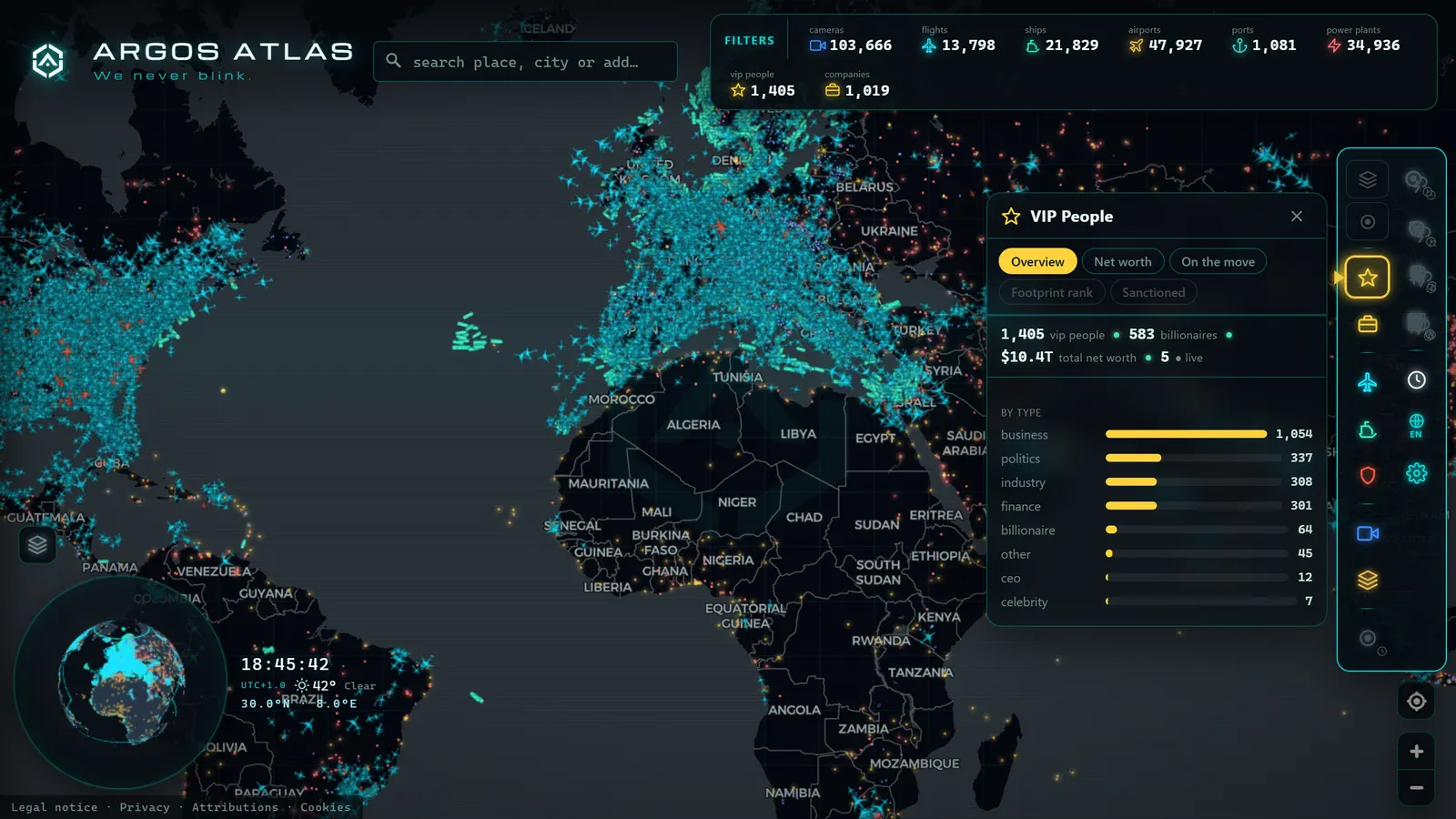
If you were to plot the headquarters of the world's largest companies on a world map, the result would look nothing like an even distribution. You would see extraordinarily dense clusters in half a dozen cities, vast continental voids, and patterns that communicate - more clearly than most analyst reports - where economic power concentrates and why. Business geography is a discipline with a century and a half of history, but it has never been as easy to explore as it is today, with open data and interactive maps. This article unpacks what a headquarters actually is, what the locations of major companies reveal, and how to read that map with informed eyes.
What a headquarters actually is (and why it can be three different places)
Start with a language trap: when we say the headquarters of a company, we may be referring to three distinct things that do not always coincide.
- The registered office. The legal address written into the corporate charter and filed with the company registry. It determines which courts have jurisdiction and under which corporate law the company operates. It can be, literally, a room with a nameplate.
- The operational headquarters. Where the company is actually run: where the executive team, central functions, and much of the corporate workforce are based. This is the building in the press photos.
- The fiscal residence. Determines where the company pays tax on its global activity, according to criteria that combine the place of incorporation and the place of effective management, with nuances that vary by country and tax treaty.
For a local small business, all three are the same address. For large multinationals, they often are not: there are well-known cases of companies registered in one jurisdiction for its legal predictability or corporate law, operating from another, and structured fiscally through a third. This is not necessarily irregular - each element responds to a distinct legal logic - but it requires precision about which type of headquarters we are pointing to on the map. Unless otherwise stated, this article uses headquarters to mean the operational headquarters: the place where decisions are made.
The geography of corporate power
Headquarters do not spread out - they cluster. Economists call this agglomeration effects, and the world map of major companies is the most vivid demonstration of the phenomenon. Some classic clusters:
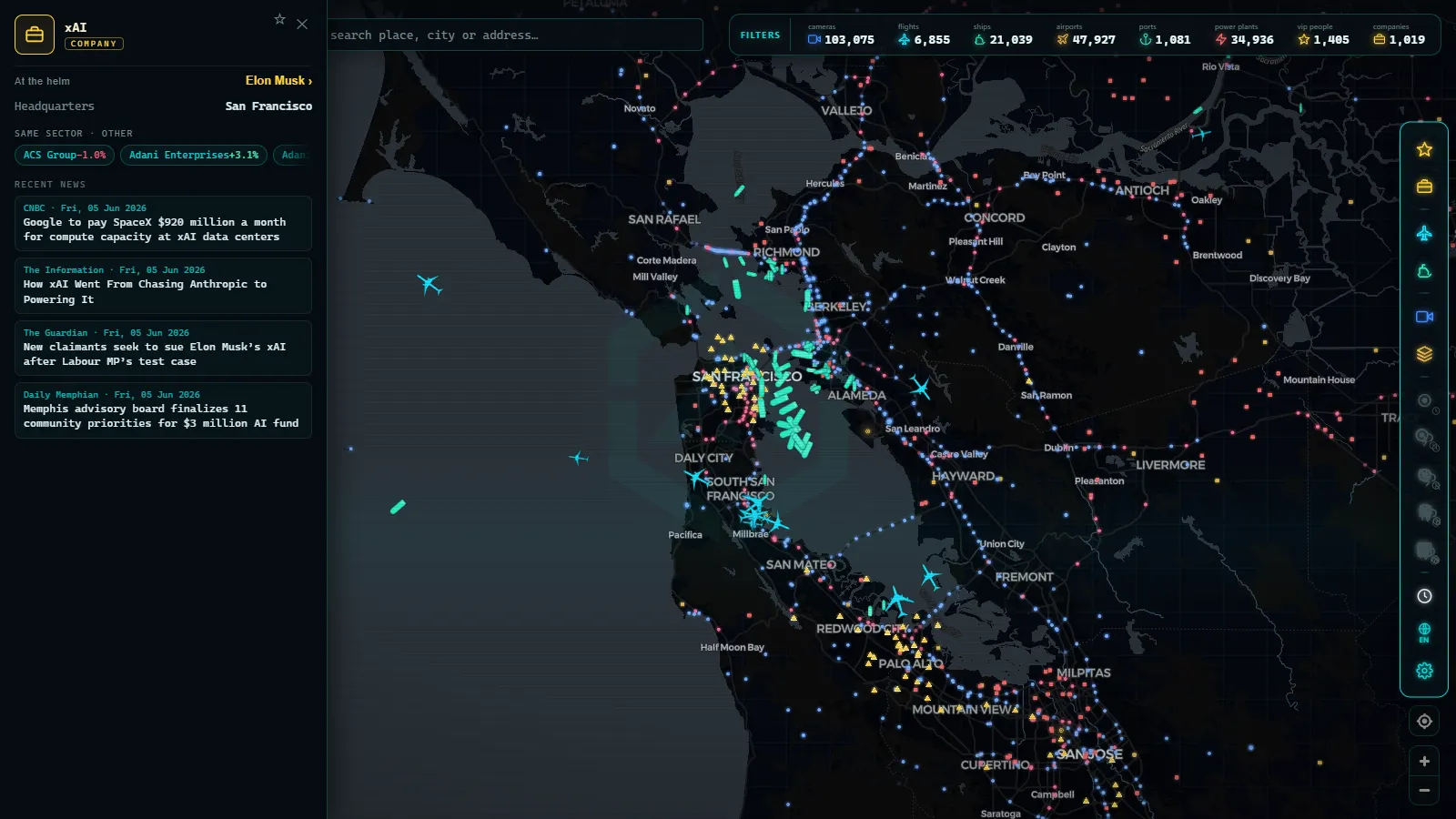
- The San Francisco Bay Area technology hub. The peninsula south of the bay and the city itself concentrate a density of technology headquarters without parallel anywhere in the world, fed for decades by elite universities, venture capital, and the virtuous circle of talent following companies and companies following talent. Apple, Google, Meta, and hundreds of others are within an hour drive of each other.
- The financial districts of Manhattan and the City of London. The two historic capitals of money still bring together banks, asset managers, and insurers within a few square kilometres, alongside newer challengers - Singapore, Hong Kong, Dubai - competing for a share of that gravitational pull.
- Planned business districts. Towers like those of La Defense outside Paris represent a different model: the state or city designs an entire district to house headquarters, and companies are drawn by the prestige and shared infrastructure. Similar planned poles exist in Canary Wharf in London, Pudong in Shanghai, and the financial district of Abu Dhabi.
- Asian corporate poles. The major Asian economies have developed their own headquarters concentrations - from South Korean chaebols in Seoul to Japanese keiretsu in Tokyo, from Chinese tech giants in Shenzhen and Beijing to the regional hubs of Singapore - fundamentally reorganizing a map that for most of the twentieth century was almost exclusively transatlantic.
In the United States, the pattern beyond Silicon Valley is instructive: financial and media firms in New York, energy companies in Houston, automotive in Detroit (though increasingly in California and Tennessee too), healthcare in the Mid-Atlantic corridor. Each cluster tells a story of what the regional economy was built on and, often, what it still depends on.
Why companies choose where to be
Behind every point on the map is a multifactor decision. The usual ingredients:
Talent. The factor that weighs most heavily in knowledge-intensive sectors: the headquarters goes where the company can hire. That is why technology firms pay extortionate rents in expensive cities rather than relocate to places where real estate is cheap.
Taxation and regulation. Corporate tax rates, special regimes, legal predictability, and administrative efficiency all tip the balance, especially for registered offices and fiscal structures. Delaware incorporations in the US and Ireland as the European base for American tech firms are textbook examples of legal-address choices driven primarily by regulatory environment.
Capital. Being close to investors, stock exchanges, and investment banks still matters, though less than it did half a century ago. Financial clusters live partly on that inertia and partly on the genuine density of deal-making expertise that physical proximity produces.
Prestige and history. A recognizable address is worth money in certain industries, and many headquarters are where they are because that is where the company was founded a century ago and moving never justified the cost. History weighs more heavily than most strategy presentations admit.
A headquarters map is a living fossil: each location preserves the imprint of the decision - or the historical accident - that placed it there.
Recorded straight off the map, no sound.
High-profile relocations as a phenomenon
Occasionally, a major company announces it is moving, and the story escapes the business pages into general conversation. As a phenomenon, headquarters relocations almost always respond to two drivers: taxation - seeking more favorable regimes or more flexible corporate structures - and politics, in the broad sense: regulatory climate, institutional stability, or episodes of uncertainty that push companies to relocate their legal address.
These moves deserve to be read with precision: most relocate the registered office - paperwork, articles of association, shareholder meetings - far more than the actual operation, which rarely moves because transferring workforces and facilities is enormously expensive. The typical result is exactly the dissociation we described at the outset: the company moves for legal purposes while its offices and employees remain where they were. For a map observer, this is a reminder that every point requires asking which type of headquarters it represents.
Recent examples abound. When companies shifted legal domiciles from California to Texas or Nevada in the US, or when multinationals relocated European holding structures from the UK post-Brexit to Ireland or the Netherlands, the operational reality on the ground changed far less than the headlines implied.
What a headquarters map actually reveals
Here is the real reward of looking at business geography attentively. A well-constructed headquarters map reveals at least three things that rankings and lists do not show:
Sectoral concentration by city. The clusters jump out: which city lives on finance, which on energy, which on technology. That specialization explains entire urban economies - from housing prices to the types of jobs available - and the vulnerabilities those economies carry into downturns.
Regional dependence. When a region concentrates its economic fabric in very few large headquarters, the map exposes it, along with its vulnerability: a merger, a relocation, or a sectoral crisis can redraw the local economy within a few years. Detroit long decline and Pittsburgh transformation from steel to healthcare both read clearly on a corporate map.
The distance between deciding and producing. Perhaps the most revealing reading: headquarters cluster in a handful of global metropolises while factories, logistics centers, and operations are distributed around the world. Measuring that distance - geographical and often social - between where decisions are made and where work is done is understanding one of the structural tensions of the contemporary economy.
Headquarters and stock markets: the building and its ticker
For publicly listed companies, a headquarters has a dual character that makes it especially interesting to map: it is a physical building and, at the same time, the visible face of a security that trades every day. Next to the skyscraper is a ticker, and next to the ticker, a price that moves with each session.
This duality allows a reading of the map that combines geography and markets: seeing not only where companies are, but how much the ones that share a city are worth today, which locations concentrate the most market capitalization, and how the market pulse of each cluster moves. The stock price also connects the headquarters to its founder or principal steward: the company value is, in many cases, the bulk of the net worth of the person who built or runs it, as we explain in how billionaire net worth is calculated.
Exploring it live in ARGOS ATLAS
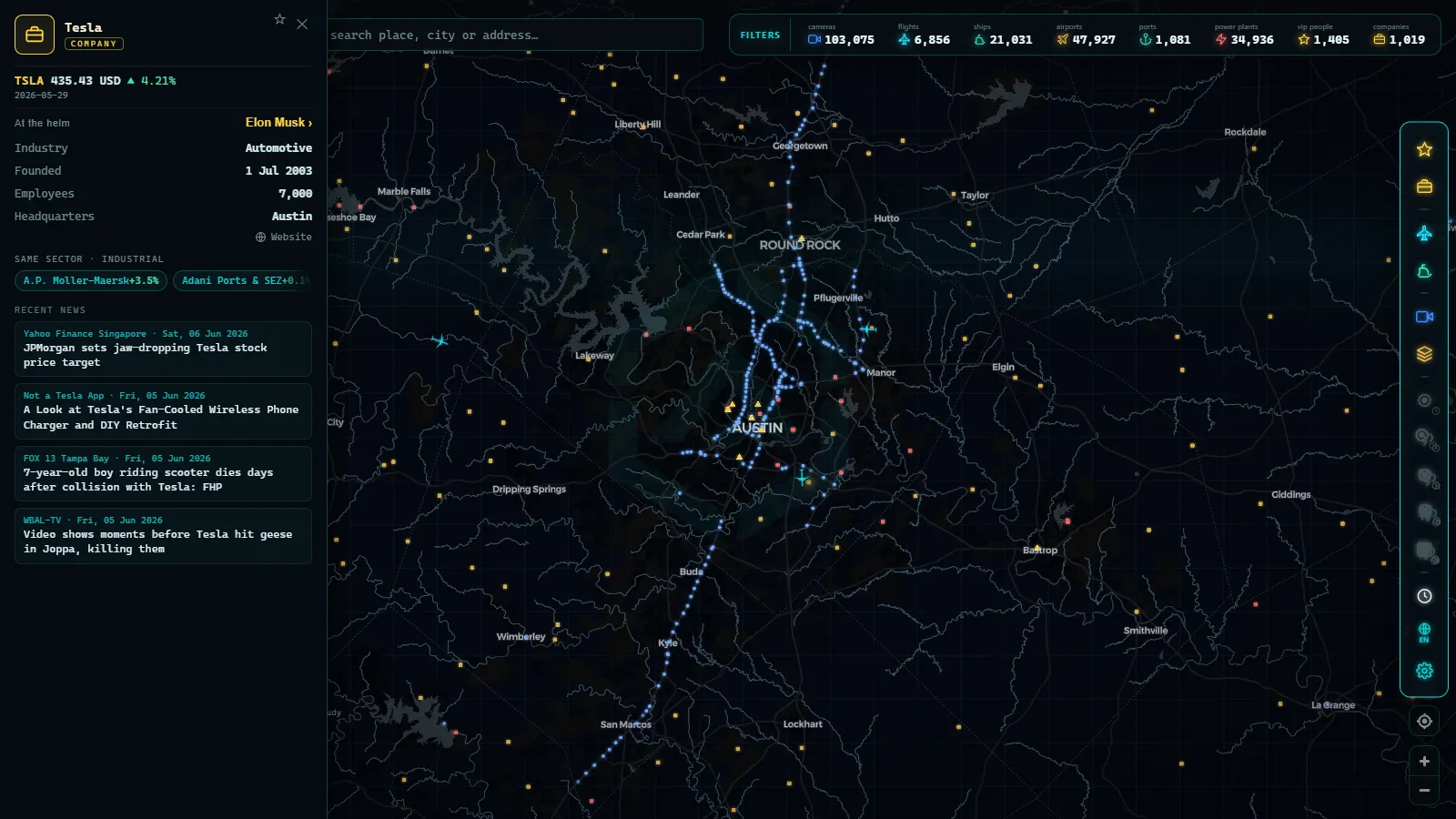
Everything above can be examined in real time. ARGOS ATLAS includes a corporate headquarters layer on the world map with live stock prices, integrated with the rest of the platform layers. The most compelling feature is the connectivity: each headquarters links to the person leading the company, their net worth from the Forbes ranking updated daily, and when that person is flying, their private jet in the air - whose tracking we explain in how to track celebrities private jets.
The result is a graph of economic power laid over the map: from the building to the stock price, from the stock price to the fortune, from the fortune to the aircraft that carries it. Each element is public data; the aggregation is what makes it legible. You can also explore how the most recognizable of those assets - superyachts - are identified and tracked, in how superyachts are identified.
A practical exercise
End with a simple experiment: look at your city. What major headquarters are there? In which sectors? How many are legal addresses with a nameplate and how many are buildings full of people making decisions? What does that list say about what your city economy runs on, whom it depends on, and where it is heading? Few local economic snapshots are as fast to construct and as revealing to read. The map already knew the answer; you only had to ask.
Frequently asked questions
Where do the largest companies concentrate their headquarters?
In a handful of sharply defined clusters: the technology hub of the San Francisco Bay Area, the financial districts of Manhattan and the City of London, planned business districts such as La Defense and Canary Wharf, and the corporate poles of the major Asian economies in Tokyo, Seoul, Shanghai, and Singapore. The concentration reflects agglomeration effects: talent, capital, services, and prestige reinforce each other. Each cluster tends to specialize sectorially - tech on the US West Coast, finance in New York and London, energy in Houston and the Gulf - and that specialization becomes self-reinforcing over time.
Are the registered office, operational headquarters, and fiscal residence the same thing?
They do not have to be. The registered office is the legal address filed in the corporate charter; the operational headquarters is where the executive team and central functions actually work; the fiscal residence determines where the company pays tax. For most businesses they coincide, but for large multinationals they can be spread across different countries, each for its own legal reason. This is why, faced with any headquarters map, the first question is always which of the three is being represented.
Why does a company move its headquarters?
The usual drivers are taxation - more favorable regimes or more flexible corporate structures - regulation, access to capital or talent, and the political and institutional climate. What almost always moves is the legal registered address, because relocating paperwork is straightforward; the actual operation, with its workforce and offices, rarely moves, because doing so costs a fortune. That is why many high-profile relocations change the legal map without meaningfully touching the physical one.
Can I see the headquarters of major companies on a map?
Yes. ARGOS ATLAS offers a corporate headquarters layer on its world map, with each company live stock price visible alongside its location. Each headquarters is also connected to the person leading the company, their net worth from daily-updated Forbes data, and their private jet when it is airborne - so you can follow the complete thread that links the building, the market value, and the individual.
Conclusion
The geography of large companies is a text written on the territory: clusters tell stories of talent and capital, relocations speak of taxation and politics, and the distance between headquarters and factories portrays the very structure of the global economy. Learning to read that text is one of the fastest ways to understand who decides what and from where. If you want to start now, open the map and explore corporate headquarters with their live stock prices: find your city, look at its clusters, and let the geography tell you what the rankings leave out.
Frequently asked questions
Where are the headquarters of the world's largest companies concentrated?
In a handful of very recognizable clusters: the technology hub of the San Francisco Bay Area, the financial centers of Manhattan and the City of London, planned business districts in major capitals, and Asian corporate poles. The concentration follows agglomeration effects, talent, capital, services, and prestige reinforce each other in a self-sustaining cycle.
Are the registered office, operational headquarters, and tax residence the same thing?
Not necessarily. The registered office is the legal address in the articles of incorporation; the operational headquarters is where the executive team and core functions actually work; the tax residence determines where the company pays tax on its global activity. For most businesses they coincide, but large multinationals can split them across three different countries, each for its own legal rationale.
Why does a company move its headquarters?
The main drivers are taxation (more favorable regimes or flexible corporate structures) regulation, access to capital or talent, and the political and institutional climate. What almost always moves is the registered office, because relocating paperwork is straightforward; moving actual operations, with staff and facilities, is rare and enormously expensive.
Can I see the headquarters of major companies on a map?
Yes. Argos Atlas includes a corporate headquarters layer on the world map, with each company's live stock price visible alongside its location. Each headquarters is also linked to the person leading the company, their net worth from the daily-updated Forbes ranking, and their private jet when it is airborne.